Get Full Government Meeting Transcripts, Videos, & Alerts Forever!
Get email alerts on the Court Grant Dispute topic
No spam. Unsubscribe anytime.
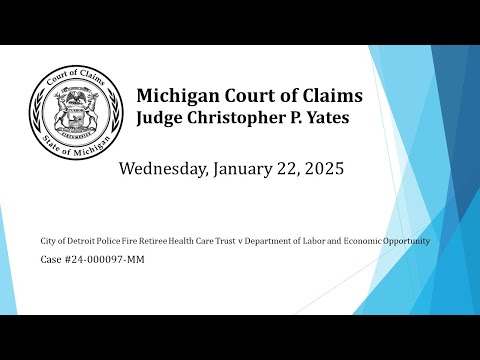
Court of Claims hears challenge to $10 million VEBA grant, judge reserves ruling
Summary
A Michigan Court of Claims judge heard arguments over whether a legislatively structured $10 million grant process unlawfully excluded two retiree VEBAs and whether plaintiffs have standing; the judge granted a 14-day response window on an amicus brief and said he will issue a written opinion.
A Michigan Court of Claims judge on Friday heard arguments in Case No. 24-000097-MM over whether the administration of a $10,000,000 legislative appropriation for VEBA entities unlawfully excluded two retiree beneficiary associations and whether the plaintiffs have legal standing to sue.
The plaintiffs—the Detroit Police and Fire Retiree Healthcare Trust and the Detroit General Retiree Healthcare Trust—are represented by David Porter, who argued the statutory requirement that an applicant secure a legislator sponsor before applying violated separation of powers and equal protection. "It violates the separation of powers and it violates equal protection of the laws," Porter told the court.
Defense counsel Adam DeBaer, appearing for the state defendants including the Department of Labor and Economic Opportunity and the State Budget Office, urged dismissal under Michigan Court Rule 2.116(c)(8) and (c)(10). DeBaer told the court the plaintiffs never obtained a legislative sponsor and so "there was never any eligibility to receive these funds," framing the threshold question as one of standing and statutory eligibility.
The judge summarized the parties' positions and the background: the issue flows from Michigan's handling of obligations arising from Detroit's bankruptcy and a 2023 appropriations provision that set aside $10,000,000 for grants to certain VEBAs. The judge told counsel the grant program required a legislator sponsor, a condition that narrowed which entities could apply. He noted that some claims in the plaintiffs' verified complaint (Counts 5–7) were tied to the Department of Treasury and that Treasury had been dismissed without prejudice.
The court devoted substantial argument time to whether the motion should be decided under c(8), which tests legal sufficiency of pleadings, or c(10), which permits consideration of factual materials and is usually premature before discovery. The judge said c(10) can be premature but also indicated the factual record may not be extensive here. He told counsel he would not decide the case from the bench and planned to write an opinion.
Plaintiffs said discovery could show that procedural barriers and behind-the-scenes contacts excluded them from the process; they asked the court to permit facts to be developed before ruling. Defense counsel countered that, on the pleadings and attachments, plaintiffs have not shown the necessary property interest or injury required for standing and that separation-of-powers concerns did not salvage an otherwise deficient claim.
The judge also addressed an amicus brief filed by the Mackinac Center, saying it raised "interesting and important points" but that he could not imagine deciding the case solely on an amicus submission. He entered an order giving the plaintiffs 14 days to file a response to that brief.
The court did not resolve the motion at the hearing. "This is one of the best constitutional disputes I've ever seen," the judge said, and he said he would consult with his commissioner and aim to issue a carefully reasoned written decision. The judge thanked counsel and took the matter under advisement.
Next steps: the plaintiffs have 14 days to respond to the Mackinac Center amicus brief, and the court will issue a written opinion after reviewing the parties' filings and the arguments made at the hearing.