
Lake Forest Park council tables resolution on community policing after public input
Get AI-powered insights, summaries, and transcripts
Subscribe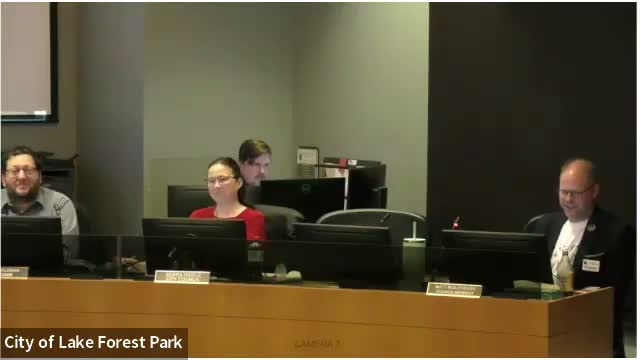
Summary
After extensive public comment and a police-chief briefing, the Lake Forest Park City Council voted to table Resolution 26-20-61 for two weeks to incorporate edits (including naming victims and clarifying scope) and formed a three-member drafting group.
The Lake Forest Park City Council on Feb. 12 deferred action on Resolution 26-20-61, which would reaffirm the city’s commitment to community policing, de-escalation and protection of constitutional rights, after residents urged edits and the police chief outlined existing department policies.
The resolution drew repeated public comment urging clarity and local preparation. Julian Anderson, a Lake Forest Park resident, told the council the measure "is needed and timely" but warned that one section "could be used to suppress some of the police policies we value, especially the duty to intervene and the duty to report" and urged additions including neighborhood communications and preparedness supplies.
Tyler Rosenau (cited by the dais) and other council members said the proposal had broad public support but that several speakers asked the council to name all victims referenced in the resolution and to avoid "othering" people not explicitly named. Vice Chair Goldman said approving the resolution now could help "bring the temperature down" while allowing staff and the chief to refine related policies.
Chief Harden read a prepared statement to the council describing department practice and legal limits. He said Lake Forest Park officers "are trained and expected to prioritize de-escalation, the sanctity of human life, and the respect for constitutional rights," and noted state law (RCW 10.93.190) defines the duty to intervene among Washington peace officers and "does not impose a legal duty on local officers to direct or control federal law enforcement officers acting under federal authority." He also confirmed body-worn cameras are used on calls and recordings are retained for 60 days, with incident data tagged to case reports and preserved longer when appropriate.
Councilmember Muhlberg moved to table the resolution for two weeks and convene a small working group to draft edits reflecting public feedback; Councilmember Good seconded. The motion passed and the council appointed Rosenau, Goldman and Millenberg as the three-member drafting team to return a revised draft on Feb. 26. Councilmember Goldman said the city’s language on public property and recording was based in part on Seattle and county examples and could be aligned with neighboring jurisdictions.
The council’s action preserves the existing policy posture while giving members time to incorporate community suggestions — including whether to explicitly name additional victims and how broadly to reference federal immigration enforcement. The working group will draft proposed edits and the item returns to the council on Feb. 26 for further consideration.