Get Full Government Meeting Transcripts, Videos, & Alerts Forever!
Get email alerts on the Election Emergency Preparedness topic
No spam. Unsubscribe anytime.
Experts tell U.S. Commission on Civil Rights panel states must fund, train and plan to keep elections running during disasters
Summary
Panelists at the Florida advisory committee hearing urged state legislatures and federal partners to clarify emergency authority, create funding streams for disaster recovery of election equipment, and invest in training and communication to protect voting access during natural disasters.
Chair Nadine Smith convened the Florida advisory committee of the U.S. Commission on Civil Rights on April 8, 2025, to hear experts on how jurisdictions can protect voting rights during natural disasters and emergencies. The panelists urged advance planning, sustained funding, clearer emergency authorities and more training to keep elections accessible.
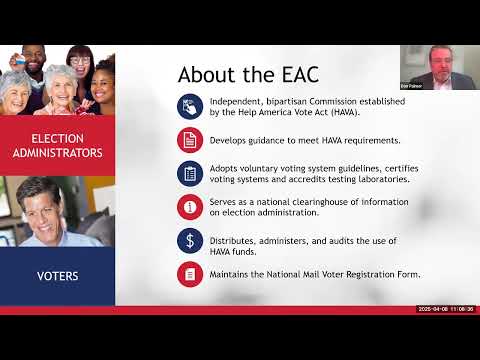
Donald Palmer, chairman of the U.S. Election Assistance Commission, said the EAC offers continuity-of-operations (COOP) resources, tabletop exercises and training decks for local election officials, and stressed the need for backup plans: “You really cannot be prepared for an election unless you understand what your plan B, C and D are.” Palmer urged Congress to consider a direct federal funding stream to help states and counties replace or recover damaged voting systems and electronic poll books after disasters, noting counties currently shoulder those costs.
Tammy Patrick, chief program officer of the National Association of Election Officials, told committee members that offering voters multiple methods—voting by mail, early in-person voting and Election Day voting—creates flexibility when storms or other events strike. She also warned of rising threats to election workers and resulting staff losses: national surveys cited by Patrick show many local administrators have left the field over safety concerns, and remaining officials are less likely to continue outreach. “We need to make sure that the truth and the facts prevail,” Patrick said, and described investments in staff safety, facility hardening and interagency coordination as central preparedness steps.
Karen Brinson Bell, executive director of the North Carolina State Board of Elections, offered a case study from Hurricane Helene. She said 25 of North Carolina’s 100 counties were declared federal disaster areas and that about 1,300,000 registered voters lived in the affected counties. Bell described rapid recovery and partnerships—76 of 80 planned early-voting sites in the disaster region opened with power and staff by Oct. 17—and stressed regular tabletop exercises, integrated emergency operations and vendor coordination, including the provision of meals and equipment support from a voting-equipment vendor.
Committee members pressed panelists on how to guard against politicized uses of emergency authority. Chair Nadine Smith asked how to balance local discretion with safeguards to ensure emergency tools are not used selectively for political advantage. Panelists pointed to horizontal and vertical checks—bipartisan poll teams, county boards, state boards and judicial review—and emphasized documenting reasons for any changes to sites or hours so the public can see the basis for decisions.
Several committee members asked whether Congress should set a national standard. Panelists and members agreed states should write clear emergency authorities into statute and that federal support should focus on funding, guidance and making elections a recognized priority for FEMA and other federal responders during disasters.
On staffing and misinformation, panelists said investment in training and readily accessible online learning, field support personnel and peer networks is essential as many jurisdictions experience turnover in election staff. Palmer highlighted free federal training resources; Patrick and Bell recommended regular exercises and cross-agency relationship-building before disasters occur.
The committee opened a public-comment period but received no live testimony. Chair Smith closed the session and said the committee will reconvene April 9 for a second panel. The testimony will inform the advisory committee’s report to the U.S. Commission on Civil Rights, which the commission may forward to federal, state and local authorities.
The committee adjourned with directions for submitting written comments to lschiller@usccr.gov within 30 days.