Lifetime Citizen Portal Access — AI Briefings, Alerts & Unlimited Follows
House Financial Services chair says staff report finds regulators pressured banks to "debank" digital-asset firms; SEC chair outlines tokenization
Loading...
Summary
Rep. French Hill discussed a House Financial Services Committee staff report that he said documents how federal regulators pressured banks to sever ties with digital-asset clients, affecting at least 30 entities; former SEC Chair Paul Atkins described tokenization as a blockchain-based method to represent securities that would remain subject to SEC rules.
Rep. French Hill, chairman of the House Financial Services Committee, told an interviewer the committee's 53-page staff report documents how federal regulators used vague rules, informal guidance and aggressive enforcement to pressure banks to distance themselves from digital-asset firms, a campaign Hill said resulted in "at least 30 entities or individuals" losing access to financial services.
Hill said the report traces actions he attributes to SEC leadership under Gary Gensler, Federal Reserve supervision associated with Michael Barr and other supervisors. "This report identifies all the ways led by Gary Gensler ... the bank supervisors led by Michael Barr ... to systematically de bank legal businesses in the United States engaged in the digital asset innovative space," Hill said during the interview.
Hill said the practice was "terrible for American competitiveness," and described it as comparable to earlier episodes when federal pressure pushed banks to avoid certain kinds of customers. He cited, as examples, past pressure on banks to avoid gun dealers and energy producers, arguing regulators were effectively using their authority to influence which lawful customers private banks may serve.
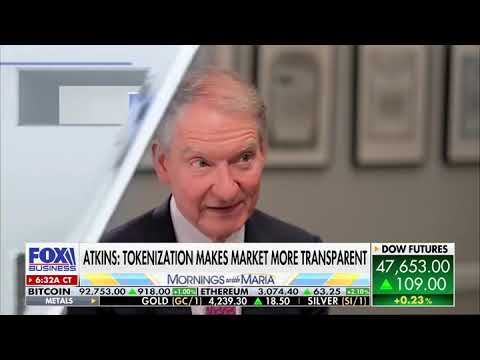
The interviewer then played a pre-recorded interview with Paul Atkins, identified in the segment as serving at the SEC, who described tokenization. "Tokenization is the idea of using ... smart contracts or ... tokens on chain to be able to ... represent, say, an underlying security," Atkins said. He added that "that tokenized security is a security and would be subject to SEC rules by law," and argued blockchain records could make ownership more transparent and could shorten clearance and settlement times.
Hill agreed tokenization has potential benefits, saying smart contracts can lower agency costs and increase transparency. He suggested initial use cases for tokenization in low-volume, high-cost transactions such as certain debt markets, loan participations, foreign-exchange transactions and accounts receivable, and noted the appeal of dollar-backed stablecoins for cash-type transactions.
Hill also praised the stated direction from SEC leadership and said the House Financial Services Committee plans to pursue capital-formation legislation to reduce the cost of being a public company and broaden investment opportunities.
On other topics, Hill criticized what he characterized as supervisors' attention to climate and DEI policies, saying regulators should focus on tailoring rules to firm size, complexity and risk to preserve safety and soundness while supporting economic growth. On health-care subsidies, Hill said members in both chambers were seeking paths to increase consumer choice and transparency but he gave no specific timetable or legislative detail.
The committee staff report and Hill's remarks in the interview present allegations and policy positions; the interview and the report were the principal sources for the claims described here. The segment did not include an on-air response from the named federal officials whose actions were described in the report.
The interview concluded without a formal vote or committee action; Hill said the committee intends to pursue legislative steps on capital formation and regulatory clarity going forward.