Get Full Government Meeting Transcripts, Videos, & Alerts Forever!
Get email alerts on the Ai Policy Financial Services topic
No spam. Unsubscribe anytime.
House Financial Services hearing highlights industry push for federal AI standards and consumer advocates’ call for enforceable safeguards
Summary
Industry witnesses urged a principles‑based federal framework and controlled regulatory sandboxes to support AI innovation in finance; consumer advocates and some Democrats warned that preemption and deregulatory sandboxes could undercut state protections and accountability.
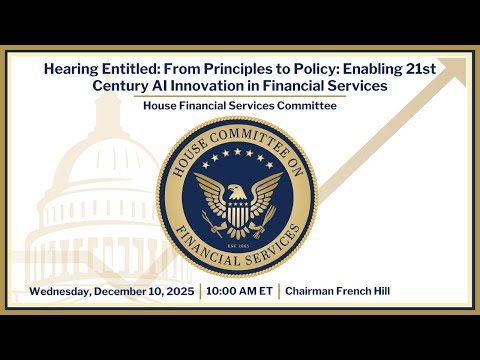
The House Committee on Financial Services convened a hearing titled "From Principles to Policy: Enabling 21st Century AI Innovation in Financial Services," hearing testimony from Google Cloud, Nasdaq, Zillow, Palo Alto Networks and Public Citizen as members debated whether Congress should set a national AI framework or leave states to regulate.
Chairman Hill opened the hearing by framing AI as an economic opportunity and said Congress must "identify gaps and obstacles in our regulatory frameworks" so innovation can flourish alongside consumer protections. Ranking Member Maxine Waters countered that AI poses serious harms — from discrimination to threats to children — and warned that measures proposed by some Republicans and the administration could "give AI and its big tech creators a pass" when they violate consumer, housing, banking or securities laws.
Industry witnesses emphasized build‑in governance, use‑case risk assessment and cooperation with regulators. Janette Manfra of Google Cloud said existing risk management frameworks can be applied to AI and described Google’s Secure AI Framework (SAFE), its agent payments work (AP2), and industry collaboration through a Coalition for Secure AI. "We believe that existing risk management frameworks and established governance practices can be applied to manage risks in the AI context," she said.
Talia Cohen, president of Nasdaq, said markets already rely on AI for surveillance and fraud prevention and urged a risk‑based approach: "Regulation should reflect risk profiles" and be flexible enough to support sandboxes, pilots and information sharing. Cohen described Nasdaq’s Verifin consortium platform for anti‑financial‑crime detection and an AI‑enabled order type designed to improve execution quality for large institutional orders.
Nicholas Stevens of Zillow outlined housing‑sector use cases and stressed fair‑housing protections, describing a Fair Housing Classifier Zillow developed and open‑sourced to reduce digital steering. Wendy Whitmore of Palo Alto Networks warned that AI also empowers attackers, saying advanced tools can compress a ransomware operation from days to minutes and urging a "secure by design" approach for AI deployments.
JB (Joshua) Branch of Public Citizen framed a starkly different risk posture: he urged Congress to reject blanket preemption and deregulatory sandboxes, to require transparency and meaningful accountability, and to fund enforcement. "The better path forward is not a mystery," Branch said, urging protection of workers and communities and stronger regulatory enforcement.
Committee members pressed witnesses on a range of topics. Republicans and some industry witnesses argued federal preemption would avoid a costly, state‑by‑state patchwork that could drive innovation overseas and raise compliance burdens; others — including consumer advocates and Democrats — said preemption would strip states of tools to protect consumers and civil rights. Members also probed housing fairness, the energy demands of training large AI models and data centers, risks of agentic AI (including hypothetical bank‑run scenarios), and workforce displacement and wage insurance.
Several members endorsed a controlled federal sandbox model that is time‑boxed, targeted, overseen by a regulator and not a vehicle to waive core consumer protections. Witnesses generally supported such guarded experimentation when accompanied by transparency, testing, human‑in‑the‑loop controls, and monitoring.
The committee recessed for floor votes and set a deadline for written follow‑ups from witnesses. The hearing reflected a persistent tension in Congress: many participants seek ways to maintain U.S. competitiveness and the benefits of AI while ensuring protections for consumers, civil rights and national security. The record shows agreement on a few points — the need for clearer standards around transparency, explainability and human oversight — but sharp division over whether federal preemption or stronger state roles best serve consumers.
The committee directed witnesses to submit written answers and additional materials; witnesses were given until 01/14/2026 to respond. The hearing was adjourned with the committee planning further oversight and legislative work on the appropriate federal approach.