Get Full Government Meeting Transcripts, Videos, & Alerts Forever!
Get email alerts on the Board Compensation topic
No spam. Unsubscribe anytime.
Board studies change allowing trustees up to $2,000 monthly; staff to draft bylaw language
Summary
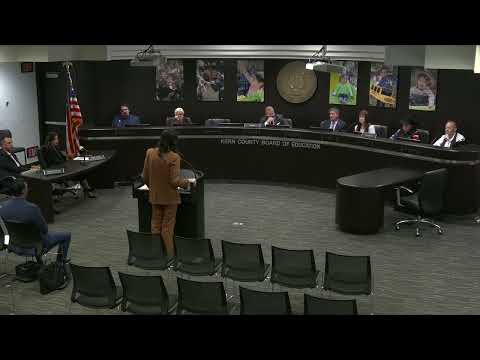
At a study session, the Kern County Board of Education reviewed a recent state law amending Education Code section 1090 (referred to in the meeting as "AB 13 90") that would allow Class 2 county board trustees to receive up to $2,000 per month. Staff were directed to draft bylaw language and an administrative form for the next meeting; no bylaw change was voted on tonight.
The Kern County Board of Education spent its Feb. 27 study session reviewing a state law the transcript records as "AB 13 90," which amends Education Code section 1090 to permit trustee compensation up to a specified monthly maximum for Class 2 counties.
Abby Alfon, from SLS, told the board the code change allows board members in a Class 2 county to be paid up to $2,000 per month and recommended updating Board Bylaw 9250 to reference the Education Code maximum rather than a per-meeting amount. "Members of the Kern County Board of Education shall be entitled to receive the sum of $80 for attendance at each board meeting not to exceed the monthly amount specified in Education Code 1090 for a class 2 County," Alfon read from existing bylaw language and said replacing the per-meeting phrasing with a code-based reference would keep the bylaw accurate if the state changes the law again.
Jonathan Medina, fiscal staff introduced to the board for the discussion, said trustee stipends and related benefits would come from local unrestricted funds (LCFF — Local Control Funding Formula) because restricted categorical funds are earmarked for specific programs. Medina cautioned the board that the statute does not provide new recurring revenue and called the change "effectively an unfunded mandate," saying staff would need to identify offsets within the current budget if trustees chose to take higher stipends.
Fiscal staff gave a rough estimate of potential cost. Medina said the district currently budgets about $130,000 for health and welfare benefits for trustees and related costs; if trustees collectively took the maximum stipend and benefits were included, the total could rise to roughly $307,000, an increase on the order of $170,000 annually.
Trustees raised procedural and political questions: several asked whether individual trustees could opt out or take differing monthly amounts (Alfon said individual trustees could elect an amount up to the code maximum), whether the choice must be filed in writing (Alfon and staff said trustees must submit a written statement to the ex officio secretary of the board), and whether the change would encourage more candidates to seek paid district positions. Board members generally said the proposed bylaw language offering individual choice was preferable to a mandatory per-meeting amount.
Board members asked staff to prepare a uniform administrative form for trustees to declare the amount they will accept (or to decline compensation) and directed staff to place the bylaw amendment and the clarifying sentence about filing a written statement on the agenda for the next scheduled board meeting for formal consideration. No vote on the bylaw change occurred at the study session.
The meeting adjourned at 6:05 PM.