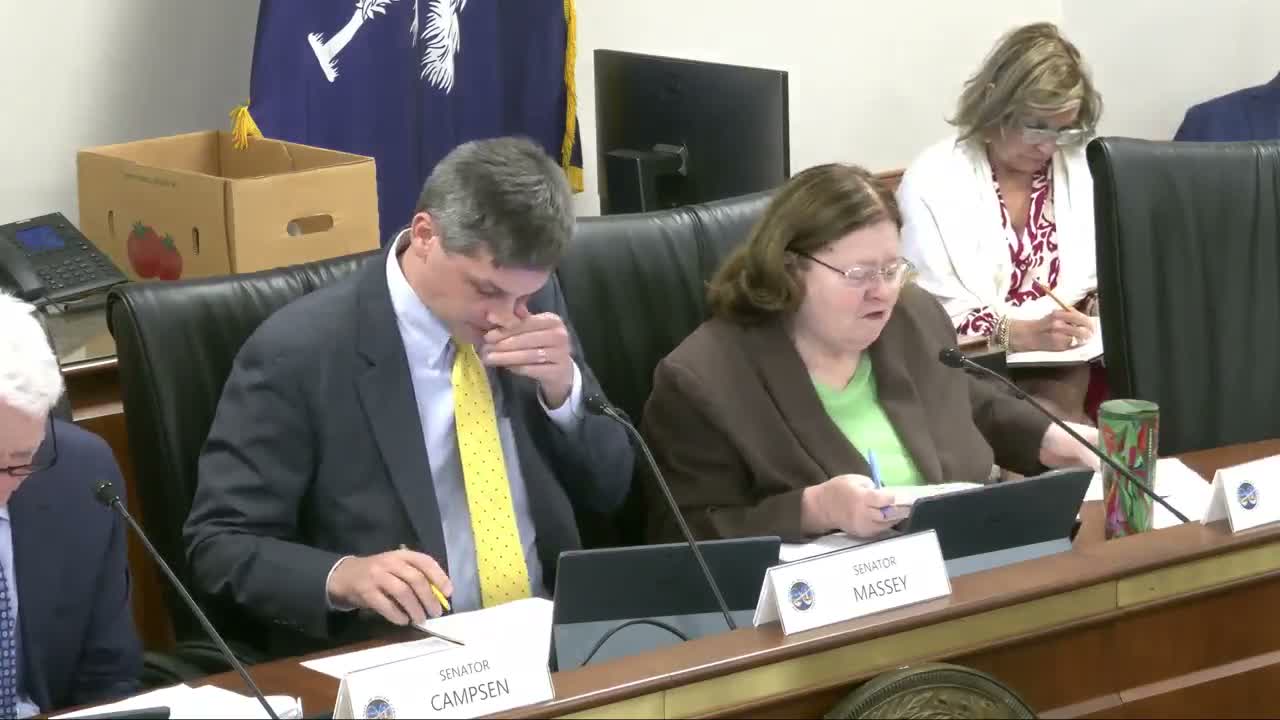
Subcommittee advances appointment overhaul with carve-outs for Forestry; Willow Gray board to shift to gubernatorial nominations
Loading...
Summary
A subcommittee reviewed a bill reorganizing how dozens of statewide boards and commissions are appointed, adopted technical and targeted amendments (including changing the Willow Gray School board to gubernatorial appointment with Senate advice and consent), retained Senate review for the Forestry Commission, and agreed to carry the measure for further consideration.
The subcommittee on nominations reviewed a bill that would overhaul how many state boards and commissions are filled, debating when the governor should appoint members and when the Senate should retain advice and consent.
Miss Benson, the bill presenter, told the panel the measure has "approximately three parts," including a provision that would require state election commissioners to be appointed "with the advice and consent of the Senate," a clarification of how interim gubernatorial appointments must be handled in the next legislative session, and a provision removing the advice-and-consent requirement for roughly "36 different appointments." Benson also offered a technical correction changing a statutory reference from the Department of Health and Environmental Control to the Department of Public Health.
Senators concentrated on two categories of concern: which statewide posts should remain subject to Senate review and how to handle interim or acting appointments between sessions. Senator Campson (from Charleston) argued the Forestry Commission should remain subject to advice and consent because it "manages over a 100,000 acres of land" and oversees heavy equipment used in firefighting. After discussion, the subcommittee agreed to delete the bill's section that would have removed Senate review for that commission, leaving the Forestry Commission subject to advice and consent.
The panel also approved an amendment to change selection of the Willow Gray School board from election by the General Assembly to gubernatorial appointment with Senate advice and consent, aligning it with the selection process used for the John de la Howe School. The amendment was moved, seconded and adopted with no recorded opposition.
Members pressed staff on how nominations would be screened and tracked. Several senators noted the screening committees—such as the education committee for school boards or PERC for other posts—would still play a role in vetting nominees before the full Senate's advice-and-consent vote. Lawmakers expressed concern that there is not a single, public roster showing who serves on which boards, their terms, and when vacancies exist; Miss Benson and other members asked for improved tracking to avoid unexpected gaps in board membership.
The subcommittee spent substantial time on interim-appointment language prompted by a recent Supreme Court opinion that narrowed out-of-session interim appointments. The bill would require interim appointments be made during the interim period in which the vacancy occurs and then receive advice and consent during the next legislative session; if the nominee is rejected, the position would remain vacant and no subsequent interim appointment could be made. The chairman said that structure "allows for the continuation of government" while ensuring the Senate has an opportunity to respond in session.
Some members warned the change could open the door to partisan or patronage appointments. One senator who apologized for arriving late said, "I like the concept. This sort of mirrors what they do at the federal level," but added a caution that shifting many appointments to the governor "could open the door to what's perhaps cronyism depending on who's governor." The chairman and others said they do not intend to remove advice and consent across the board and emphasized they would retain Senate review for posts they consider significant.
Lawmakers also discussed removal and backstops in the event of poor appointments. The chairman noted constitutional remedies—such as impeachment or other removal mechanisms—exist for statewide officers, and senators asked staff to clarify which removals or oversight steps would apply to appointees who serve at the pleasure of the governor.
On administrative burdens, senators said the current confirmation paperwork and disclosure requirements deter some nominees. The chairman observed that for lower-profile advisory panels, the full financial disclosure and in-person screening may be unnecessary, and that streamlining could make it easier to fill vacancies. But he said he is not "wedded to anything" and invited members to identify positions they think should remain subject to Senate advice and consent.
The subcommittee adopted the technical amendment correcting the department reference and approved the Willow Gray selection amendment with no recorded opposition; it also agreed to delete the bill's section removing advice and consent for the Forestry Commission. Rather than move the bill to full committee on the same day, members agreed to carry it over and schedule another subcommittee meeting before the next full committee hearing to allow time for additional review.
The subcommittee left open several items for staff to clarify, including the exact list of positions the bill would remove from advice and consent, the process and timing for interim appointments and acting designations, and whether additional posts (such as the Office of Regulatory Staff director) should remain subject to Senate review. The panel set a follow-up subcommittee meeting to continue consideration.