Get Full Government Meeting Transcripts, Videos, & Alerts Forever!
Get email alerts on the Process Workplan topic
No spam. Unsubscribe anytime.
Charter Review Commission approves Step 4 to schedule second readings after debate over process and majority threshold
Summary
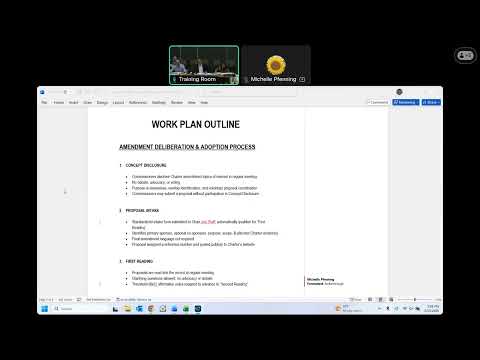
The Clark County Charter Review Commission voted 10–5 on Feb. 25 to approve Step 4 of its work plan, enabling the scheduling of second readings for proposed charter amendments after commissioners debated whether approving the whole plan now would be premature and whether a majority threshold is appropriate.
On Feb. 25, 2026, the Clark County Charter Review Commission voted 10–5 to approve Step 4 of its work plan, a procedural rule that allows commissioners to schedule second readings for proposed charter amendments.
The vote followed a lengthy discussion and a failed attempt to adopt the entire work plan at once. Commissioner Jay offered an amendment to approve the whole plan (merging steps 6 and 7), arguing the commission should "keep moving this process forward." That secondary motion failed on a roll-call vote. Chair Erickson then called the roll on the main motion to adopt Step 4, which carried by a 10–5 margin.
Opponents said approving the full plan before the work plan subcommittee completed technical work would be premature. Commissioner Landesberg asked whether an amendment that fails on a first reading could be reintroduced, and Commissioner Holmgren said it “seems early to set the standard at a majority vote” because sponsors may not yet have language to present for committee review. Supporters, including Commissioner Benton, said adopting the next step would prevent delays and allow the commission to move proposals into committee or to scheduled second readings.
Legal and procedural clarity was a recurring theme. Commissioners stressed the subcommittee’s role is administrative—process, timelines and outreach—and not to evaluate amendment content. Chair Erickson and staff clarified that the subcommittee will aim to comply with the Open Public Meetings Act and that approved items meeting the five-vote minimum will be asked to present at the next meeting for a scheduled second reading.
What’s next: With Step 4 approved, items that earn the minimum affirmative votes in a first reading can be calendared for a second reading; sponsors will be asked whether they are prepared to present at the next meeting. The commission also scheduled an additional meeting on March 31 to provide more calendar capacity.