Evanston workshop outlines source-of-income protections, local enforcement gaps
Loading...
Summary
Open Communities and partners reviewed Illinois source-of-income protections, common landlord practices that may violate the law, how to document complaints, and a notable enforcement gap in Evanston that blocks use of Cook County'level investigative resources.
Open Communities, joined by Housing Action Illinois, led a public webinar in Evanston explaining Illinois'wide source-of-income protections and how voucher holders can report discrimination.
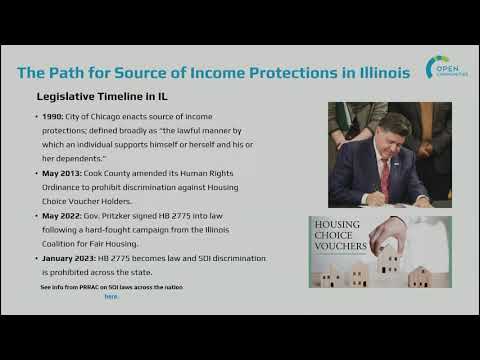
Anna Ellis Arrega, the City of Evanston's housing and economic development analyst, opened the session and introduced the presenters from Open Communities. Dominic Voss, who introduced himself earlier in the program, summarized the history of state action on source-of-income protections and said the amendment to the Illinois Human Rights Act (HB2775) took effect on 2023-01-01.
Why it matters: advocates said source-of-income discrimination—most commonly, refusal to rent to housing choice voucher holders—remains widespread and often functions as a proxy for racial discrimination. Voss told attendees that voucher discrimination frequently appears alongside practices such as increased security deposits, blanket refusals to work with third parties (the housing authority), algorithmic screening that ignores voucher income, and steering voucher holders toward particular buildings or neighborhoods.
What to watch for: Open Communities recommended that housing seekers document incidents precisely: date and time, names of staff, property address, and copies of ads, emails or texts. The group explained how landlords sometimes apply screening rules incorrectly (for example, using a three-times-rent rule on the full contract rent rather than the tenant's portion when a voucher covers part of the rent).
Local enforcement gap: Voss highlighted a structural enforcement problem affecting Evanston. Because the Cook County Human Rights Ordinance excludes municipalities where local protections overlap, residents discriminated against in Evanston cannot access Cook County's investigative resources and must pursue relief locally. Voss said Evanston lacks a dedicated commission and that the city law department is stretched thin, limiting practical enforcement options for voucher holders.
How to seek help: Open Communities described its services: direct advocacy with housing providers, guidance on filing complaints with the Cook County Commission on Human Rights or the Illinois Department of Human Rights (depending on venue), referrals to legal resources, and fair-housing testing to build evidence. The presenters noted statutory filing windows: in Illinois a complainant generally has one year from the incident to file; in Cook County the window is six months.
Outcome and next steps: advocates urged attendees to report discriminatory ads and to collect and submit anecdotal examples to support enforcement and legislative efforts. The session closed with contact information and a promise to make a recording available.