Get Full Government Meeting Transcripts, Videos, & Alerts Forever!
Get email alerts on the Ethics Waivers topic
No spam. Unsubscribe anytime.
OGE training frames 18 U.S.C. §208(b)(1) waivers as agency decisions with an OGE consultative role
Summary
Office of Government Ethics instructors outlined how §208(b)(1) waivers let agencies permit employee participation despite financial interests, stressed waivers must be issued prospectively, and explained OGE’s consult, advise, and reporting roles and key guidance resources.
Cheryl Kane Piasecki, senior instructor at the Office of Government Ethics’ Institute for Ethics and Government, and Melba Melton, assistant counsel in OGE’s Ethics, Law, and Policy Branch, presented an introductory training module on 18 U.S.C. §208(b)(1) waivers.
Piasecki said the statutory core is 18 U.S.C. §208(a), which she described as “a participation bar,” meaning an employee who has a disqualifying financial interest must not participate in the covered government matter. She emphasized the statute contains no de minimis exception: “Whether an employee's potential for gain or loss in a matter is worth 1,000 or 1,000,000, the prohibition at §208(a) equally requires their disqualification.”
Because §208(a) is broad, Congress provided agencies two statutory waiver authorities—§208(b)(1) and §208(b)(3)—that permit agencies in individual cases to waive an employee’s disqualification. Piasecki explained that a §208(b)(1) waiver, once an agency determines the employee’s financial interest “is not so substantial to affect the integrity of the employee’s service,” may allow participation in all or part of a matter; the waiver does not eliminate the financial interest itself.
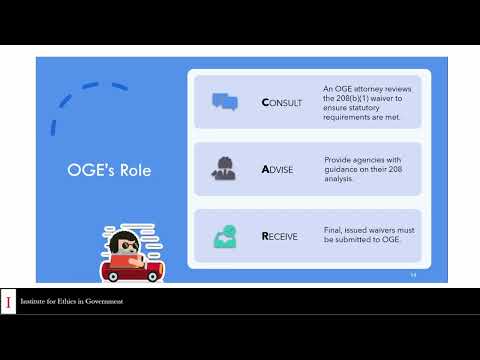
Melton framed the allocation of authority: the final decision to grant a waiver rests with the agency, not with OGE. “OGE does not concur in any waiver determinations, and consulting with OGE is not the same thing as getting OGE's approval,” she said. Melton described OGE’s role in three parts: consult, give advice, and receive copies of issued waivers. She cited regulatory and executive-order references used to ground the consultation requirement.
On process, Melton instructed that agencies should consult with their OGE desk officer after drafting a proposed waiver; the matter will be assigned to an ELPB attorney who may pose follow-up questions and thereby initiate the consultation. She underscored a recurring, controlling requirement: a §208(b)(1) waiver must be issued prospectively—before an employee participates in any particular matters covered by the waiver—to be valid. “Waivers issued after the employee has engaged in that prohibited conduct are not valid,” Melton said.
Melton and Piasecki also reviewed resources for ethics officials, pointing to OGE’s website (oge.gov) and its legal research collection. They named OGE guidance documents and advisories discussed during the module and said part 2 of the series will provide drafting tips and sample language for preparing waiver documents.
The training concluded with a reminder that agencies must document the waiver decision in writing, include a clear statement of the disqualifying financial interest and the matters covered, and, where practicable, consult OGE before issuing a waiver. The presenters said OGE may advise against issuing a waiver when statutory requirements are not met. Part 2 will address drafting and practical considerations for agency ethics officials.