Get Full Government Meeting Transcripts, Videos, & Alerts Forever!
Get email alerts on the Public Financial Disclosure topic
No spam. Unsubscribe anytime.
OGE outlines how ethics officials should review public financial disclosure (Form 278)
Summary
A presenter for the Office of Government Ethics explains who must file OGE Form 278, what must be disclosed, filing deadlines, the reviewer's role in checking for conflicts of interest, and the OGE resources to support reviews.
A presenter for the Office of Government Ethics (OGE) provided a concise guide for ethics officials on reviewing public financial disclosure reports, known as OGE Form 278. The video summarized who must file the form, what must be disclosed, when filings are due, and the primary resources and questions reviewers should use to assess possible conflicts of interest.
The presenter said the disclosure system "was first created by the Ethics and Government Act of 1978," and described its two primary purposes: to help agencies prevent conflicts of interest and to provide the public with a view into the financial holdings of senior government leaders. "A conflict of interest occurs when a federal employee takes government action on a government matter that could affect her own financial interests or the financial interests of certain family members or those with whom she is financially associated," the presenter explained.
The presenter noted there are roughly 26,000 executive-branch public financial disclosure filers and that coverage includes "essentially anyone above the General Schedule," extending through senior executive service officials "all the way up to the president and vice president." The presenter cited OGE's implementing regulation for disclosure coverage at "5 CFR 2634."
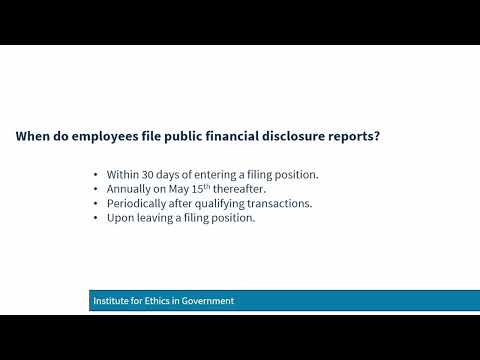
On what to report, the presenter listed: stocks, bonds, mutual funds, retirement-account holdings, sources of outside income, outside employment and positions, certain debts, certain gifts, and the financial and business holdings of close family members. For timing, the presenter advised that an employee must file an OGE Form 278 within 30 days of entering a designated filing position, must file annually on May 15, must submit periodic transaction reports on OGE Form 278-T for qualifying transactions, and must file on termination from a filing position.
The guidance framed the reviewer's role as a comparison of two things: the filer's financial holdings as reported on the OGE Form 278 and the filer's duties and responsibilities. The presenter said reviewers should obtain position descriptions, planned work documents, or conversations with the filer or supervisor to understand duties before certifying a report. Reviewers were directed to the "Analyzing Potential Conflicts of Interest" collection on OGE's website as the primary resource for conflicts analysis, and to the Public Financial Disclosure Guide for comprehensive guidance and program-management information.
To start a review, the presenter recommended two checklist questions for each entry: "Is the entry completely and accurately reported?" and "Does this entry pose a potential conflict of interest?" The presenter said the review should produce two outputs: (1) a complete and accurate OGE Form 278 and (2) an advice document (for example, an ethics agreement, advice memo, or counseling document) that sets out steps the filer will take to avoid conflicts. The presenter noted ethics agreements are required for Senate-confirmed presidential appointees and that other written counseling may be used for other filers. Possible remedies mentioned included selling assets, resigning outside positions, or agreeing not to participate in particular government matters.
The video closed by encouraging new reviewers to use OGE training courses and the legal geography quick start guide for further learning and professional development.