Get Full Government Meeting Transcripts, Videos, & Alerts Forever!
Get email alerts on the Ethics Training topic
No spam. Unsubscribe anytime.
OGE highlights online tools and scenarios to help agencies prepare annual ethics training
Summary
Office of Government Ethics instructors demonstrated OGE’s toolkit, a customizable 11‑scenario slide deck, advisories and full‑text course search to help designated agency ethics officials meet annual training requirements and track completion.
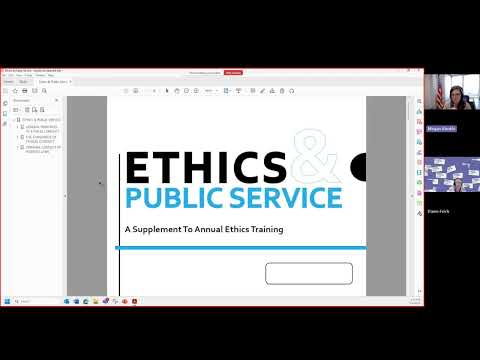
Megan Kunkle, an instructor at the Office of Government Ethics’ Institute for Ethics and Government, and colleague Dawn Fike walked attendees through OGE’s online resources for preparing annual ethics training, showing how agencies can use a customizable slide deck, advisory tables and prosecution surveys to structure instruction.
Kunkle pointed participants to the OGE homepage — “the OGE homepage can be found at www.oge.gov” — and the Resources for Ethics Officials tab, which she described as “parts of an ethics program management handbook” for designated agency ethics officials (DAOs). She said the education page links to regulatory authorities and OGE advisories that clarify training content.
The presenters emphasized several practical requirements and materials. Kunkle summarized the training benchmarks included on OGE’s chart: training must run at least one hour, required written materials include a summary of the standards of ethical conduct and any relevant supplemental agency regulations (agencies may provide instructions for accessing materials in lieu of distributing large files), and agencies must track training completion for the annual questionnaire.
OGE highlighted two advisories often referenced on the resource pages: LA‑1609 (a table overview of ethics education requirements) and Program Advisory PA‑1905 (guidance on appropriate content for annual ethics training). Kunkle also directed attendees to the Code of Federal Regulations guidance cited on the site (see authorities).
Fike demonstrated the ethics education toolkit’s embedded video and the Institute course library. She recommended instructors watch the video that explains the facilitator model before using the slides and showed how to access videos through the Institute’s YouTube channel if embedding is blocked by an agency’s network settings. “If you click on the video, it will take you to the course page,” she said.
The session included a walk‑through of a large, customizable slide deck broken into 11 scenarios, with instructor notes and bracketed instructive language for easy tailoring. Fike and Kunkle used the spousal‑employment scenario as an example of a discussion prompt that links principles to applicable ethics rules and encourages participants to consider how they would act in real workplace situations.
To help instructors enliven training, Fike pointed to OGE’s prosecution survey — a collection of conflict‑of‑interest cases under federal criminal statutes — and suggested agencies can adapt case facts as classroom scenarios. Fike referred to a recent case in the survey and said, as an example, an individual was sentenced to “151 months” in one entry; she presented that as illustrative material for engagement, not as new OGE policy.
Kunkle also highlighted accessibility and presentation tips and linked to General Services Administration guidance for creating accessible slide materials. The presenters concluded by demonstrating the Institute’s redesigned site features — a "what’s new" listserv archive, a course calendar listing live sessions and a full‑text search that indexes transcripts and materials — and invited attendee questions.
The session ended with an offer for live Q&A from participants and instructions on how to post chat questions or be unmuted for follow‑up.