OGE demonstrates 18 U.S.C. 208(a) job aid with three sample scenarios
Loading...
Summary
The Office of Government Ethics demonstrated a new 18 U.S.C. 208(a) job aid in a live training, showing how it guides ethics officials through the six statutory elements and illustrating outcomes for a volunteer intern, an HHS attorney drafting broad health-care legislation, and a VA contract administrator appointed to a nonprofit board.
Margaret Dylas Yukins, an attorney in the Office of Government Ethics' ethics law branch, led a live training demonstrating a new job aid to help ethics officials analyze potential conflicts under 18 U.S.C. 208(a).
The job aid lays out the six sequential elements of 18 U.S.C. 208(a) and links each element to regulatory citations, OGE guidance, Office of Legal Counsel opinions and relevant case law. Yukins said the tool is intended to ‘‘assist ethics officials in analyzing 208(a) questions,’’ ‘‘teach ethics officials to review 208(a) elements in their sequential order,’’ and ‘‘direct ethics officials to relevant resources for each element.’’
In three worked examples, instructors used the checklist to show how facts drive the analysis. In the first scenario, a volunteer intern at the Department of Energy researching oil refinery practices had a spouse who owned significant Chevron and Exxon stock. Citing an OGE legal advisory on interns, Yukins said, ‘‘Volunteer interns who are appointed under the authority 5 U.S.C. 311 [are] not generally considered executive branch employees,’’ and concluded that the intern did not qualify as an employee for 18 U.S.C. 208(a), so the analysis stopped there.
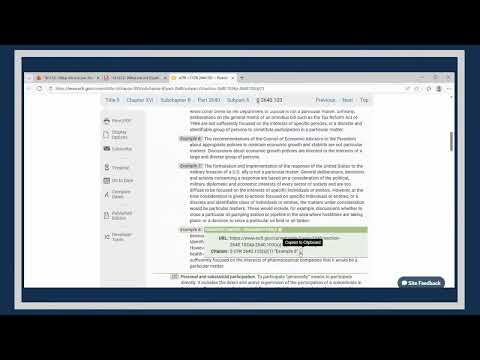
In the second example, an attorney at the Department of Health and Human Services was drafting a memo supporting broad health-care reform while a dependent child held substantial investments in health-care securities. Yukins walked through the employee and participation elements and then discussed the ‘‘particular matter’’ element. She quoted the regulatory guidance saying a ‘‘legislative proposal for broad health care reform is not a particular matter because it does not focus on the interest of a specific person or a small, identifiable class of persons,’’ and concluded that 18 U.S.C. 208(a) would not apply to the attorney’s work in that fact pattern.
The third scenario involved a Department of Veterans Affairs contract administrator who volunteers with a local blood bank and was appointed to its board. Presenters said the administrator clearly meets the employee and knowledge elements, and that her board service is a potential outside organizational financial interest. However, Yukins emphasized that the analysis could not be completed without further factual follow-up: staff need to know which contracts or matters the administrator handles and ‘‘how she participates personally and substantially’’ to assess direct and predictable effect on her financial interest.
Throughout the session, instructors repeatedly urged using the job aid’s checklist to identify missing information and preserve the analyst’s reasoning. Yukins closed by reminding attendees that when an element is clearly not met ‘‘the 18 U.S.C. 208 inquiry can stop,’’ and added, ‘‘18 U.S.C. 208 is hard.’’
The training demonstrated the job aid’s role as both a learning tool and a practical checklist for ethics officials faced with complex conflicts questions; the OGE encouraged participants to review course materials and complete the evaluation posted on the course page.