Get Full Government Meeting Transcripts, Videos, & Alerts Forever!
Get email alerts on the Native Children Legislation topic
No spam. Unsubscribe anytime.
Tribal leaders and advocates endorse sweeping Native Children’s bill draft, urge clarifications on scope and funding
Summary
A coalition of tribal organizations reviewed Senator Murkowski’s discussion draft of the Native Children’s Commission Implementation Act of 2025, broadly endorsing its set‑asides, new offices and tribal self‑governance options while urging clearer funding levels, tribal representation and technical fixes before the Sept. 12 comment deadline.
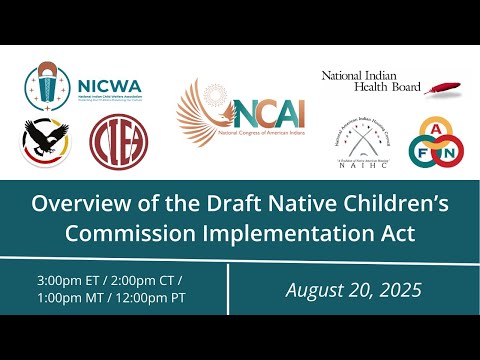
A coalition of tribal advocates including the National Congress of American Indians, the National Indian Child Welfare Association and other tribal organizations reviewed a discussion draft of the Native Children’s Commission Implementation Act of 2025 and broadly endorsed the proposal while asking for targeted clarifications and funding detail.
In introductory remarks, Megan Bishop, director of policy at the National Congress of American Indians, said the webinar’s purpose was to walk attendees through the draft so tribes and organizations could prepare comments for Senator Lisa Murkowski’s Sept. 12 public‑input deadline. The draft implements 29 recommendations from the Commission on Native Children across nine titles and 44 provisions addressing child welfare, health, environmental protections, housing, education and food programs.
Speakers praised measures to increase direct federal funding for tribes. "Tribal governments only have access to about one half of 1% of all of the federal funds that states have access to, for child welfare services," said David Simmons, government affairs and advocacy director for the National Indian Child Welfare Association, summarizing the bill’s child‑welfare intent. Title I would raise several tribal set‑asides and streamline reporting to increase tribal access to Title IV‑B funds, Social Service Block Grant funds and Child Abuse Prevention and Treatment Act resources.
Panelists supported multiple interagency and tribal advisory bodies in the draft but urged stronger tribal representation and statutory language to ensure tribal collaboration. Wynn Davis of the National Indian Health Board urged disaggregating data‑sovereignty work from traditional ecological practice coordination and recommended moving some tribal data‑sovereignty functions to HHS to align with existing tribal data policy work.
The draft would create an Office on Native Children at the Department of the Interior and a National Clearinghouse to compile federal data, grant opportunities and technical assistance. David Simmons said the concept is "a really big scope" and raised concerns that the draft does not specify funding levels, potentially creating prioritization and staffing problems if left unclear.
On health, speakers backed new maternal‑health and behavioral‑health tribal advisory committees and proposed tribal set‑asides for the Maternal and Child Health block grant and SAMHSA programs, with several presenters recommending raising some proposed set‑asides from 5% to 15% to reflect longstanding underfunding. Title 5 would create a cross‑agency task force and an Office of Native Children’s Environmental Health at EPA, charged with standards, monitoring, research that incorporates traditional ecological knowledge, and biennial reporting to Congress; panelists asked that demonstration projects include dedicated funding.
Advocates also supported expanded tribal administration options for food programs. The draft would allow tribes to assume broader FIDIPRA administration and create self‑determination options for SNAP, plus Alaska pilot projects to address rural delivery challenges. Jay Spahn, speaking on self‑governance demonstrations for behavioral health, recommended clarifying negotiation processes for funding transfers and reconciling the draft’s $2,000,000 demonstration authorization with entitlement‑style language.
Education and family‑support provisions drew specific funding requests: a five‑grantee teacher‑apprenticeship pilot at $1,000,000 per grantee annually, expanded reimbursement for Bureau of Indian Education (BIE) school meal programs and categorical eligibility so enrolled Native children qualify for free school lunch regardless of school setting. Speakers urged Congress to fund the Durbin Feeling Native American Languages Act survey so the Administration for Native Americans (ANA) can complete its work rather than spending time on an additional report about delays.
Housing and homelessness proposals include a tribal homelessness assistance stream at HUD modeled on Tribal HUD‑VASH and a Continuum of Care‑style competitive grant with at least 75% of funding reserved for tribal and Indian area projects; the draft cites a FY‑25 allocation of $25,000,000 for that program. For Head Start, the draft would allow tribal grantees more parity to use funds for facilities and extend nonfederal match waiver timelines.
Panelists flagged several recurring concerns: (1) many provisions authorize new programs or advisory bodies without specifying appropriations or exact funding levels, (2) language inconsistencies and transcription errors in the discussion materials that should be fixed (for example, statutory references and the consistent use of "tribal" rather than mis‑transcribed forms), and (3) the need for clearer tribal representation requirements on interagency committees and advisory bodies.
Megan Bishop closed by asking participants to submit feedback to NCAI by Sept. 3 (policyinfo@ncai.org) so NCAI could incorporate comments into a letter to Senator Murkowski; public input to the senator’s office is due Sept. 12 (murkowskioutreach@indian.senate.gov). Slides and a recording of the webinar will be posted on NCAI’s website and YouTube channel.
What’s next: the draft remains a discussion document; panelists urged clearer funding specifications, statutory tribal‑representation requirements on new committees, and technical fixes that will guide implementation if the legislation advances to formal introduction.