Get Full Government Meeting Transcripts, Videos, & Alerts Forever!
Get email alerts on the Ems Authority topic
No spam. Unsubscribe anytime.
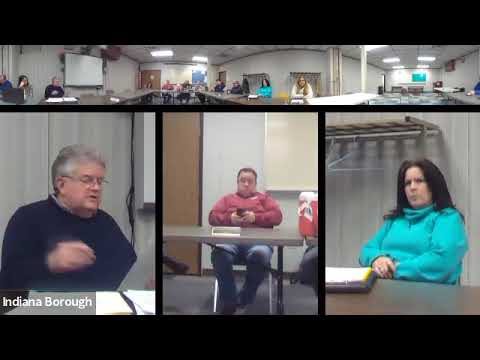
Indiana Borough council debates county EMS authority, seeks data before Thursday vote
Summary
Council members reviewed a county proposal to delegate emergency-medical-service administration to a county-created authority funded in part by a per-household fee (example $100). Members expressed concern about governance, asset transfers, fee methodology and lack of transparency and agreed to submit questions and send spokespersons to a joint meeting Thursday.
Indiana Borough council members spent most of a meeting debating a county proposal to create a countywide emergency medical services (EMS) authority that would administer (and potentially fund) EMS across multiple municipalities.
Speaker 4, an unnamed council member, summarized the county's plan and said it would centralize administration because EMS providers nationwide struggle with low insurance reimbursements and unreimbursed calls. "They've been coming and talking about the $100 the household type thing," he said. He also warned the authority could assume administrative control — and, in his words, "take over" assets such as ambulances and facilities, citing what he said had occurred in Lancaster County.
The discussion centered on three practical issues: how much money the authority is trying to raise, how fees would be structured, and who would govern the authority. Council members repeatedly asked for the consultant's methodology and source data used to derive cost estimates and household counts.
Why it matters: Citizens Ambulance, the borough's long-standing local EMS provider, is reported in the meeting as operating with a multimillion-dollar shortfall. Members said the county's example goal — described in the meeting as about a $6.6 million target based on roughly 33,000 households — would translate to roughly $100 per household, a figure several members said sounded arbitrary without supporting data. Speaker 4 also cautioned that if municipalities decline to participate, the per-unit fee would rise for those remaining.
Council members pressed specific governance concerns. According to Speaker 4, the authority prospectus envisions nine districts each with one vote, meaning population centers such as Indiana Borough and White Township could have the same vote weight as sparsely populated districts. "You see, that doesn't make it," Speaker 4 said, warning that the proposed structure could allow smaller districts to outvote larger-population areas on service placement and resource allocation.
Members also debated implementation options. They described three different paths the authority might take: (1) contract with Citizens Ambulance to continue day-to-day operations while the authority administers billing and fees; (2) absorb or purchase Citizens' assets and personnel; or (3) allow municipalities to form their own local authorities. Speaker 2 stressed contracting as an option, while Speaker 4 said evidence from Lancaster suggests authorities sometimes assume assets.
On process, Speaker 2 explained the joint special meeting procedure scheduled for Thursday: the county will present, then open a public-comment period (3 minutes per speaker), then call each municipality in alphabetical order to record a roll-call motion and vote. The council discussed three procedural choices for Thursday: pass the ordinance, vote no, or table it for more information.
Several members urged preparation rather than an immediate vote. Speaker 1 proposed that the council compile a concise list of questions for the county and send a designated spokesperson (or two) to the joint meeting to ask them directly. Items they want answered include the authority's target funding amount, the methodology used to calculate fees, how different user types (single-family households, multi-unit apartments, student residents, nursing beds, businesses) would be charged, whether the authority would directly hire staff or contract, and safeguards for municipal interests.
On training and operations, Speaker 4 said Citizens does in-house training and is working with Indiana University of Pennsylvania (IUP) on paramedic programs; Speaker 7 asked whether the authority had training plans and whether funds would be used for workforce development.
No formal motion was voted on at this meeting. Speaker 4 read the draft ordinance text — "to enact the ordinance delegating the administration of EMS to a county created authority on a mutually agreeable date" — but the council opted to collect questions, coordinate a spokesperson and attend Thursday's session rather than move immediately to a final vote. Members emphasized the need for the consultant's data and a clear strategic plan before committing to a fee or governance structure.
What comes next: Council members agreed to email questions (with caution to avoid violating open-meeting rules) and to have representatives attend the Thursday meeting at 7 p.m. to ask for clarification about funding targets, fee caps and governance. The meeting adjourned with no ordinance vote recorded.
Quotes from the meeting appear verbatim and are attributed to unnamed council members as recorded in the transcript.