Hibbing utility credits fuel flexibility with about $1.5 million gas‑cost savings during January price spike
Loading...
Summary
Mr. Peterson told commissioners that a late‑January cold snap combined with a regional pipeline rupture pushed spot gas prices toward $72 per decatherm and wholesale power near $800/MWh; shifting the plant to biomass and coal saved about $1.5 million and kept average gas costs near the $4.90/decatherm budget, and officials said they will not pass emergency costs to customers.
Mr. Peterson, a staff member, told the commission that Hibbing’s utility avoided large market costs during a late‑January cold snap by switching the power plant from natural gas to biomass and coal. He said the move saved the utility about $1,500,000 and kept the system’s average gas cost near the budgeted figure of about $4.90 per decatherm.
Peterson said the city faced temperatures near 30 below and a regional supply shock caused by a pipeline rupture in Willow River that left the Carlton, Minn., compressor station operating at roughly 30% of normal capacity before the cold snap. ‘‘When it was 30 below here in Hibbing, we ran into this very cold weather with very high gas prices,’’ he said, framing the event as similar to the February 2021 polar vortex.
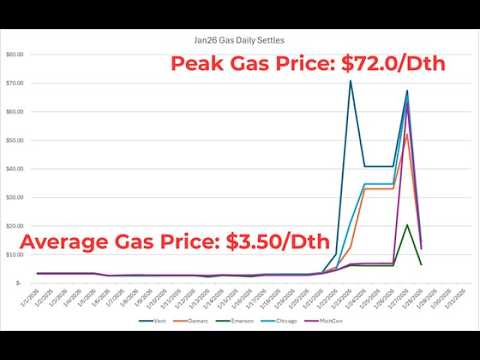
The presentation included a month‑long gas price chart that Peterson said showed wholesale gas near $3 per decatherm for most of January before spiking to roughly $72 per decatherm around the 23rd. He said wholesale power prices rose in step with gas and reached about $800 per megawatt‑hour in MISO’s day‑ahead market.
According to Peterson, crews — and in particular work led by staff including Paul Plumbaugh, who manages the utility’s gas portfolio — coordinated to reduce gas use in the plant and shift generation to biomass and coal during the peak price period. ‘‘We saved $1,500,000 just on gas prices alone, during that event,’’ Peterson said.
Peterson told commissioners that because the utility generated or purchased much of its electricity locally during the period — at times covering over 100% of local demand according to his remarks — the market shock’s financial impact should be muted. He said other municipal utilities are filing emergency rate provisions to pass costs to customers, but ‘‘we will not be doing that in Hibbing’’ and that the utility remains in line with its budget.
Commissioner Stolz thanked Public Utilities staff and the plant team for their work. The presentation concluded with appreciation from the dais and no formal action recorded in the transcript.
What happens next: staff presented numbers and operational decisions to the commission; the transcript records no vote or formal rate action and indicates commissioners thanked staff and accepted the update as information.