
House member urges backing for HR 4626, Home Appliance Protection and Affordability Act
Get AI-powered insights, summaries, and transcripts
Subscribe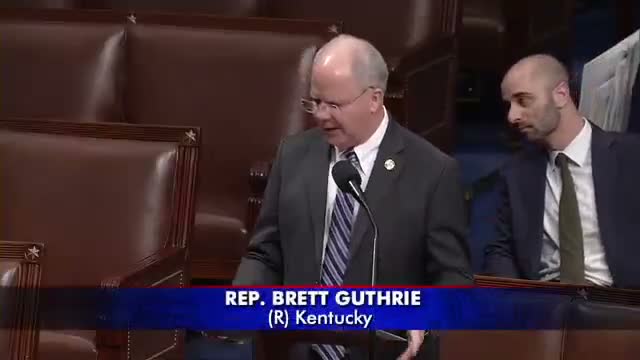
Summary
An unidentified House member urged support for HR 4626, the Home Appliance Protection and Affordability Act, arguing that the Department of Energy has overreached under the Energy Policy and Conservation Act and that the bill would protect consumer choice and affordability; the speaker reserved time at the end of the floor remarks.
An unidentified House member spoke on the floor in support of HR 4626, the Home Appliance Protection and Affordability Act, saying the measure would "modernize energy efficiency authorities to lower costs for households and protect consumer choice." The speaker identified the bill as sponsored by a colleague from Georgia's 12th District and urged members to back it.
The speaker placed the bill in the context of the Energy Policy and Conservation Act (EPCA), saying EPCA was established in 1975 "amidst the oil crisis of the 1970s" and granted the Department of Energy authority to set minimum efficiency standards for products including stoves, water heaters and dishwashers. "By reducing consumption to the use of innovative technologies, we can insulate families," the speaker said in describing EPCA's original energy-security rationale.
The floor remarks criticized what the speaker described as a shift in regulatory focus under recent administrations. "During the 4 long years of the Biden Harris administration, however, the Department of Energy used EPCA authorities to regulate a host of everyday products like dishwashers, freezers, and dryers," the speaker said, adding that those regulations were "rooted in ambitious climate goals" rather than consumer affordability. The speaker also said DOE rules were not always "economically justified" and asserted that, as an example, DOE regulations on dryers "could take up to 46 years to see efficiency benefits," while household appliances are replaced "every 8 to 9 years on the average." These numbers were presented by the speaker as part of the case for legislative change; the speaker did not provide sourcing for the figures during the remarks.
To bolster an affordability argument, the speaker said "Americans are already paying 34 percent more for their energy bills than they were in 2010." That statistic was offered to support the claim that households "simply cannot afford more expensive mandates coming out of Washington." The speaker also attributed rising costs to inflation and linked that inflation to the current administration's spending policies.
The speaker framed HR 4626 as instituting "common sense accountability at DOE to protect consumers from overregulation" and said the bill would "foster continued innovation in energy efficiency technologies" while refocusing EPCA authorities "on cost effective efficiency standards." The remarks concluded with the appeal: "I urge my colleagues to join me in supporting HR 4626, the Home Appliance Protection and Affordability Act ..." The speaker then said they "reserve[d] my time." Notably, the transcript uses an alternate phrasing at one point, calling the measure the "Home Alliance Protection and Affordability Act;" the bill number HR 4626 appears consistently and is used here as the canonical identifier.
No vote or formal motion appeared in the provided remarks, and no other speakers or responses to the claims were recorded in the transcript excerpt.