Get Full Government Meeting Transcripts, Videos, & Alerts Forever!
Get email alerts on the Federal Ethics topic
No spam. Unsubscribe anytime.
Training video summarizes federal ethics authorities for new executive branch officials
Summary
A training video for newly assigned executive branch ethics officials explains how statutes, executive orders and agency regulations interlock to govern ethical conduct, highlighting the Ethics in Government Act, key Title 5 and Title 18 provisions, and Office of Government Ethics regulations.
A training video for newly assigned executive branch ethics officials lays out how statutes, executive orders and agency regulations fit together to govern federal ethics.
"If you are watching this video, you have probably been recently assigned ethics duties for the first time in an executive branch agency," the presenter says, describing the intended audience as officials who may not have formal legal training.
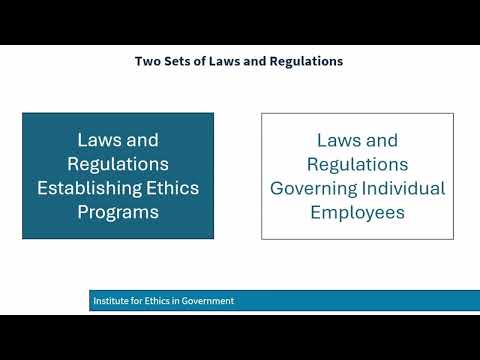
The film distinguishes two classes of authority that ethics officials consult. One group establishes and governs the executive branch ethics program — the rules that tell the Office of Government Ethics and agency ethics programs which activities to undertake, such as advising employees, collecting financial disclosure reports and providing ethics training. The presenter summarized this point: "The Ethics in Government Act, first passed in 1978 and amended several times since, is the core statutory authority for the Executive Branch Ethics Program." The video notes OGE's rulemaking authority implementing parts of that law in the Code of Federal Regulations.
The other class governs individual employee conduct. The presenter cited Title 18 criminal conflict-of-interest provisions (for example, sections that prohibit certain representations or payments and post-employment restrictions) and explained that some of those statutes are implemented through the standards of conduct at 5 CFR and related parts. As one example of a regulatory citation the video used to illustrate standards of conduct, the presenter said, "Putting it all together, we can find 5 CFR 2635.101 Basic Obligations of Public Service." The video advises ethics officials to consult both statutes and implementing regulations when advising employees.
The presentation also traces the administrative origins of the standards of conduct, noting Executive Order 12674 as the directive that led to the standard-of-conduct framework and calling out statutory gift restrictions codified in 5 U.S.C. § 7353 and the way those limits are folded into 5 CFR 2635 (subpart B). The narrator directs viewers to the Institute for Ethics and Government on‑demand library for topical courses and to study specific authorities as they arise in daily work.
The video concludes by framing the material as an introductory "table of contents" for a developing knowledge base and encourages new ethics officials to become fluent in the cited authorities as part of their professional development.