Get Full Government Meeting Transcripts, Videos, & Alerts Forever!
Get email alerts on the Federal Ethics Gifts topic
No spam. Unsubscribe anytime.
OGE trainer outlines gifts rule, VTIA analysis and personal-relationship exception
Summary
Patrick Shepherd, a senior instructor at the Office of Government Ethics, walked attendees through 5 CFR Part 2635's gifts provisions, introduced a four‑factor VTIA analysis (value, timing, identity, access), and applied exceptions including the $20/$50 de minimis rule and the personal‑relationship exception using a hockey‑ticket example.
Patrick Shepherd, a senior instructor at the Office of Government Ethics, led a 30–45 minute webinar explaining how ethics officials should evaluate gifts from outside sources under the federal standards of conduct. Shepherd said the central concern is that “gifts may actually or apparently influence federal employees who receive them,” and that even permissible gifts can erode public trust or create perceptions that donors receive special treatment.
Shepherd began from the regulatory text in 5 CFR Part 2635, identifying two separate prohibitions: an employee may not solicit or accept a gift from a prohibited source, and may not accept a gift given because of the employee’s official position. He stressed that meeting either condition is sufficient to trigger the prohibition and advised lawyers and ethics officials to consult the regulation’s precise language rather than relying on memory.
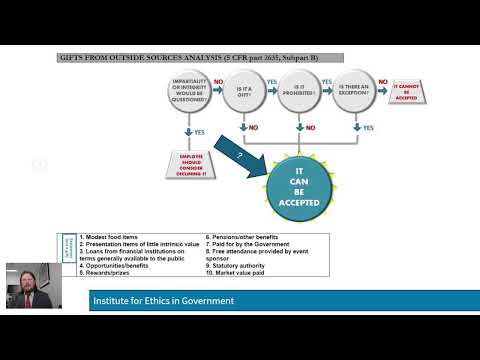
To help ethics officials structure advice, Shepherd introduced a four‑factor shorthand—"value, timing, identity, and access," or VTIA—to guide initial appearance inquiries. He said ethics officials should first ask whether acceptance would lead a reasonable person to question an employee’s integrity or impartiality and then apply VTIA to decide whether to proceed to the more detailed regulatory steps.
Shepherd reviewed the regulatory definition of a gift, which covers “any gratuity, favor, discount, entertainment, hospitality, loan… services as well as gifts of training, transportation, local travel, lodgings, and meals.” He also listed common exclusions from the definition, including modest nonmeal food items, presentation items of little intrinsic value, loans on ordinary terms, government‑paid items, and payments the employee made at market value.
Using a hypothetical, Shepherd described an employee whose brother‑in‑law—an employee of an agency grantee—offers access to an executive suite at an Arlington Raiders hockey game for the employee’s daughter. Shepherd noted the best non‑suite seats cost about $150 and estimated the suite hospitality could amount to “hundreds to $1,000,” concluding the tickets meet the general definition of a gift and likely come from a prohibited source if the brother‑in‑law’s employer is a grantee of the agency.
Shepherd then applied VTIA to the example: the ticket value weighs against acceptance; timing required checking whether the grantee sought agency action; identity raised family‑relationship questions; and access was less concerning because the employee herself would not be attending. He explained that these considerations led to treating the suite tickets as an indirect gift from a prohibited source and therefore to the next step—checking exceptions.
Shepherd discussed common exceptions. He noted the familiar de minimis exception—gifts of $20 or less per occasion and $50 per donor per calendar year—would not apply to high‑value tickets. He then described the personal‑relationship exception, which allows gifts motivated by family or friendship to be accepted when the history and nature of the relationship make the motive clear and when the family member personally pays. To illustrate, he recited an FDIC example where a bank gave employees tickets and the invite was motivated by personal friendship rather than agency business; under similar facts, Shepherd said the personal‑relationship exception could apply to the hockey‑ticket scenario if the brother‑in‑law truly paid or used tickets without employer direction.
Throughout, Shepherd reminded attendees that exceptions do not eliminate appearance concerns and that additional steps—such as recusal under the standards of conduct—may be appropriate to manage risk even when an exception technically applies. He closed by urging participants to consult the full regulatory text and OGE’s Institute for Ethics and Government training materials, and he invited feedback via the course evaluation link.
The Office of Government Ethics' guidance emphasizes a structured approach: begin with appearance and VTIA, determine whether the item is a gift, test for prohibitions, and then seek applicable exceptions while considering recusal or other management steps.