Get Full Government Meeting Transcripts, Videos, & Alerts Forever!
Get email alerts on the School Safety topic
No spam. Unsubscribe anytime.
Molalla River SD 35 details safety task force work, communications upgrades and reunification planning
Summary
The Molalla River SD 35 board heard a presentation from the district safety task force outlining emergency procedures, drill tracking, medical preparedness, and communications upgrades including PA/panic buttons, additional cameras, an AI pilot, and a VoIP-to-cellular failover; no formal votes were taken.
The Molalla River SD 35 board heard a detailed briefing from the district safety task force on its emergency-preparedness work, spotlighting updated procedures, drills and communications upgrades intended to improve on-campus response.
The presentation, led by the task force chair (Speaker 3), said the group formed after attending a Clackamas County emergency-management summit and includes administrators, district operations staff, a school nurse, the school resource officer and district office personnel. "Our goal is to be ready day 1 for an emergency in our building or in the district," Speaker 3 said, summarizing the committee's primary objective.
Why it matters: the task force is standardizing response language, tracking training and drills, and investing in communications that can directly connect staff to emergency services. The district has adopted the I Love You Guys standard response toolkit and distributes small badge inserts and posters so staff and students see the same language for "hold," "lockdown," "evacuate" and "shelter." Speaker 5 said the district "adopted that" program and provides badge inserts and room posters to reinforce the language.
Key upgrades and logistics: Speaker 6, who presented communications details, said the high school deployed a new Bell PA/panic system that has produced two accidental triggers but also several successful activations for medical emergencies. The district is using a school-violence-prevention grant to expand the PA/panic system and purchase additional cameras. "We're also looking at a VoIP failover gateway for our phone system," Speaker 6 said, adding that the failover would "connect them to cellular" so phones that depend on the district's internet would still be able to dial out in the event of an outage. The district is evaluating AI integration with its Meraki camera system to enable more proactive detection capabilities, and Communications Northwest helped assess radios and repair a tower that improved communications with remote schools.
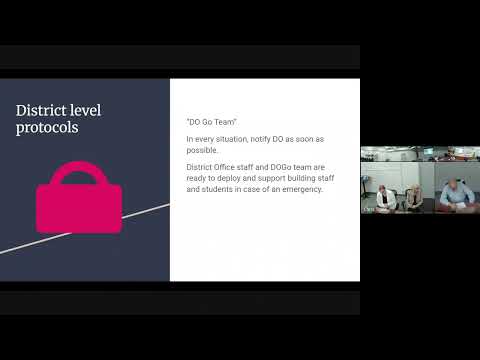
Training, drills and documentation: staff said schools complete emergency response packets and drill sheets the district monitors; administrators keep a 300-page Emergency Operations Plan (EOP) binder, and the district produces one-page scenario checklists for operational staff. The district also maintains two totes with reunification supplies (cards, surge strips, extension cords, staplers) and a "go" team with assigned responsibilities for reunification; Speaker 5 said the team plans a non-emergency site visit to the reunification location so staff can rehearse setup.
Medical and supplies planning: the district emphasized medical continuity during evacuations. A school nurse (Amanda, mentioned by staff) reviews which students require medications and what classroom kits should contain for extended relocations, including snacks, water and basic sanitation items.
Questions and limitations: board members asked whether panic buttons could be triggered off campus. Speaker 6 clarified the devices require connection to district Wi‑Fi and will not call out once a staff member leaves the wireless range; they noted one staff incident where a child's accidental press at home did not summon emergency services. On system reliability, staff said they prefer an occasional accidental internal alert to a missed real emergency because the current setup routes panic signals directly to emergency services.
What the board directed or decided: there were no motions or votes recorded on these topics during the meeting. Board members expressed appreciation for the work and discussed next steps, including follow-up coordination with law enforcement and first responders and scheduling a reunification site visit.
Next steps and schedule: staff will continue refining communications, completing the camera and panic-button rollouts funded by the grant, and conducting drills and tabletop exercises. The board listed upcoming meetings for December and January before adjourning.
Sources: presentation and Q&A at the Molalla River SD 35 board meeting; task force chair (Speaker 3); communications presenter (Speaker 6); district operations staff (Speaker 4, Speaker 5).