OGE warns federal employees on monetized social media and crowdfunding limits
Loading...
Summary
The Office of Government Ethics told ethics officials that monetized personal accounts are treated as outside business activities and that crowdfunding donations must be treated as gifts; anonymous donations are not permitted and use of government time or equipment for paid content is generally barred.
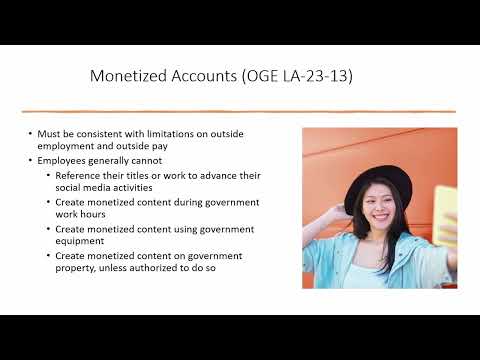
In training for ethics officials, a presenter from the Office of Government Ethics said employees seeking to monetize personal social media or to run crowdfunding campaigns must consult with their ethics offices because such activities often implicate the Standards of Ethical Conduct. "Monetizing an account is an outside business activity," the presenter said, and many agencies require prior approval before engaging in outside business activities.
OGE warned that employees "cannot capitalize on their government positions to make money through social media," and emphasized that using government time, equipment, or property to create monetized content is generally prohibited. The trainer walked through examples: an employee selling 3-D sculptures on Etsy might post a link while keeping a government title in their background section if a reasonable person would not view that as a government endorsement, but endorsing products while wearing a department-issued uniform or during work hours would not be permissible.
The presenter also addressed crowdfunding, explaining that donations to individuals through platforms such as GoFundMe are analyzed as gifts, not as fundraising under OGE rules. As a result, employees must be able to identify donors and "cannot accept anonymous donations," the presenter said. Donations from those other than close friends or family must be vetted to confirm donors are not prohibited sources or that contributions are not made because of the employee's official position.
OGE advised ethics officials to help employees assess whether an outside activity requires prior agency approval, whether it involves disclosure of nonpublic information, and whether a separate account or prominent disclaimers should be used to avoid the appearance of government endorsement. The training closed by urging ethics officials to consult OGE legal advisories for case-specific guidance.