
County auditor gives Queen Anne’s County a clean opinion for FY2025; flags one material weakness
Get AI-powered insights, summaries, and transcripts
Sign Up Free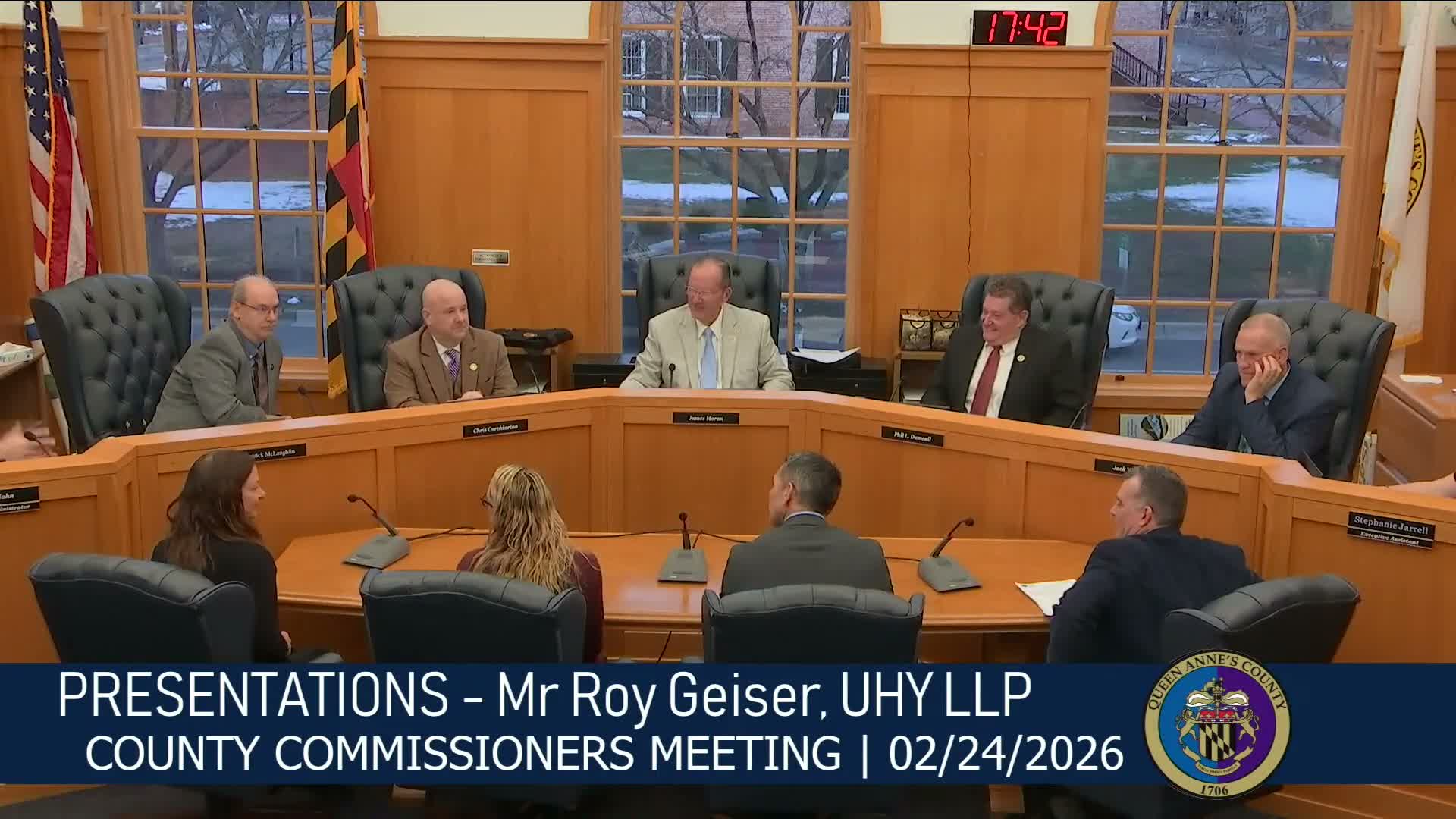
Summary
Independent auditor UHY issued an unmodified (clean) opinion on Queen Anne’s County’s FY2025 financial statements, reporting $354 million in net position and noting one material weakness and two management comments; enterprise funds and long‑term liabilities were highlighted for attention.
Roy Geiser of audit firm UHY presented the county’s FY2025 audited comprehensive financial report, telling the Board of County Commissioners that the firm issued a clean, unmodified opinion on the financial statements. "A clean opinion" was the auditor’s primary takeaway, and he said the county’s combined net position was about $354 million.
Geiser pointed to key numbers in the ACFR: approximately $234 million in net investment in capital assets, $34 million in restricted net position and roughly $85.5 million in unrestricted net position. He said the general‑fund reserve level met and exceeded the Government Finance Officers Association recommendation, at about four to five months of expenditures.
The auditor noted enterprise fund results and long‑term obligations. The Southern Kent Island sanitary district recorded an operating loss of about $2 million in FY2025; other enterprise units (Bay Bridge Airport and several non‑major funds) also showed losses or smaller deficits. Geiser warned these figures reflect depreciation and other accounting entries and said the county invested roughly $14.5 million in new capital assets during the year while recording about $13.5 million in depreciation.
On funding of post‑employment liabilities, Geiser reported the county’s pension plan funding at approximately 72%, the county’s Other Post‑Employment Benefits (OPEB) at about 51% funded, and the length‑of‑service award program (LOSAP) at essentially 0% funded. He described these as disclosures, not violations, and noted there is no statutory requirement to fully pre‑fund these plans.
Geiser also disclosed audit communications required by professional standards: UHY recorded one material weakness and two other comments that management has been given and is addressing. He said there were no disagreements with management on the audit and that the firm will continue to work with county staff on upcoming GASB standards (GASB 103 and 104). The audit presentation and materials were accepted without further action at the meeting.
The county’s auditors and finance staff emphasized that while the overall financial position suggests fiscal strength relative to a 10‑year trend, some enterprise operations and unfunded liabilities will remain items for the board and staff to monitor going forward.