
House backs expansion of Utah Energy Council and special-district tool to finance large projects
Get AI-powered insights, summaries, and transcripts
Subscribe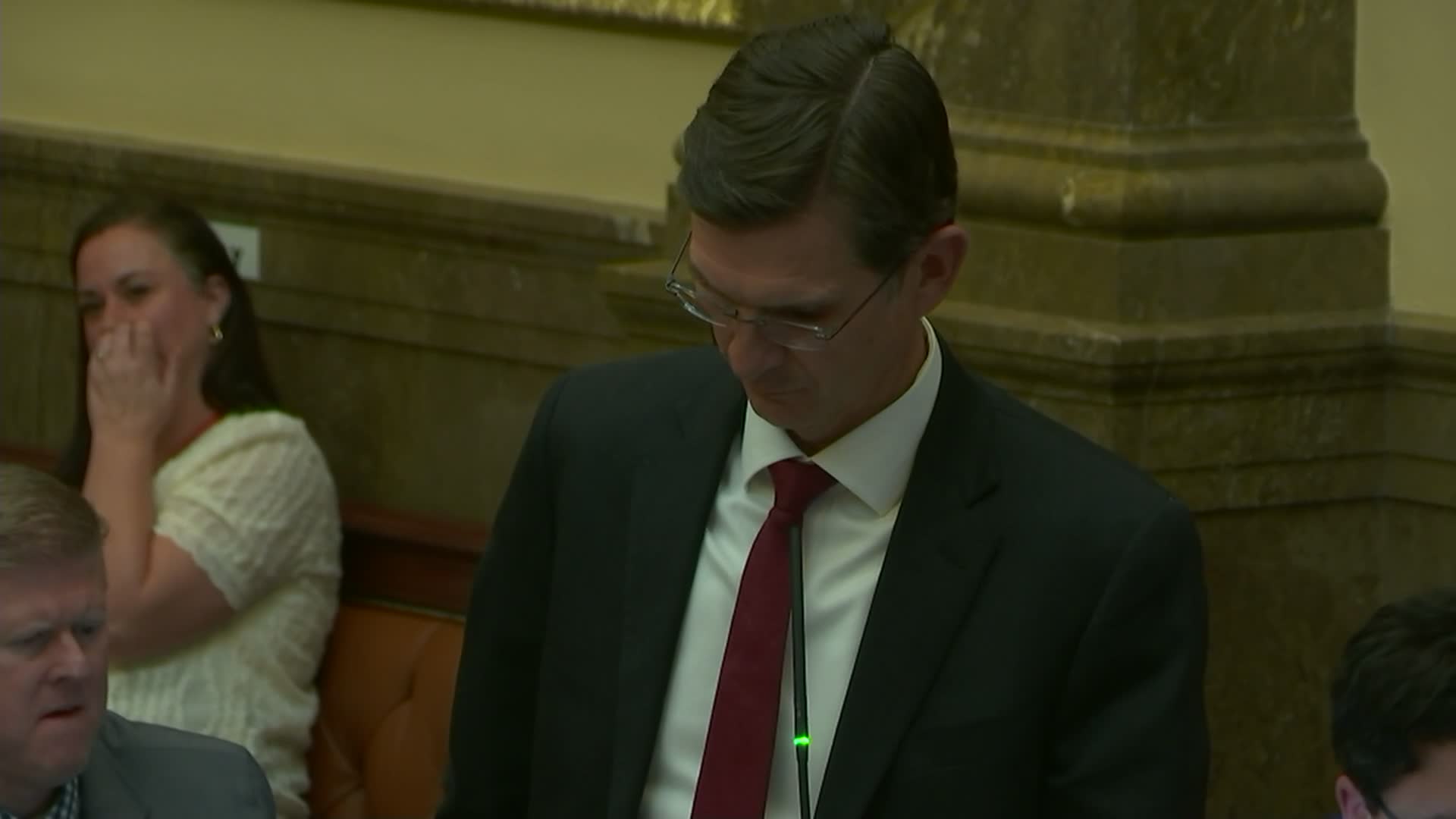
Summary
Representative Walter's first-substitute bill expanded Energy Council membership, authorized co-chairs, and established a special-district financing mechanism to facilitate large energy-generation and transmission projects without state obligation; sponsors said the bill avoids eminent-domain authority and coordinates with local governments.
Representative Walter presented first-substitute HB 514 on Feb. 26 to expand the Utah Energy Council from five to seven members, authorize co-chairs, and create a special-district financing mechanism that could be used to support large energy-generation or transmission projects without creating a direct state credit obligation.
Walter said the measure is designed to help develop 'reliable, affordable, dispatchable' power over coming decades and to provide financing tools for projects such as large-scale renewables or potential future nuclear generation. He said the Energy Council is not a regulatory body and that the Office of Energy Development within the Governor's Office handles permitting and regulatory roles.
During floor Q&A members pressed on local-government impacts, water and air rights, taxation and whether the structure allows eminent domain. Walter answered that the bill does not create eminent-domain authority, that constitutional protections require coordination with local authorities for any projects occupying streets or highways (citing Article XI, Section 9 of the Utah Constitution), and that state assets remain exempt from property tax though a privilege tax mechanism can compensate local governments.
Supporters said the substitute clarifies that the Council would not displace municipal electric providers, co-ops or private utilities. Representative White asked about local governments, and Walter said the special district is like existing water conservancy or mosquito districts and would not automatically change distribution or service territories. The House adopted the substitute and voted to pass the bill; the transcript records the substitute adoption and a subsequent recorded passage consistent with floor procedure.