Committee advances bill to codify appellate performance standards and change evaluation metrics
Loading...
Summary
A House committee voted to favorably recommend first substitute SB 233, which moves appellate case-processing standards into statute and changes a fixed-count lateness rule to a percentage-based standard for Judicial Performance Evaluation purposes. Supporters said it increases transparency for retention elections; court administrators warned of separation-of-powers concerns.
A Utah House committee on [date] voted to advance first substitute Senate Bill 233, a measure that places appellate court case-timing standards into statute and switches the Judicial Performance Evaluation metric from a fixed-number allowance for late opinions to a percentage-based standard.
The bill’s sponsor, Senator Brammer, told the committee the change gives the Judicial Performance Evaluation Commission greater flexibility to use ratio-based surveys and embeds minimum appellate timelines into statute so the legislature would have to be involved if those standards were changed. "It provides some additional flexibility for the Judicial Performance Evaluation Commission to do surveys," he said, adding the intent is to encourage judges to adopt clearer docket-management metrics.
Supporters argued the change helps voters. Representative Acton asked whether the evaluation scores used in retention elections would reflect the statutory standards; Brammer said the metrics feed the Judicial Performance Evaluation process and that codifying them will strengthen objective data available to voters.
Opponents raised separation-of-powers concerns. Michael Drexel, assistant state court administrator, urged the committee to oppose the section that moves appellate case-processing standards into statute, saying the courts already addressed the ratio-based approach through rulemaking and that putting it into statute "creates some separation of powers issues." Drexel told lawmakers the court had adopted ratio-based rules in response to concerns and that publishing those standards in the code of judicial administration already allowed legislative oversight through the rules-review process.
Other public commenters offered divergent views. Laurie Cartwright, representing Mormon Women for Ethical Government, said the change risks increasing political influence on judges, while Mary Ann Christiansen of Utah Legislative Watch said more informative evaluation data is prudent for retention elections.
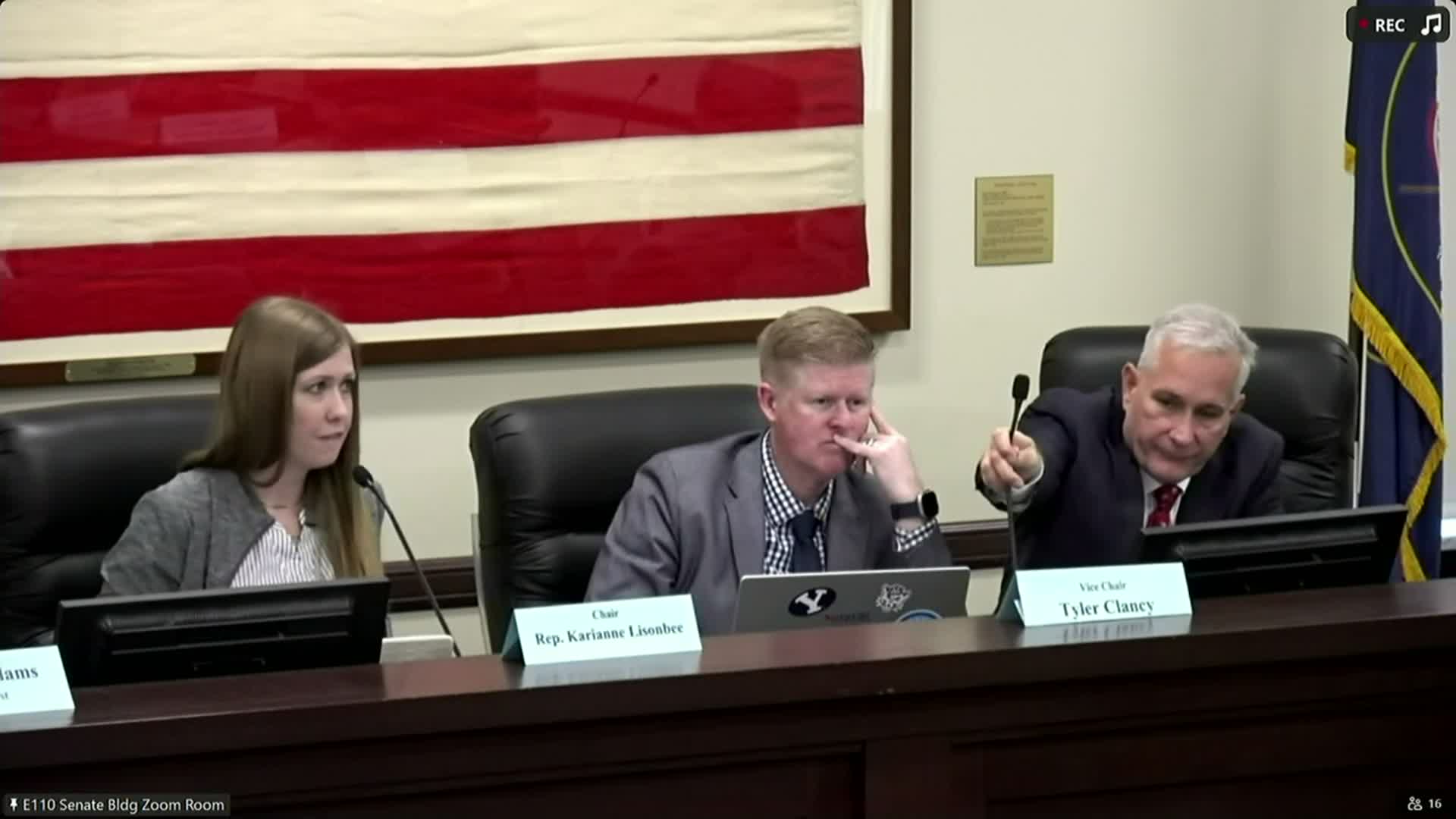
On final committee action, Representative Clancy moved to favorably recommend the first substitute to the full House. After brief discussion and a voice/hand vote the committee advanced the bill; the clerk reported the motion passed with eight members in favor and two opposed.
The committee record shows lawmakers debated whether judicial independence would be undermined by statutory standards, while sponsors emphasized the measure applies to administrative standards for case processing rather than decision-making in individual cases. The bill now goes to the full House for further consideration.