Get Full Government Meeting Transcripts, Videos, & Alerts Forever!
Get email alerts on the Historic Preservation topic
No spam. Unsubscribe anytime.
Davidson County survey documents hundreds of historic burial sites and urgent preservation needs
Summary
Presenters from New South and Metro Historical Commission summarized Phase 3 of a countywide cemetery survey, reporting roughly 98 sites surveyed in the phase, five newly recorded cemeteries added to the Davidson County Cemetery Survey, and preservation challenges ranging from abandonment to harmful landscaping practices.
Lydia, a presenter on the New South survey team, said the Phase 3 Davidson County Cemetery Survey aimed to ‘‘document our current conditions of the cemeteries throughout Davidson County’’ and to collect geospatial data and size estimates to inform a countywide preservation plan.
The project team visited 98 cemeteries in the most recent subareas of western Davidson County and added five previously unrecorded sites to the Davidson County Cemetery Survey (DCCS) database, the presenters said. Surveyors also reported about 13 sites they could not access and the earliest burial they documented in the field dated to 1816.
‘‘We are connecting with property owners, community members, and stakeholders who might be interested in preserving these cemeteries,’’ Lydia said. The team uses two forms for each site: an in-house New South database form for detailed condition notes and the Tennessee Historical Commission survey form required for the statewide inventory.
Field lead Claylee Caudle Peacock described typologies encountered in the field. Vernacular family and community graveyards — such as the Drake Walton family graveyard and Young Cemetery — frequently feature field stones, wooden markers and irregular layouts. Rural garden and lawn-park sites (examples: Gilbert Marshall Cemetery; Pasco Church of Christ) show more planned rows and ornamented stonework, while memorial-garden cemeteries (Harpeth Hills, Hills of Calvary) use flat markers to facilitate lawn care.
Claylee highlighted institutional cemeteries, including a Vanderbilt University research cemetery that ‘‘doesn’t have any individual markers’’ but contains a monument honoring body donors. In a separate example, the Bordeaux Hospital/Metro County Cemetery includes a memorial garden section with named markers and a different section with small numbered concrete markers for unidentified or indigent decedents; Claylee said those numbers ‘‘may correspond with hospital files’’ but that she had not been able to confirm that connection.
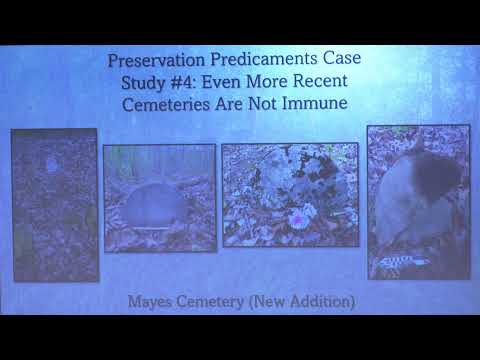
Surveyors presented three main preservation predicaments: abandonment (overgrown sites with crumbling walls and rare markers at risk), lack of resources (owners or descendants unable to maintain or complete repairs), and well-intended but harmful beautification (planting trees within burial grounds, use of chemical mulches, overcleaning that accelerates stone deterioration). Claylee described discoid markers at one overgrown site that are delaminating and require conservation attention.
The team noted opportunities for targeted follow-up: community reporting led to the discovery of a family cemetery called Maze Cemetery (oldest burial from 1974), an African American site where many markers are homemade; because it is recent, presenters said descendants may be traceable through recent records. Claylee suggested future outreach specifically aimed at engaging community members to identify and help record additional unlisted cemeteries.
The presentation concluded with a question-and-answer period in which audience members asked about specific cemeteries and site boundaries. Presenters emphasized that the Phase 3 deliverables — a summary report, site documentation, plotted surveys and photographic records — will inform where to target preservation funding and next steps for historically vulnerable sites.