Get Full Government Meeting Transcripts, Videos, & Alerts Forever!
Get email alerts on the Urban Agriculture Plan topic
No spam. Unsubscribe anytime.
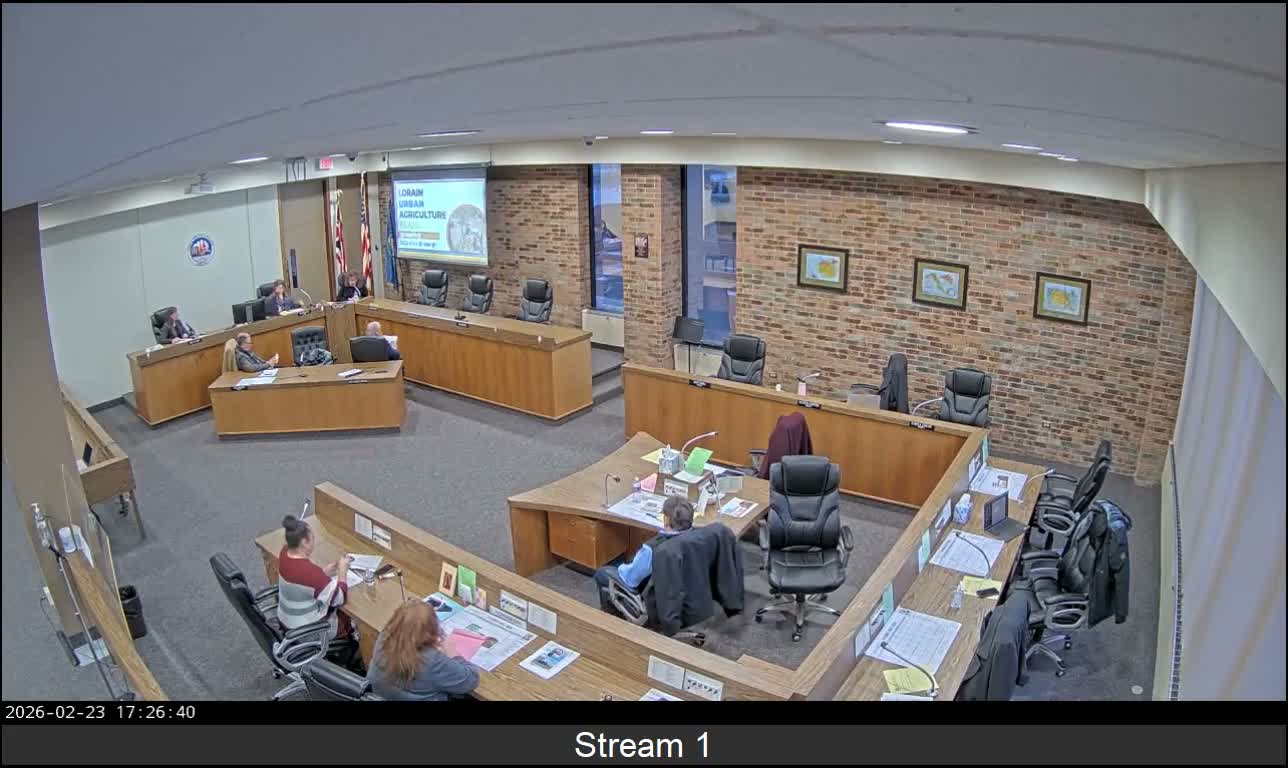
Committee forwards "Growing Together" urban agriculture plan to council after presentation
Summary
The Building & Lands Committee heard a presentation by Hannah Corraly on a USDA-funded 396-page urban agriculture plan, "Growing Together," recommended zoning and permitting changes, and voted to send the plan and resolution to full council for consideration.
The Building & Lands Committee voted to forward Lorain's draft urban agriculture plan, "Growing Together," to full city council after a presentation by Hannah Corraly, program manager of community and economic development.
Corraly said the plan, produced with a USDA urban agriculture planning grant and partners including Second Harvest, Lorain County Public Health, Solidarity Urban Farms and consultants TSW Inc. and AdriTexture LLC, is "about 396 pages." She told the committee the plan is intended to boost food security, support local food businesses and create programming and partnerships to increase access to fresh produce in food deserts.
Corraly summarized key recommendations and limits: the plan calls for amending zoning and permitting to support small- and mid-scale growing and for establishing a steering committee and permitting process. "It does not recommend permitting farm animals like cows, chickens, goats, etcetera," she said, and it also does not recommend that the city operate community gardens or use every vacant lot for agriculture. The plan recommends resources, a tax and incentive strategy, site assessments, and an emphasis on connecting youth and schools to local food efforts.
Committee members pressed for details on several operational points. Miss Kenton asked whether bees would be classified as livestock; Corraly said bees would not be considered livestock. Kenton also asked about brownfield remediation and who would be responsible; Corraly replied that responsibility rests with the individual tending the land and that the plan can add clarifying language and links to resources such as Ohio State Extension. Committee members asked for a soil-test requirement as part of permitting, and Corraly said the permitting process could include a soil test and resources for remediation.
Miss Gonzales asked whether indoor or controlled-environment agriculture (for example, greenhouses or gardens inside buildings) was included; Corraly confirmed it was. Committee members also discussed short-, medium- and long-term timelines; Corraly said short term is 0'to'2 years, medium 3'to'5 years, and long term 5+ years. Questions about water access for vacant-site growers produced agreement to explore utility tie-in assistance and to identify existing infrastructure before requiring full connection fees.
Chairwoman Morjalski moved to send the plan and a resolution to council for consideration; the motion was seconded by Missus Gonzales and the committee voted in favor (Ellen Stater said "Aye" and other members responded). Chairwoman Morjalski announced the plan will go to council for approval.
The plan as presented is a policy and implementation framework; the committee's vote forwards consideration to council but does not itself adopt the resolution or enact new rules. Staff and consultants will provide additional clarifications for permitting, brownfield guidance, and implementation details as the plan advances.