
Advocates tell Senate panel Alaska's domestic‑violence rates remain high and funding gaps limit services statewide
Get AI-powered insights, summaries, and transcripts
Subscribe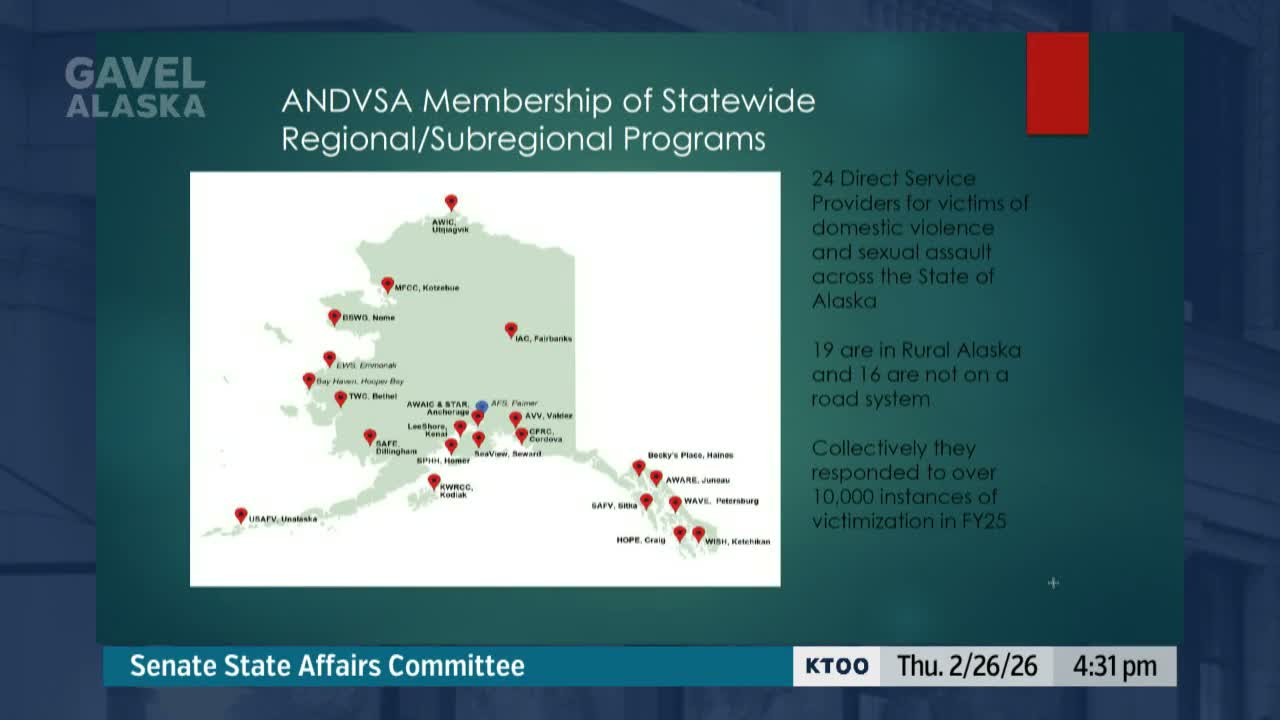
Summary
The Alaska Network on Domestic Violence and Sexual Assault told the Senate State Affairs Committee that statewide rates of violent crime and assault exceed national averages, rural programs face access barriers, and funding declines — notably in VOCA allocations — have reduced enhanced services including civil legal aid and child‑advocacy centers.
Representatives of the Alaska Network on Domestic Violence and Sexual Assault (ANSA) told the Senate State Affairs Committee on Feb. 26 that Alaska’s rates of violence and reported sexual assault exceed national averages and that service programs face persistent funding and access challenges.
ANSA Executive Director Brenda Stanfill said the network comprises 24 member programs statewide; 19 of those programs operate in rural communities and 16 are not on the road system. She said ANSA and member programs collectively responded to more than 10,000 incidents last year and cited comparative metrics presented to the Criminal Justice Data Analysis Commission that put Alaska’s violent crime rate at 5.4 times the national average, aggravated assault 6.7 times the national average, and reported sexual‑assault rates about three times the national average.
Rebecca Shields, executive director of the Kodiak Women’s Resource & Crisis Center, described Kodiak’s Community Coordinated Response (CCR) and Sexual Assault Response Team (SART) arrangements: multidisciplinary immediate responders including law enforcement, advocates and forensic medical providers, and broader community teams that include probation, the district attorney’s office and emergency‑room staff. Shields stressed advocates’ roles in accompanying victims to exams and interviews and maintaining confidentiality.
Christine Pate, ANSA’s legal services director, outlined the civil legal services gap for survivors — protective orders, custody, and spousal or child support — and said roughly 80% of domestic relations litigants are unrepresented. ANSA operates a small statewide legal program (three attorneys and two paralegals) that leverages volunteers and reduced‑rate contract attorneys; Pate said legal representation materially improves survivors’ ability to obtain safety‑focused remedies.
Stanfill and others urged renewed investment in prevention and offender‑focused interventions and asked the Legislature to consider a coordinated funding strategy. Witnesses detailed a funding history in which VOCA allocations dropped substantially (ANSA described a peak of about $9 million and a low near $1.5 million with a multi‑million dollar gap) and said some enhanced services have been defunded. They requested legislative attention to restore capacity and to study pilot programs and coordinated prevention efforts that helped reduce victimization previously.
What happens next: Advocates asked the committee to convene stakeholders, consider pilot programs and funding strategies, and follow findings from the Criminal Justice Data Analysis Commission.