Get AI Briefings, Transcripts & Alerts on Local & National Government Meetings — Forever.
Alaska committee narrows portable solar bill, adds safety limits; registration amendment fails
Loading...
Summary
The House Special Committee on Energy on Feb. 26 adopted three amendments to House Bill 257 that cap output, exempt small utilities, and require anti-islanding safety features; a measure letting utilities require pre-use registration failed on a 2–4 roll call.
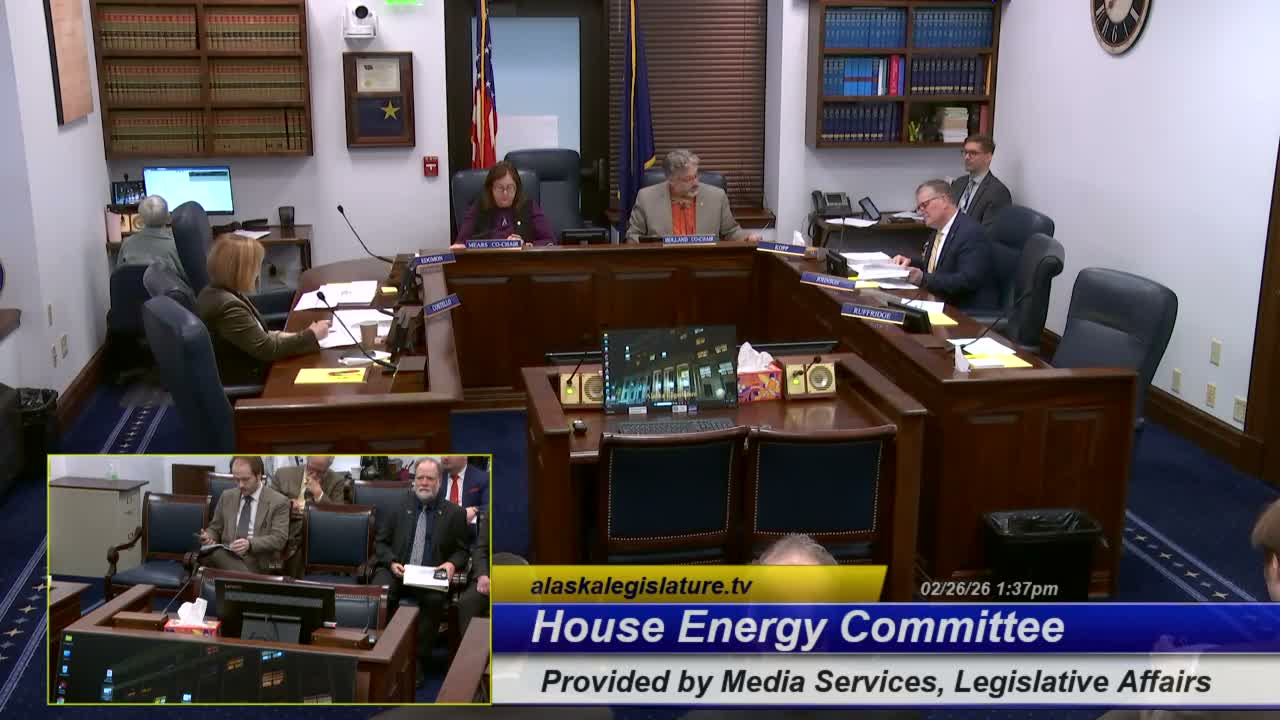
The House Special Committee on Energy on Feb. 26 amended House Bill 257, the portable solar generation devices bill, adopting three clarifying changes but rejecting a fourth amendment that would have allowed utilities to require customer registration before device use.
Cochair Colin Holland moved the first amendment to clarify the bill’s 1,200-watt limit, saying it applies to “1,200 watts individually or combined with other portable solar generation devices connected to the same electric meter.” The committee adopted that clarification without objection.
The committee then adopted an amendment exempting small utilities from the bill. Cochair Holland explained the change means the measure “would not apply to utilities that sell 5,000,000 kilowatt‑hours or less of electricity,” a threshold intended to leave off-grid and very small community systems out of the statutory exemption.
Members also approved an amendment to require that portable devices cannot energize household wiring or the local distribution system during a power outage — a so‑called anti‑islanding requirement. Holland described the safety rationale: if a circuit appears dead for repair work, an energized panel could endanger repair crews. Representative Eisheide, the bill sponsor, and his staff said the devices on the market already include automatic shutoff and that the bill requires UL certification to qualify for the interconnection/net metering exemption.
Aaron Callahan, staff to Representative Eisheide, told the committee, “In my research, I’ve not been able to find any documented cases of either back‑feed into the grid causing problems for linemen or touch safety issues on the plugs.” He also cited Germany’s experience, noting an estimated 4,000,000 residential installations historically with about 1,000,000 registrations at one point.
The committee debated a fourth amendment that would have made clear electric utilities “may require a customer to register a portable device” and could require registration before a device is used. Opponents argued a mandatory pre‑use registration could functionally become an approval and thus conflict with language in the bill that forbids utilities from requiring approval before installation or use. Ian Walsh of Legislative Legal Services advised that the amendment would create a clear registration authority separate from an approval requirement, and that adopting it would allow utilities to require registration before use; without the amendment, he said, a utility could run a voluntary registration but might not be able to prevent use without such a statutory registration requirement.
The committee held a roll call on that registration amendment. The recorded tally was 2 yeas and 4 nays, and the amendment failed. After the amendment votes the committee set HB257 aside for further consideration.
What happened next: HB257 remains amended on power limits, the small‑utility exemption and anti‑islanding language; the committee declined to give utilities explicit authority in statute to require pre‑use registration.