Alaska DPS warns victim services, crime lab and compensation board face funding squeeze after federal grant losses
Loading...
Summary
Department of Public Safety officials told a House Finance subcommittee in February that cuts to federal grants—most notably a 63% drop in VOCA—along with flat state dollars and rising costs are pinching community victim-service providers, the state crime lab and the Violent Crimes Compensation Board, prompting calls for more prevention funding and data on response costs.
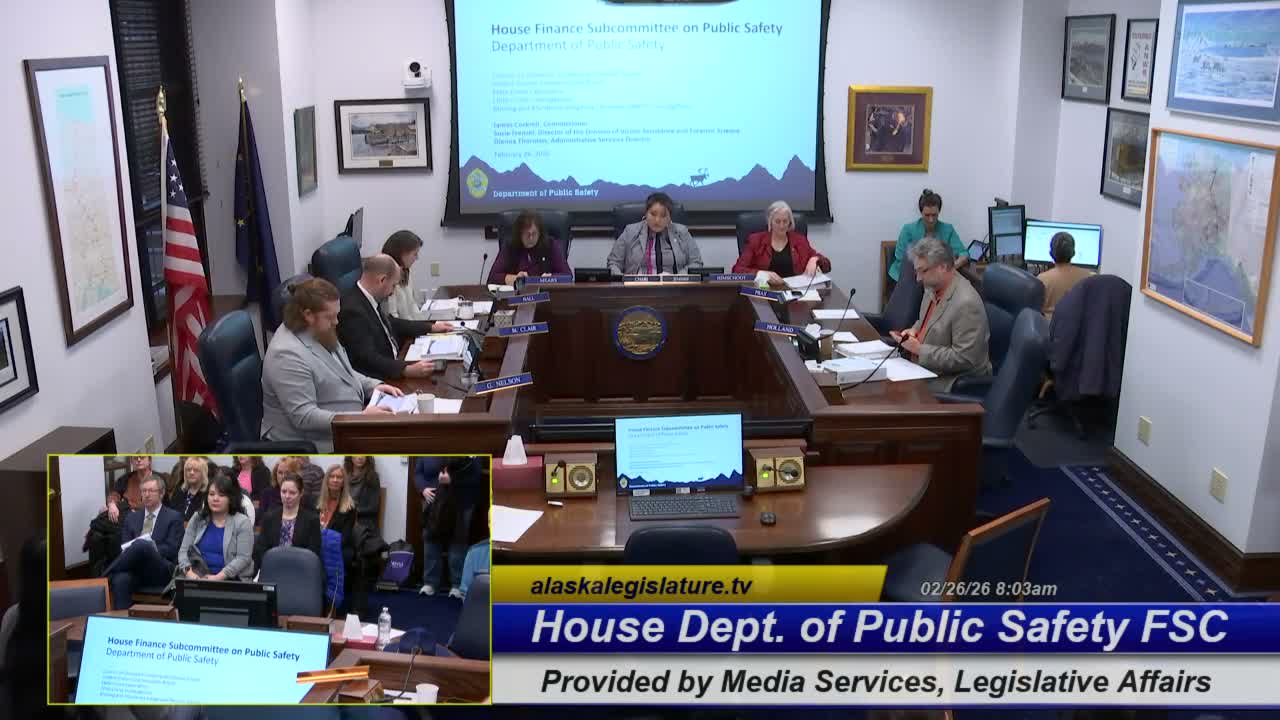
ANCHORAGE — Department of Public Safety officials and victim-service leaders told the House Finance Department of Public Safety Subcommittee in February that a string of federal grant losses and flat state funding are straining statewide services for victims of domestic violence and sexual assault, the state crime laboratory and the victim compensation program.
James Cockrell, commissioner of the Alaska Department of Public Safety, opened the department’s presentation by stressing that DPS responsibilities extend well beyond trooper patrols to victim services, forensic science and specialized investigations such as the Missing and Murdered Indigenous Persons (MMIP) unit and Alaska Bureau of Investigation child-crimes teams. “Our goal is measurable impact, stronger cases, better outcomes for victims,” Cockrell said.
The Council on Domestic Violence and Sexual Assault (CDVSA) manages grants to community partners that deliver shelter, crisis services, prevention programming, civil legal services and perpetrator rehabilitation. Marybeth Gagnon, executive director of CDVSA, told the subcommittee the council funds 37 community-based agencies and manages 87 grants that equal about $22.6 million in grant awards. She said CDVSA’s FY26 budget authority is roughly $32 million but actual annual spending is about $26.5 million, with the bulk of funds going to direct service providers.
Gagnon said prevention funding is limited: roughly $2 million of the council’s grant dollars are dedicated to prevention programs, supporting prevention work in about 14 communities and amounting to roughly $140,000 per community. She and committee members said that level is insufficient to produce large-scale, sustained change.
“The work they are doing is impactful,” Representative Hemshutt said; Gagnon responded that prevention investment must increase to disrupt cycles of violence rather than primarily funding post‑incident response.
Gagnon also told lawmakers that Victims of Crime Act (VOCA) funding to the council has fallen about 63% over the past two years — from about $7.9 million in an earlier year to roughly $3.0 million most recently — and that several one‑time federal relief grants used to backfill that loss are expiring. “Bed nights are up. Shelter nights are up,” she said, adding that program directors are covering overnight shifts and providers are struggling to pay living wages.
Victoria Shanklin, executive director of the Violent Crimes Compensation Board (VCCB), described the board’s role paying for medical needs, funeral and transport expenses, relocation and other costs not covered by insurance. She said a recent three‑year snapshot showed an average paid per application of about $4,000 and about $5,500 per crime in that sample. Asked about a roughly $592,000 reduction in the board’s budget, Shanklin said the agency is facing about a 20% cut and that any shortfall would likely lead to reduced payments until new funds arrive.
David Kanaris, chief of the Alaska Scientific Crime Detection Laboratory, outlined the lab’s workload and finances. The lab receives more than 11,000 evidence items and about 4,000 case requests annually across DNA, fingerprint, firearm and controlled‑substance analysis; roughly 100 expert witness appearances result each year. Kanaris said the lab’s general‑fund budget is a little over $9 million and it relies on about $1 million in federal grants, with DNA consumables and reagents costing roughly $870,000 per year — more than 60% of which has been federally funded. He warned the lab faces uncertainty if federal support is reduced.
Cockrell also described the MMIP unit, created about four years ago, which he said now includes four investigators and has visited more than 20 communities for follow‑up investigations and DNA collection. He described ABI pilot teams in rural hubs, saying the three‑person investigative team in Bethel keeps patrol troopers focused on patrol while providing specialized investigators for serious child‑crime and sexual‑assault cases.
Advocates who accompanied the presenters told lawmakers front‑line providers are “flat funded” and increasingly unable to pay staff living wages or meet rising demand for transitional housing and shelter nights. Brenda Stanfield, executive director of the Alaska Network on Domestic Violence and Sexual Assault, said small agencies often operate with a single staff member handling crisis work and compliance tasks and asked the legislature to examine upstream prevention strategies.
Lawmakers pressed DPS for additional data. Representative Prox asked the department to quantify the state’s total spending on responding to domestic violence and sexual assault; Cockrell offered to assemble a consolidated figure. Kanaris said the lab records the location and duration of expert testimony in its lab information management system and can provide that data to the committee.
The subcommittee scheduled a closeout meeting for March 3 at 8 a.m. to continue the discussion.