
Alaska lawmakers briefed on ANCSA, revenue‑sharing and corporate model at House Tribal Affairs hearing
Get AI-powered insights, summaries, and transcripts
Subscribe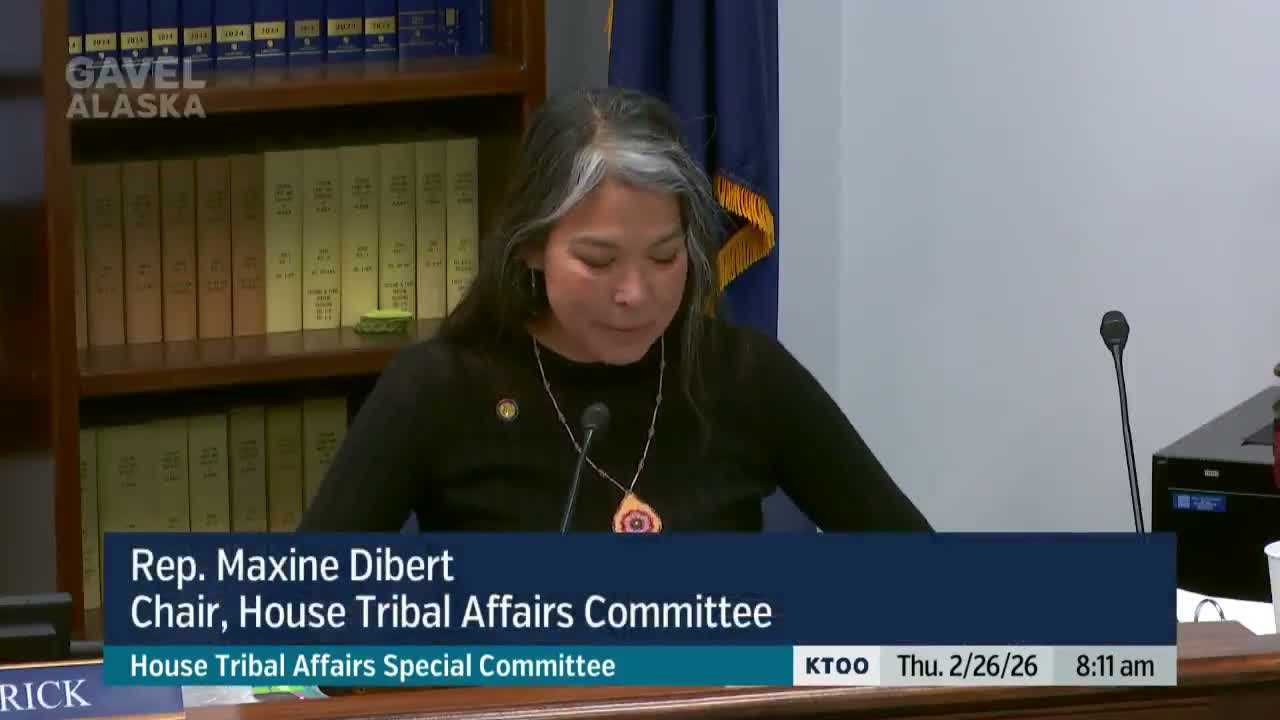
Summary
ARA president Nicole Borromeo told the House Tribal Affairs Committee Feb. 26 that ANCSA created a unique Alaska model of regional and village corporations, described how 7(i)/7(j) revenue sharing distributes resource proceeds across regions and villages, and answered lawmakers’ questions on enrollment, dividends and education.
Juneau — The House Tribal Affairs Committee received a one‑item briefing Feb. 26 from the Alaska Native Regional Association (ARA) on the Alaska Native Claims Settlement Act (ANCSA), its corporate structure and the state’s revenue‑sharing rules, including 7(i) and 7(j) distributions. ARA president Nicole Borromeo told legislators the law created a distinctive system of regional and village for‑profit corporations coupled with regional nonprofit tribal organizations and that the arrangement has shaped Alaska’s economy and governance for decades.
"It is very much unique to us here in Alaska," Borromeo said of ANCSA’s corporate model, explaining that when a region develops natural resources it keeps a portion of revenue but that a mandated sharing mechanism moves the majority into a pool for distribution across regions. "Through the act, 70% of natural resources that are developed within a region are distributed among the 12 regional corporations," she said, describing the two‑step distribution in which regional recipients pass a share on to village corporations and at‑large shareholders under 7(j).
Why it matters: ANCSA reorganized how Alaska Natives hold land and receive settlement funds, creating corporate entities that must balance profit‑making with social obligations to shareholders and communities. The system underpins employment, scholarships and local services across vast and often remote regions of the state.
Key points from the briefing
- Structure and scope: Borromeo summarized ANCSA’s outcomes — roughly 12 regional corporations and about 200 village corporations (the number varies as village entities enter or exit solvency), roughly 45 million acres retained in fee simple, and nearly $1 billion in settlement funds distributed over multiple years. The regional corporations generally hold subsurface title while village corporations hold surface title.
- Revenue sharing (7(i)/7(j)): Borromeo described the statutory revenue‑sharing framework that redistributes most resource revenues so lower‑resource regions and village corporations benefit from development elsewhere. She cited recent fiscal‑year redistributions in the low hundreds of millions and cumulative 7(i) distributions of about $4.6 billion and 7(j) distributions of about $1.9 billion since ANCSA’s passage.
- Economic and social impact: Borromeo said Alaska Native corporations drive significant statewide activity — she cited figures of roughly $6.1 billion in economic activity, nearly $2.0 billion in annual wages, and about 25,000 jobs supported either directly or indirectly. Corporations also fund scholarships, elder benefits and cultural programs; Borromeo said distributions include millions for language revitalization, elder benefits and scholarships.
- Enrollment and stock classes: Committee members asked how shares pass between generations. Borromeo described ANCSA’s stock classes (for example, permanent Class A shares and life‑estate Class C/"afterborn" stock in some regions), transfer rules and the fact that some corporations have opened enrollment for afterborns by creating new share classes.
- Education and outreach: Members asked whether ANCSA and Alaska Native history are taught statewide. Borromeo and several representatives noted existing programs (including curricula in some districts and courses at Mount Edgecumbe) and suggested the Legislature request model curricula from the Department of Education for broader review.
Questions and follow‑up: Representatives pressed for region‑level data on which corporations contribute the largest shares to 7(i)/7(j) pools and for more detail on litigation referenced in the presentation (including a recent carbon‑storage case). Borromeo said she did not have all region‑level figures at hand but offered to provide the committee with detailed numbers after the hearing and to follow up on litigation questions offline.
No formal action: The committee did not take votes or make formal motions on the presentation. Chair Divert thanked the presenters, said staff would coordinate follow‑up materials, and adjourned the hearing at 9:35 a.m.
What to watch: Committee members expressed interest in receiving the ARA’s region‑level revenue‑share data, model curricula for ANCSA/Alaska Native history in schools, and supplemental materials on litigation and specific 7(i)/7(j) contributions by corporation.