
Committee hears Student Fee Transparency Act; bill would require notice and itemized fee statements, held for revisions
Get AI-powered insights, summaries, and transcripts
Subscribe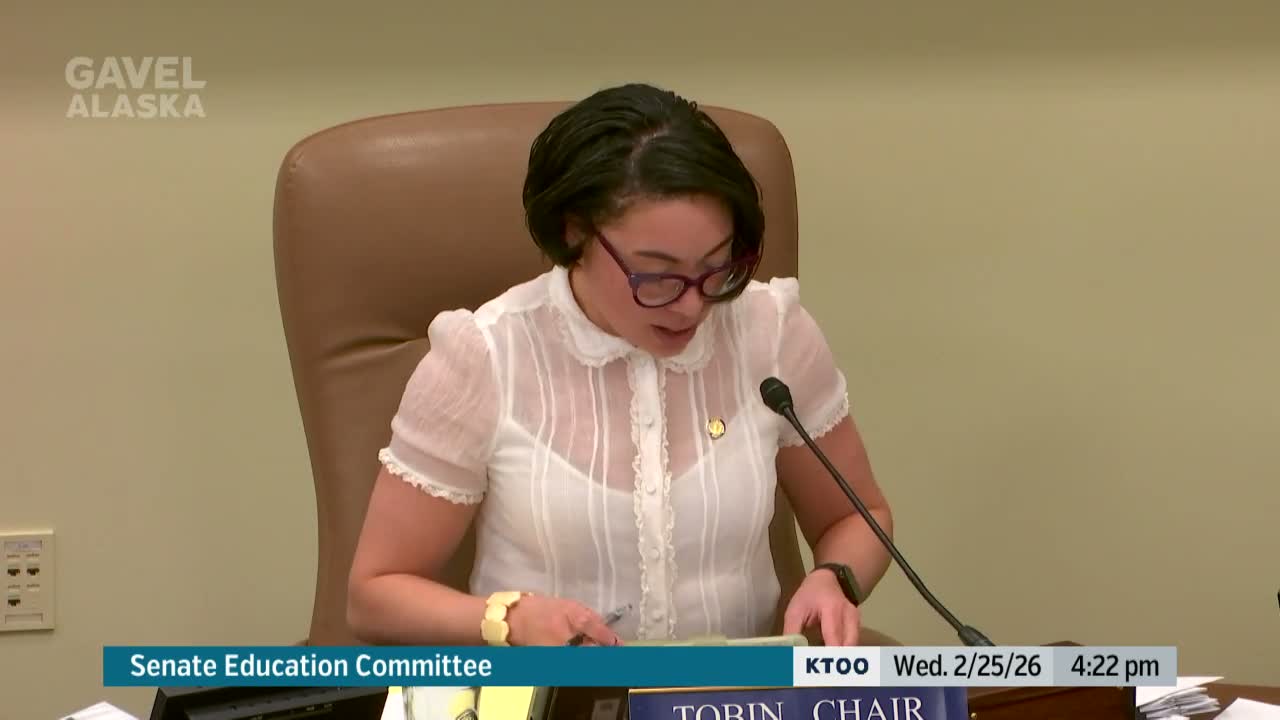
Summary
SB 157 (companion HB 176) would require the University of Alaska Board of Regents to notify students of new or increased system' or campus'wide fees and to provide itemized billing statements; the university's government relations manager presented a 0 fiscal note and both student testimony and sponsor representatives urged clearer breakdowns. The committee held the bills for further work.
Sen. Robert Myers introduced SB 157 (the Student Fee Transparency Act) at the Senate Education Committee hearing, saying the measure responds to student concerns about consolidated fees at the University of Alaska and seeks to give students clear notice and an itemized breakdown of how consolidated fee dollars are allocated.
Myers said students often receive a consolidated fee without seeing how much goes to specific campus services or student groups. "When students receive a bill, they should be able to understand what they're paying for," he said, framing the bill as a transparency measure rather than a restriction on what the university may charge.
Aaron Raybock, an intern, read the sectional analysis: Section 2 would add AS 14.40.170 requiring the Board of Regents to specify the amount of a new fee, the reason for the fee, and whether it is temporary or permanent; Section 3 would add AS 14.40.252 to require the University of Alaska to provide students itemized billing statements showing tuition and fees charged to the student. The bill sets an effective date of July 1, 2027.
Committee members raised questions about whether the university could shift costs between tuition and fees to avoid transparency and whether the requirement would create administrative burdens. Representative Ashley Kerrick (House sponsor office) and Sen. Myers said the intent is to target system'wide or campus'wide consolidated fees and not routine course or parking fees. "The point of the bill here is not to short circuit any of those negotiations or anything. It's really going to help empower the student government," Myers said, explaining the bill would make distributions transparent to campus groups.
Katie McCall, government relations manager for the University of Alaska, presented a fiscal note for HB 176 and said the university does not anticipate a fiscal impact if bill language allows communications targeted only to affected students. "We do not anticipate a fiscal impact from this legislation," McCall told the committee.
Miriam Hall, a nontraditional UAA student, provided public testimony in support and described difficulty finding a dollar'by'dollar breakdown of the consolidated fee; she said better notice and itemization would increase accountability and student participation.
After discussion, Chair Tobin said the committee will hold HB 176 and its companion SB 157 for a future meeting and asked sponsors to work with the university and the chair's office on language and targeted notification procedures.