
Committee advances bill to classify certain wearable/app health data as sensitive, sends it to judiciary
Get AI-powered insights, summaries, and transcripts
Subscribe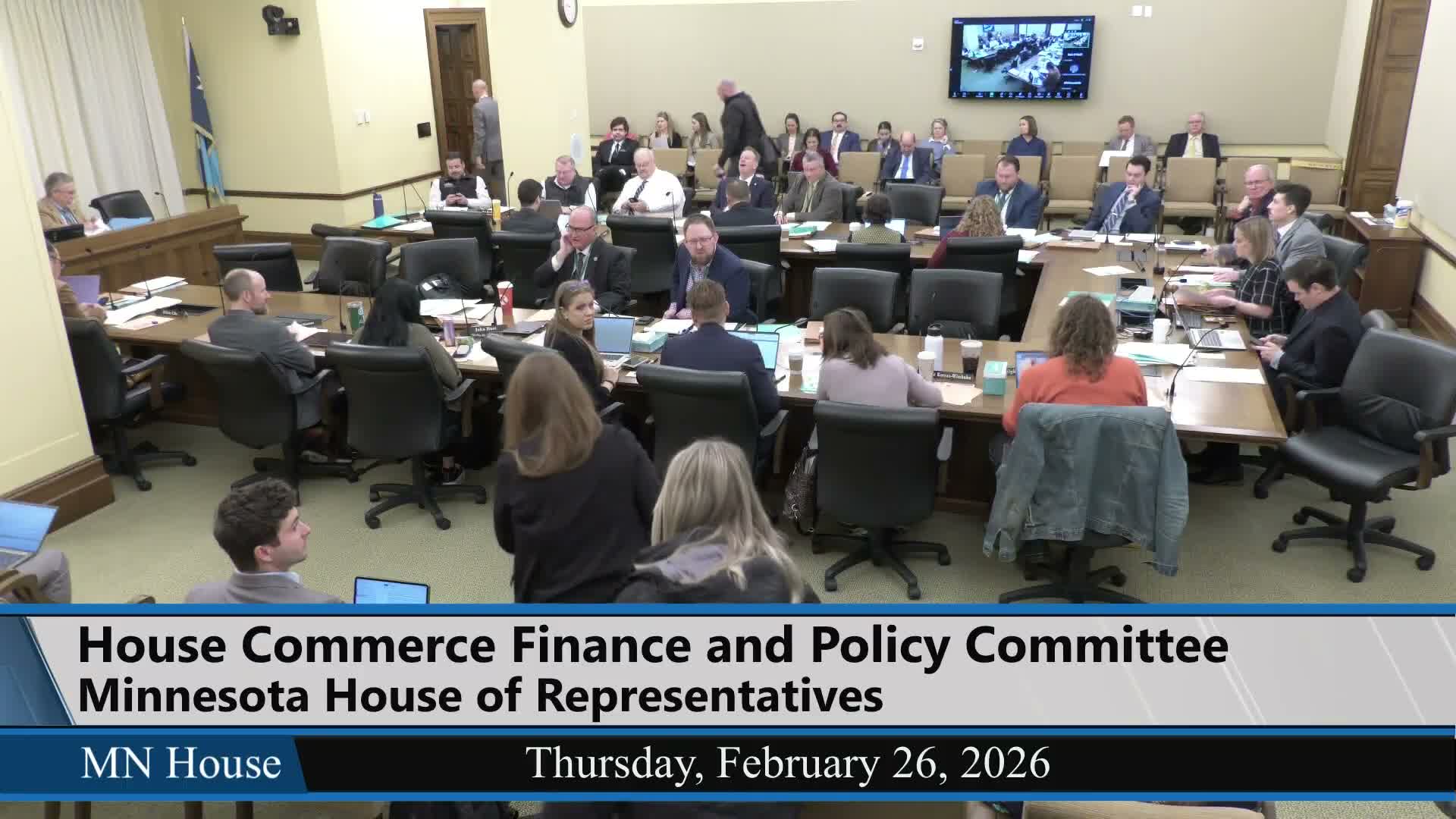
Summary
Representative Elkins' bill would categorize data from wearables and health apps as sensitive under Minnesota's privacy law and restrict geofencing and 'sharing' without prior authorization; supporters and privacy‑industry groups agreed more work is needed. The committee adopted two technical amendments and referred H.F. 2700 to Judiciary.
Representative Elkins presented House File 2700 to expand the Minnesota Consumer Data Privacy Act by designating data collected from wearables and health‑related apps as a class of sensitive data that requires prior authorization for sharing or sale. The bill also seeks to limit geofencing around health‑care locations and clarifies how 'sharing' differs from 'sale.'
Elkins said the bill closes a gap left by HIPAA, HITECH and the Minnesota Health Records Act for consumer devices and apps that collect health‑adjacent data, noting geofencing could be used to target users visiting urology or mental‑health providers. The committee considered two amendments: A1 (technical date corrections) and A4 (removing problematic language); both were adopted.
William Martinez, counsel to the State Privacy and Security Coalition, testified in support of stronger protections for health data but warned the bill mixes two different statutory approaches (Connecticut’s consumer‑health provisions and Washington’s standalone model), risks sweeping in inferred or predictive data (for example purchases that can be proxy indicators), and could create duplicate consent requirements if 'sharing' is defined separately from existing processing rules. Martinez offered to work with the author on targeted amendments.
Members discussed jurisdictional overlap and the need to refine definitions. The committee voted to refer H.F. 2700, as amended, to the Judiciary and Civil Law Committee for further consideration and drafting.
The referral preserves the bill for more detailed work on definitions and enforcement mechanisms and does not constitute final passage.