
Sen. Kelly Merrick convenes industry panel to outline 'Alaska’s Workforce Future' plan
Get AI-powered insights, summaries, and transcripts
Subscribe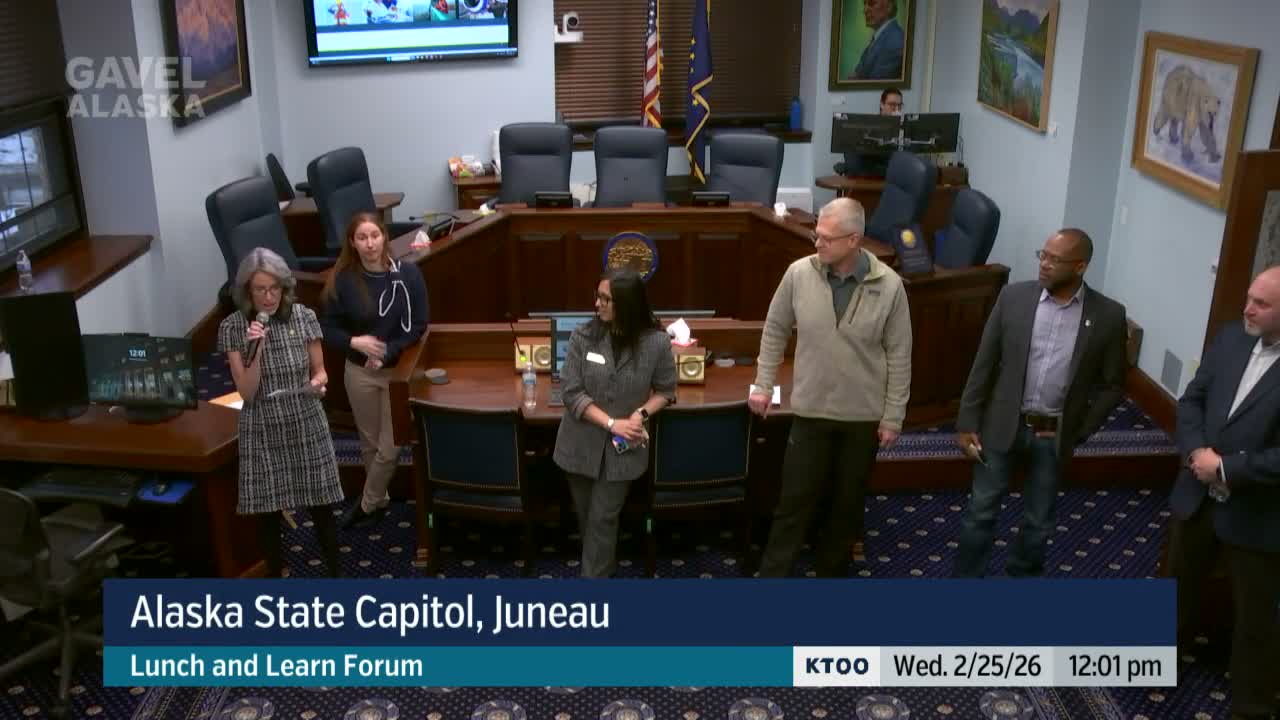
Summary
A panel convened by Sen. Kelly Merrick reviewed 'Alaska’s Workforce Future,' an industry‑led six‑strategy plan to boost career awareness, expand training (including AVTEC and apprenticeships), improve licensing reciprocity and pilot career guides aimed at keeping payroll dollars and talent in Alaska.
Sen. Kelly Merrick convened a legislative lunch‑and‑learn to review "Alaska’s Workforce Future," an industry‑led roadmap intended to strengthen recruitment, training and retention of skilled workers across the state.
The plan, described by Mari Sell, executive director of the Alaska Workforce Alliance, lays out six shared strategies to be pursued over roughly four to six years: increase career awareness; resourcing for training and career technical education; market Alaska to retain and attract workers while tapping underutilized labor pools (veterans, justice‑impacted people, immigrants and people with disabilities); foster regional workforce development; improve access to housing and support services; and sustain cross‑agency collaboration.
"We wanted it to be industry led," Sell said, adding the plan was developed with an industry advisory group, the Department of Labor and the governor's office. She said the effort relied on employer surveys, key‑informant interviews and a meta‑analysis of existing workforce plans.
Panelists from industry described the practical skills gaps and how the plan would be applied on the ground. Jose Owens of American Marine Corporation Alaska said the marine trades need captains, cooks, commercial divers, welders and pipefitters, and that most recent resumes came from outside Alaska. "I have a very high preference for Alaskans to be here," Owens said, arguing that apprenticeships and targeted high‑school pipelines can keep payroll dollars in state.
Steven Hours, health, safety and environment manager at Cruise Construction, summarized the broad skillset construction projects require — from operators and laborers to drone pilots and GIS specialists — and emphasized early outreach at career fairs and university recruiting (UAF, UAA) as part of a hiring pipeline. He noted regional hiring for rural projects such as Bethel and Noatak and said local hires help keep money in those communities.
Paloma Harbor, director of the Division of Employment and Training Services at the Department of Labor and Workforce Development, described recent program expansions. The department said it provided employment and training assistance to 1,702 Alaskans in the past year, expanded industrial electricity and plumbing programs at AVTEC in Seward, created a new industrial machine and maintenance program, launched an Office of Citizenship Assistance that served over 250 legal immigrants, and broadened electrician and plumber licensing reciprocity to 30 states while allowing up to one year of provisional licensure for comparable out‑of‑jurisdiction licensees.
A statewide career guidance coordinator leading the Rooted Initiative pilot described a strategy to place dedicated career guides in participating high schools to ensure seniors complete FAFSA and post‑secondary plans, and to coordinate regional consortiums offering 40‑hour trainings. The coordinator cited Department of Labor figures showing a decline in working‑age population since 2013, roughly 23% of workers classified as nonresidents and an estimated $3.8 billion in wages flowing out of state; they also cited a study finding about 15.2% of youth (ages 16–24) are disconnected from work or education.
In audience questions, panelists said additional business and international commerce would raise worker demand and that hiring local residents produces long‑term community benefits — quality‑of‑life improvements, retained wages and broader local capacity to staff future projects.
Sell closed by offering printed copies of the workforce plan and contact information for follow‑up. The panel did not take formal votes or adopt policy during the session; materials and mini‑reports from the plan are available online and a printed stack was offered at the back of the room.