
MDE explains 15-day enrollment drop, says funding ADM counts excused and unexcused absences
Get AI-powered insights, summaries, and transcripts
Subscribe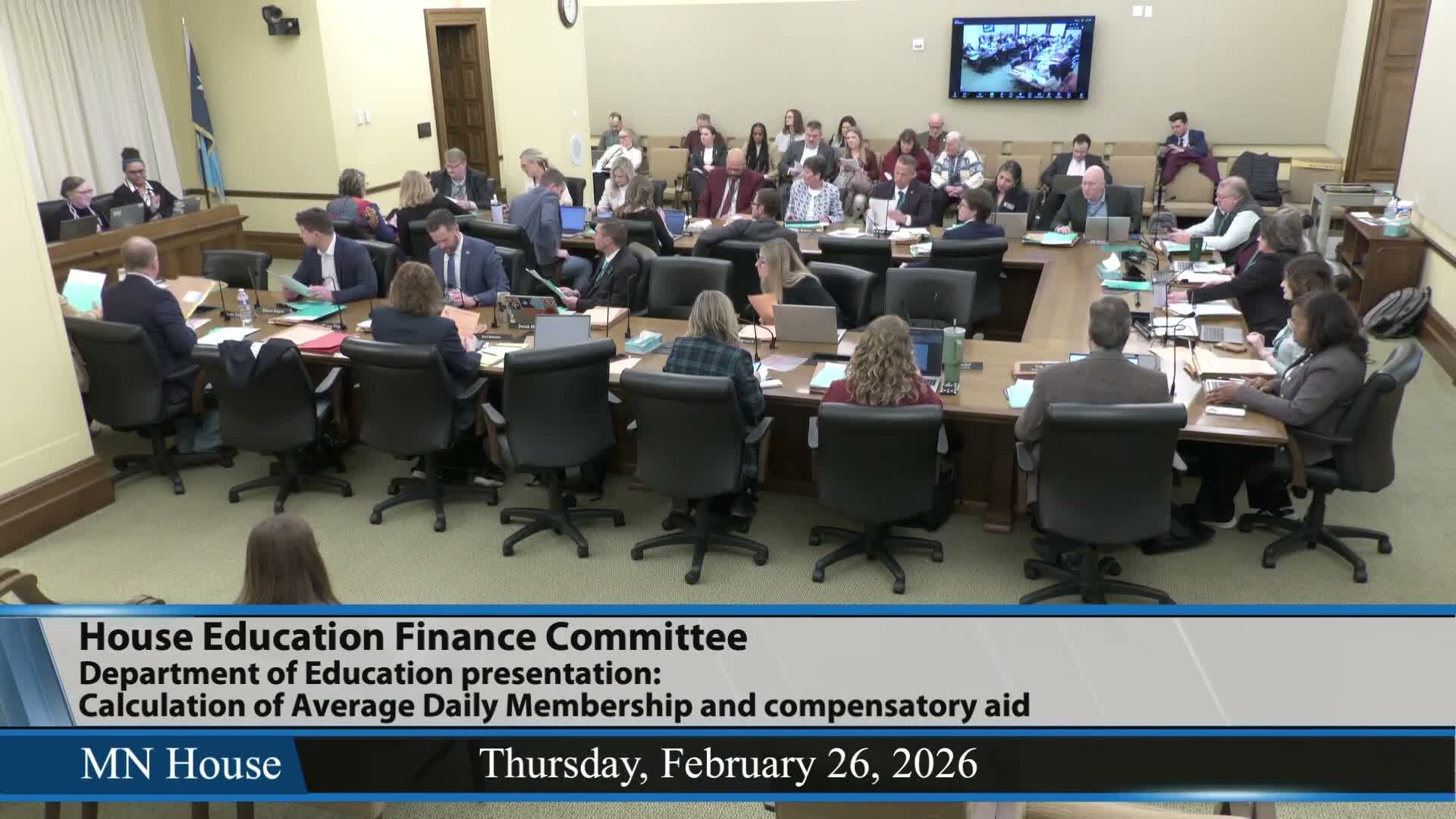
Summary
At a March 5 Education Finance Committee hearing, Minnesota Department of Education staff described how students absent 15 consecutive instructional days are removed from enrollment files and stop generating average daily membership (ADM). MDE clarified funding counts both excused and unexcused absences for the ADM drop; a separate county reporting form covers unexcused cases.
The Minnesota Department of Education told the House Education Finance Committee on March 5 that students who miss 15 consecutive instructional days are removed from a district’s enrollment file on the 16th instructional day and stop generating average daily membership (ADM), the measurement used to calculate much school funding.
"If a student stops attending December 1, they will have 15 days of enrollment even if they are not in attendance," said Kathy Erickson, director of school finance at the Minnesota Department of Education, illustrating how the sixteenth instructional day triggers an enrollment drop. Erickson used a sample calendar to show how missed days are prorated and provided an example that reduced a student’s ADM to roughly 0.74 over a typical 165-day instructional year.
Why it matters: ADM drives state funding allocations and district cash flow. Erickson said the department initially distributes aid based on districts’ pupil estimates closed in December or January and reconciles to actual ADM after the school year; MDE will perform a statewide edit of MARS enrollment files in April and begin reconciliations in August 2026.
Assistant Commissioner Angela Mansfield described a separate reporting process created by legislation passed last session. Districts must report lists of students who have been ‘‘15-day dropped’’ at the end of each term to their local welfare or county agency, which has a period to attempt contact and return the list if students cannot be reached. Those returns trigger an MDE "unaccounted-for student" form that collects student name, MARS number, last contact information and last interaction date.
MDE clarified that the two systems have different scopes. "The unaccounted-for student form recognizes unexcused absences," Mansfield said; Erickson added that the ADM funding drop is based on 15 consecutive instructional days regardless of whether absences are recorded as excused or unexcused. "Going on vacation for a month ... that enrollment file will drop," Erickson said, and noted an educational connection from the district during the gap can reset the enrollment clock.
Data and limits: MDE staff said real-time tracking is limited by current data systems. Mansfield said MDE is modernizing data infrastructure (Ed-Fi, Compass, MARS integration) but that state-level improvements may take about a year to 18 months. Preliminary counts tied to the new reporting process are incomplete: Mansfield said MDE had received 36 unaccounted-for-student reports so far (not including Hennepin County’s forthcoming submission), of which 13 were for the 2024–25 school year, and that number is expected to rise when Hennepin’s data are added. Erickson also provided historical reference counts: roughly 3,300–3,480 students in fall half-year counts and about 6,000 total in prior full-year edits as a benchmark.
What the committee asked: Members pressed MDE on whether excused absences restart the 15-day clock (Erickson: educational contact resets the enrollment file), on the mechanics of the 90/10 and year-end reconciliation payments, and on whether districts can apply for commissioner-authorized flexible‑year programs to respond to localized disruptions; MDE said inquiries have come in but could not confirm on the record whether formal applications had been filed.
What’s next: MDE said it will provide updated counts after the April statewide edit and will continue to accept district questions about estimates and reconciliation. The department recommended that districts monitor enrollment volatility and reach out to MDE if estimates look inaccurate to request an adjustment.
Minutes: The committee earlier adopted minutes from its Feb. 24 meeting; that procedural motion was moved during the opening of the hearing.