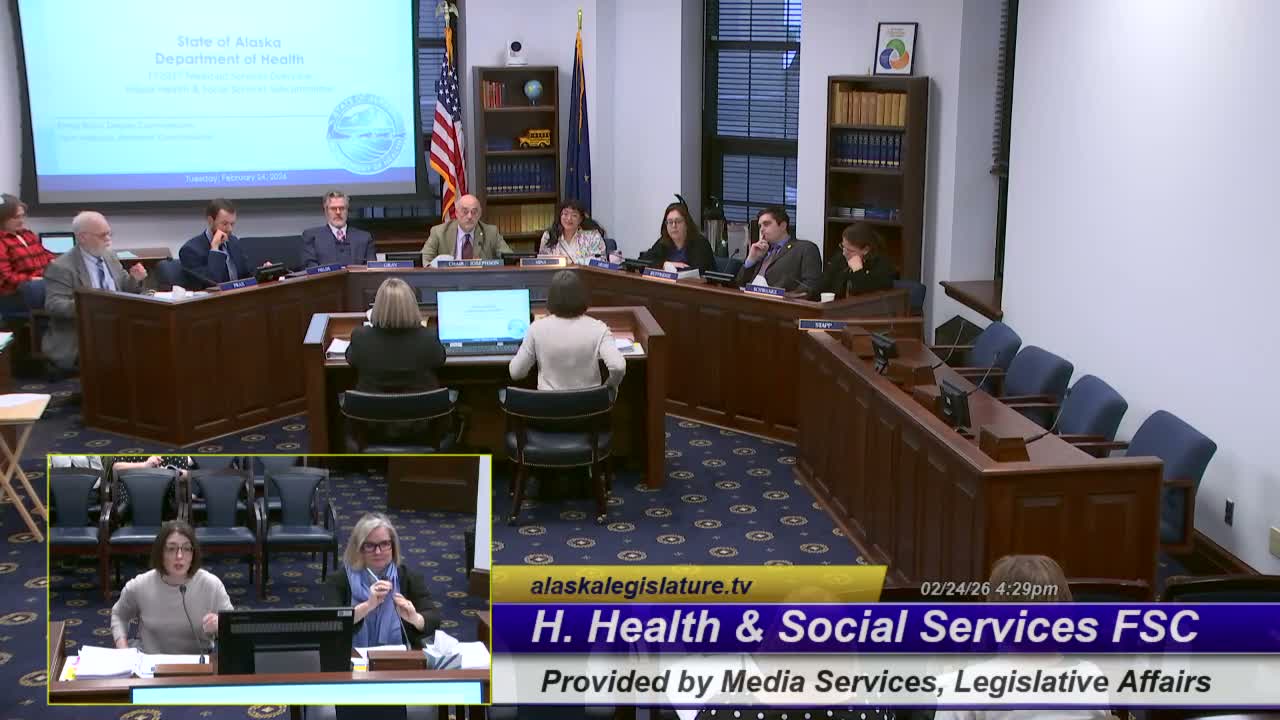
House Finance subcommittee reviews Medicaid budget, governor’s amended items including $8M contact center and $21M systems alignment
Loading...
Summary
Department of Health officials told a House Finance subcommittee that Medicaid covers about 1 in 4 Alaskans (~210,000) and presented the governor’s amended FY26–FY27 budget, highlighting a $7.99M SNAP administrative match change, $21.04M for eligibility systems maintenance, and an $8M virtual contact center request. Committee members pressed on rate rebasing, 1115 waiver cost‑neutrality and timing for legislative engagement.
Juneau — Deputy Commissioner Emily Ritchie and Assistant Commissioner Pam Halloran briefed the House Finance Department of Health Subcommittee on Feb. 24 on Medicaid spending drivers and the governor’s amended FY26–FY27 budget. Ritchie said Medicaid covers "1 in 4 Alaskans or just over 210,000 Alaskans," and told members the program averaged about $59,000,000 in weekly claims in fiscal 2025.
Why it matters: Lawmakers must reconcile projected federal match changes, a one‑time extra weekly claims payment in FY26, and several general‑fund items in the governor’s amendment as they prepare BA reports and possible amendments before the March 3 subcommittee closeout.
Budget totals and drivers The department reported the Medicaid services budget with the supplemental at roughly $3.49 billion. Ritchie identified two timing and match drivers that complicate year‑to‑year comparisons: a 53rd weekly claims payment at the end of FY26 that the department estimates at about $63.7 million (adding roughly $14.4 million in general fund pressure for FY26), and a recalculated FMAP (federal medical assistance percentage) that reduces the federal match by about 1.05%, adding about $10.8 million in general fund pressure for FY27.
Ritchie also explained utilization trends: following eligibility redetermination work in 2023–24, the state saw a decline in total enrollees but a smaller proportional decline in recipients, with the remaining population showing higher acuity and per‑recipient costs. "We're spending about $1,000 more per recipient on average than we were in 2012," she said, and noted roughly 10% of recipients account for about two‑thirds of total spending.
Governor’s amended general‑fund items highlighted - SNAP administrative claiming: Halloran described a $7,990,000 general‑fund increase to assume an increased state share for SNAP administrative costs for three quarters after an Oct. 1, 2026 policy shift that moves the state share from 50% to 75% and the federal share from 50% to 25%. The department said this change affects administrative costs only, not SNAP benefit payments.
- Eligibility systems operations: The division reported a $21,040,000 increase to align the budget with rising licensing and vendor support fees associated with moving eligibility systems from implementation to maintenance and operations. Division Director Deb Etheridge said the committee requested a breakdown of capital and prior expenditures, and the department will provide that detail.
- Virtual contact center: Halloran detailed an $8,000,000 contract request ($3,700,000 general fund, $4,300,000 federal) to maintain a virtual contact center that supports telephonic application intake, interview scheduling, document processing and escalation management for eligibility work. Halloran said the contract was necessary to meet federal and state timelines for processing eligibility and to avoid benefit disruptions. "Without a virtual contact center, we would not have been able to serve Alaskans in any timely manner," she said.
Rate‑setting, rebasing and 1115 waiver oversight Members queried timing for rate rebalancing and rebasing across behavioral health, long‑term care, federally qualified health centers (FQHCs) and medical transport. Ritchie said Guidehouse’s recent study focused on behavioral health and long‑term care and that regulatory rebasing is a state process typically occurring every four to five years. She added some behavioral health regulation changes were out for public comment and that legislative engagement will be needed for other rate‑setting changes.
On 1115 (section 1115) demonstration waivers, Ritchie described the federal cost‑neutrality requirement: "The cost neutrality requirement for section 1115 demonstration waivers is that the cost would not be higher than they otherwise would be if the services were not covered." She said the department tracks outcomes and budget neutrality through required reporting to the Centers for Medicare and Medicaid Services (CMS).
Next steps and procedure Chair Josephson told members draft budget action (BA) reports will be distributed on Friday, Feb. 27, with the chair’s recommendations; amendments are due by noon on Monday, March 2. The subcommittee intends to adopt the updated report and vote on amendments on March 3. The meeting adjourned at 5:15 p.m.
Speakers and sourcing Quotes and figures in this report come from the Department of Health presentation and exchange on Feb. 24 before the House Finance Department of Health Subcommittee (Deputy Commissioner Emily Ritchie; Assistant Commissioner Pam Halloran; Division Director Deb Etheridge; Chair Josephson; and multiple representatives). When the department committed to providing additional breakdowns (eligibility system capital costs and annual licensing fees), it said it would deliver those details to the committee for follow‑up review.
What to watch for next Committee members asked for a detailed capital/expenditure breakdown for eligibility systems and for timeline estimates and regulatory materials on any proposed rebasing or rebalancing. Draft BA reports will show the chair’s recommendations; members may file amendments ahead of the March 3 adoption and vote.