State outlines Alaska Reads Act early-learning pathways, standards and participation data
Get AI-powered insights, summaries, and transcripts
SubscribeSummary
Department presenters summarized the Alaska Reads Act’s early education program standards, grant pathways and the 0.5 ADM formula; 58% of districts participate in one of three pathways and 1,711 students statewide are in state-supported preschools, with the department seeking better disaggregated data.
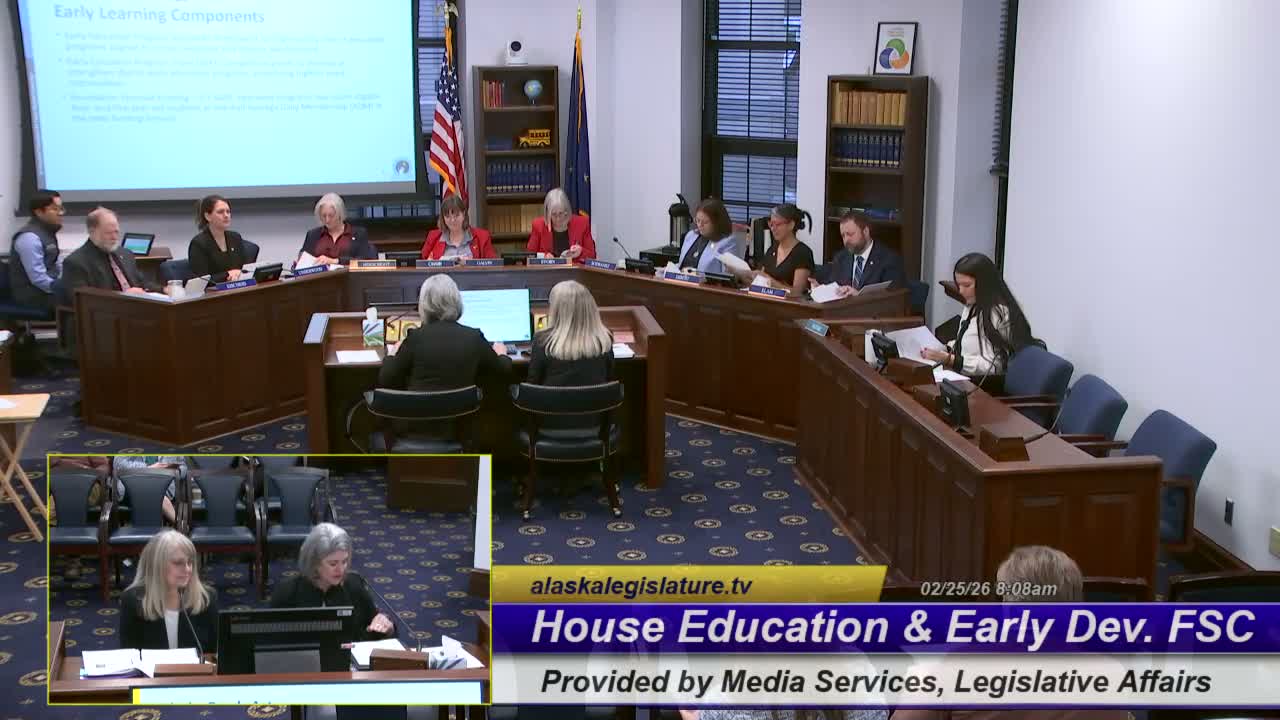
At a Feb. 25 House Finance education subcommittee briefing, Alaska Department of Education and Early Development staff described the early-learning components of the Alaska Reads Act, the criteria districts must meet for counting preschool students in the foundation formula, and recent changes to program standards.
Dr. Monica Goyette said the early education program standards provide the quality framework districts must meet to qualify for 0.5 ADM counting; standards require an evidence-based curriculum aligned to early literacy, certified teacher oversight, formative assessment, family engagement and culturally responsive practices. Goyette told the committee the standards were adopted in 2022, effective April 2023, and revised in 2025 after feedback and passage of House Bill 148, which removed a line requiring standards to meet Head Start performance standards.
Riddle and Goyette explained three state-supported preschool pathways: the competitive three-year Early Education Program (EEP) grant to help districts meet rigorous standards; 0.5 ADM formula funding for eligible 4- and 5-year-olds meeting standards and holding required teacher credentials; and the pre-elementary grant (PEG), a separate three-year program predating the Reads Act that supports 3–5-year-old programs and offers more pedagogical flexibility. The department noted PEG is funded by annual legislative appropriation and not technically part of the Reads Act.
On participation and outcomes, the department reported that 58% of districts participate in at least one of the three preschool pathways and that 1,711 students statewide participate in state-supported early-learning programs. Teaching Strategies GOLD literacy measures showed fall-to-spring gains (fall nonmeeting 46% down to 15% in spring), and the department said it is working with vendors to tag students who participated in state-funded preschools so future presentations can disaggregate results and better measure program efficacy and return on investment.
Department staff told the committee that the parent-focused Parents as Teachers program (a birth-to-5 partnership administered through the Department of Health with funds passed through the department) receives roughly $474,000 annually.
The department said it will open applications this spring for FY27 grant cycles and provide follow-up data when possible. Committee members requested more school- and site-level disaggregation of outcomes to evaluate effectiveness.