
Statutory cap forces department to pare early-learning awards; several districts lost funding
Get AI-powered insights, summaries, and transcripts
Subscribe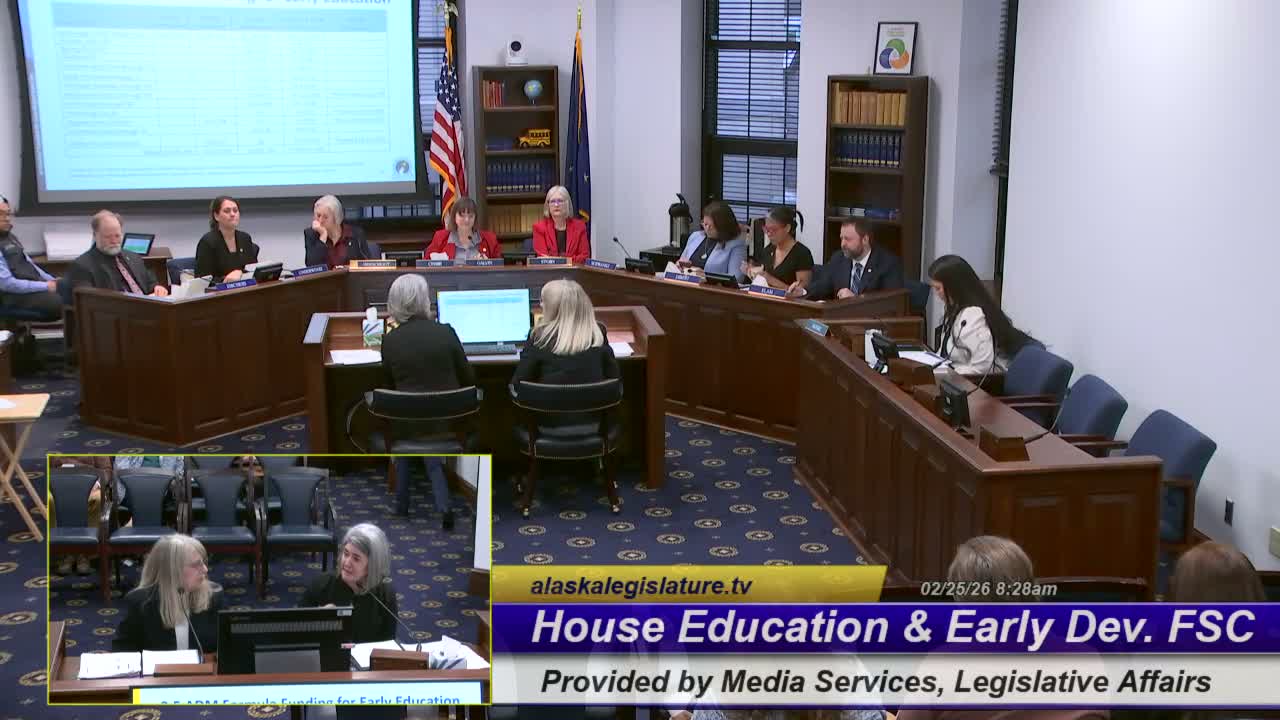
Summary
The Department of Education said a statutory cap on 0.5 ADM early-learning funding for FY26 forced prioritization by need, reducing or eliminating awards for several districts (Mat-Su, Petersburg, Skagway, Valdez); the department acknowledged it failed to communicate the cap clearly and is exploring remedies.
The Alaska Department of Education and Early Development told the House Finance education subcommittee on Feb. 25 that a statutory cap on 0.5 ADM early-learning funding for fiscal year 2026 required the department to prioritize awards by need and that several districts consequently saw funding reduced or removed.
Dr. Monica Goyette, the department’s Division Director of Innovation and Education, said FY26 was the first year that available ADM funding exceeded the statutory cap and that the department used the school accountability index score—ranking from lowest to highest—to distribute limited funds. "This is a challenge and something that we did not do a good job communicating the statutory cap to our districts," Goyette said.
Department staff gave examples of specific reductions. Deborah Riddle, Division Operations Manager, said Mat-Su (listed in department materials as "Matt Sue School District") had 298 students in its program and was reduced by $323,765; Petersburg was reduced by $5,408 for one student; Skagway lost $14,553 for nine students; and Valdez lost $51,473 for 42 students. Riddle also said three districts received no ADM funds under the FY26 prioritization (a total of 52 students across those three districts) and that Mat-Su’s reduction represented roughly one-third of its program (about 152 students) after recalculation.
Committee members pressed the department on communication and remedies. Lawmakers said districts received notices that suggested they qualified for funding, then later learned awards were curtailed after ADM calculations and application of the cap. "Looks like you're going to get some money... but then when we did the calculation... there was a difference in time," Riddle said, acknowledging the department’s messaging shortcomings.
Goyette and Riddle told the committee some districts braid other revenue streams—including Title I and other grants—to continue preschool services despite reduced state ADM support. Goyette said the department would convey legislators’ concerns to the commissioner and explore options to "make these districts whole," though she did not commit to a specific funding patch. Committee members asked the department to brief the legislature on possible fixes and to provide clearer, earlier notices to districts in future funding cycles.
Next steps: the department said it will provide follow-up information on communications and potential internal reallocation options; no formal vote or statutory change occurred during the Feb. 25 subcommittee session.