Lifetime Citizen Portal Access — AI Briefings, Alerts & Unlimited Follows
Alaska trucking groups tell Senate panel state oversight limits fraudulent CDL risk
Loading...
Summary
Industry representatives told the Senate Transportation Committee that Alaska'specific authorization and audits for training providers and examiners have kept fraudulent commercial driver's licenses from becoming a major problem in the state, while warning of workforce shortfalls for large upcoming projects and noting training costs and medical/testing requirements.
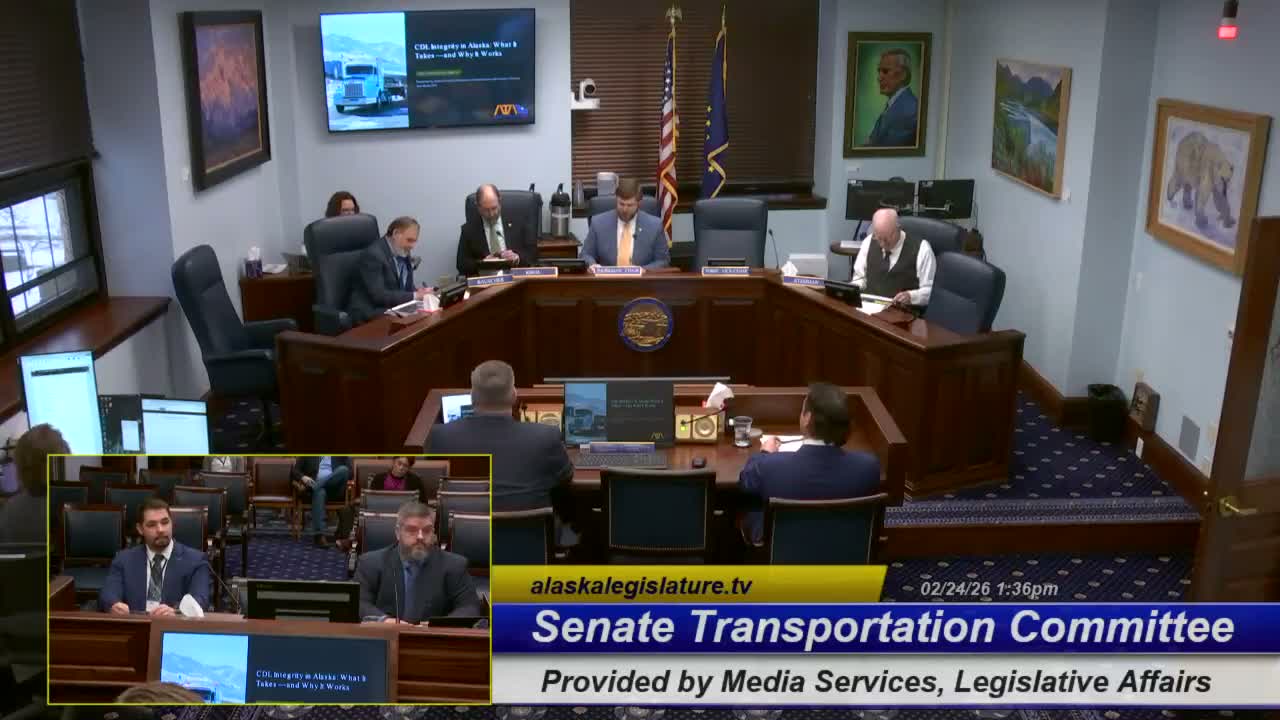
Alaska Trucking Association representatives told the Senate Transportation Committee on Feb. 24 that state-level oversight of commercial driver training and testing has helped prevent the spread of fraudulent commercial driver's licenses (CDLs) seen in parts of the Lower 48.
"We have seen fraudulent CDLs granted," said Joey Crum, president and CEO of Northern Industrial Training, describing national concerns about training-provider self'attestation and inconsistent enforcement. Crum told the committee the Federal Motor Carrier Safety Administration (FMCSA) removed nearly 6,900 training providers from its Training Provider Registry (TPR) in 2025 and that some reports say tens of thousands of CDLs nationwide were invalidated as part of federal actions.
Crum and Randy Eford, vice president of strategic relations and labor affairs at Weaver Brothers Trucking, said Alaska has added layers of state authorization and ongoing compliance that reduce the risk that a training provider listed on the federal TPR can operate here without state documentation. "Alaska's system is robust," Crum said, describing requirements that a provider demonstrate financial viability, bonding and insurance, approved road-exam routes, examiner qualifications, background checks and periodic audits.
Why it matters: federal TPR listings can be created by self'attestation before federal audit, Crum said; Alaska requires state DMV and related agency sign-offs, which the industry credited with helping catch gaps other jurisdictions missed. Committee members pressed for specifics about prevalence, and Crum said the problem appears concentrated in some regions of the Lower 48 but is not "a prevalent problem" in Alaska.
Committee members asked how the CDL system addresses training standards and workforce needs. Crum described the three-step path of entry'level driver training (ELDT), the road exam and state issuance, saying lapses can occur at any step. Eford and Crum emphasized that many specialized skills (coupling/uncoupling trailers, cargo securement, snow/ice chains, long-combination vehicle operation) are typically taught by employers after school. Eford described Weaver Brothers'on-the-job training of four to six weeks with in-truck trainers and spot checks.
On capacity and cost: Crum said Alaska's CDL schools were not at full capacity at the time of the committee's survey but acknowledged the state will need to import drivers for very large projects. He gave 2025 Alaska issuance totals as roughly 4,914 Class A CDLs, 1,622 Class B and 103 Class C. On training cost, Crum said a market survey showed a Class A program in Alaska "can range anywhere from typically $7,000 to 12 to 13," varying by program length and additional training offered.
Medical and testing requirements: Crum told senators a valid CDL requires a Department of Transportation physical—generally valid for up to two years depending on the provider's findings—and that employers keep driver qualification files that include five'panel drug testing, which currently screens for marijuana.
The committee did not take action. Chair Senator Bjorkman thanked the presenters and said the committee will reconvene Thursday to hear Senate Bill 239 on motor vehicle registration and House Bill 26 on the statewide public and community transit plan.