
Alaska committee hears bill to codify Purple Star Schools, tighten implementation of military‑student compact
Get AI-powered insights, summaries, and transcripts
Subscribe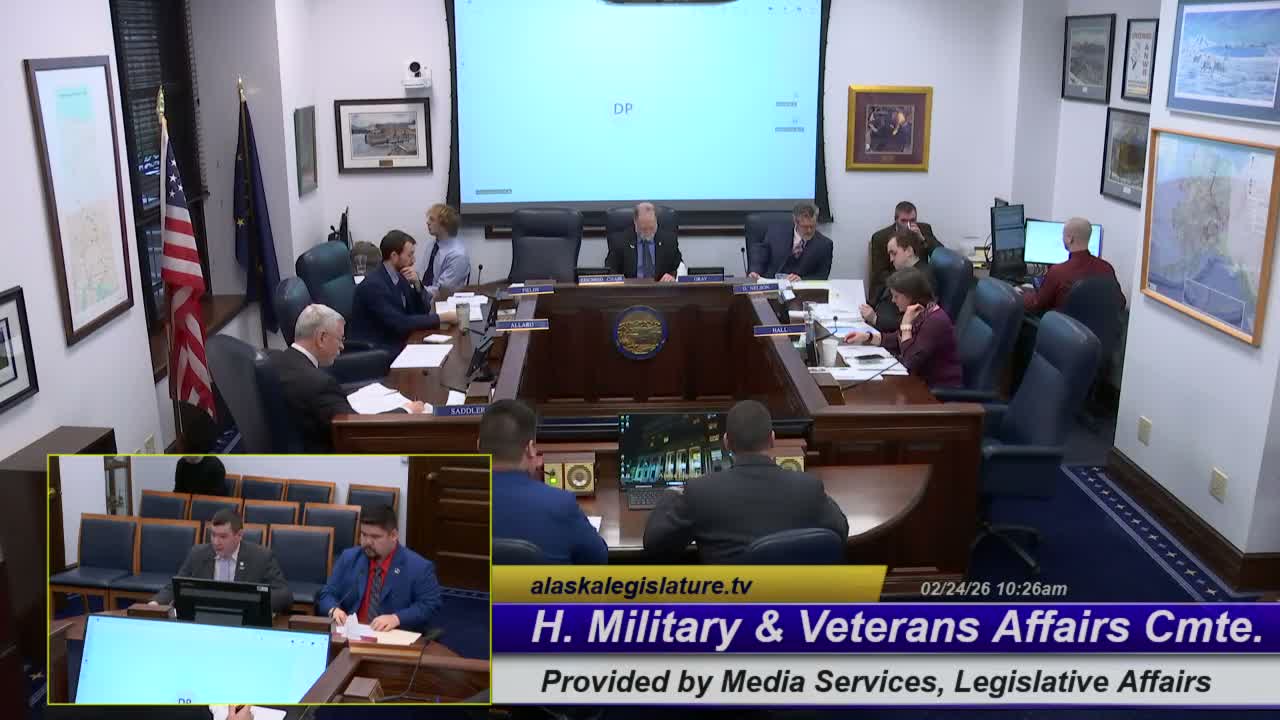
Summary
Lawmakers heard testimony on HB256, which would embed the Military Interstate Children’s Compact (MIC3) duties into state law, create a statutory Purple Star School program and coordinator, require timely IEP/504 accommodations, and apply a 1.75 funding factor; witnesses warned of implementation gaps and a large potential fiscal cost (~$928M).
Representative Will Staff introduced House Bill 256 on Feb. 24 before the House Special Committee on Military and Veteran Affairs in Capitol Room 124. The bill would update Alaska’s implementation of the Military Interstate Children’s Compact (MIC3), codify the Purple Star School program in statute, create a dedicated military‑children coordinator, and add a Purple Star funding factor to the state foundation formula with an effective date of July 1, 2026.
Supporters told the committee the bill is designed to reduce disruptions for military‑connected students by speeding records transfers, ensuring comparable accommodations for students with IEPs and 504 plans, and clarifying the state council’s duties under MIC3. "Section 4 encourages a fix" for delayed IEP implementation, Department witness Tammy Perreault said, noting national guidance that encourages smoother transitions for highly mobile students.
The bill’s statutory mechanics would amend multiple school‑funding provisions (including AS 14.17.410(b), AS 14.17.420(a) and AS 14.17.440(a)) to add a Purple Star funding factor. Committee staff described the factor as 1.75 and said staff had discussed an eligibility threshold of 75% of a district’s schools being designated Purple Star to qualify the district for the multiplier; the bill text and staff testimony tie the multiplier to the district’s ADM (average daily membership) calculation and state that the Purple Star factor would be applied after existing size, district cost, special‑needs and vocational factors.
Fort Wainwright School Liaison Officer Janet Farris said Alaska’s MIC3 implementation suffers from frequent turnover in the state commissioner role and inconsistent compliance with compact obligations. "We have only met the compliance two years of my six years as school liaison officer," Farris said, and she urged statutory clarification and dedicated staff to stabilize implementation and ensure required annual reporting.
Eielson Air Force Base liaison Ernest Kinkade described outreach to schools and the Purple Star emblem’s role in signaling that a school has trained personnel and resources for military families: "When they see that emblem, they know that the school is already trained." Kinkade and other witnesses also told the committee that, in most districts, Purple Star activities have been sustained with volunteer time and donations rather than dedicated funding.
Committee members focused on two practical questions: the existing baseline of policies supporting military children (witnesses cited MIC3, advance enrollment and special‑education protections) and the bill’s fiscal implications. Committee staff reported Department of Education estimates that if every school district applied and all qualifying districts received the factor the statewide cost could be about $928,000,000; Mount Edgecumbe separately submitted an additional estimated fiscal impact of $3,600,000. Staff said discussions with the Department of Education (DEED) were ongoing and that alternatives — such as targeted grants rather than a foundation‑formula multiplier — were under consideration.
Representative Sadler and others asked how the additional funds would be targeted once they flow to districts. Staff emphasized that the funding factor would increase a district’s ADM‑based allocation, which districts would then distribute according to their own budget priorities; Sadler said she wants to ensure any new money is spent on the intended supports for military and special‑needs students.
The committee did not vote on HB256; the sponsor and witnesses were thanked and the bill was set aside. The committee announced a follow‑up meeting for Feb. 26 to hear HB299. The hearing record shows the bill’s supporters and DEED staff will continue discussions about fiscal design and implementation details before further committee action.