
Lawmakers and Fish and Game debate use of Dingell‑Johnson and Pittman‑Robertson funds for hatcheries, invasive species
Get AI-powered insights, summaries, and transcripts
Sign Up Free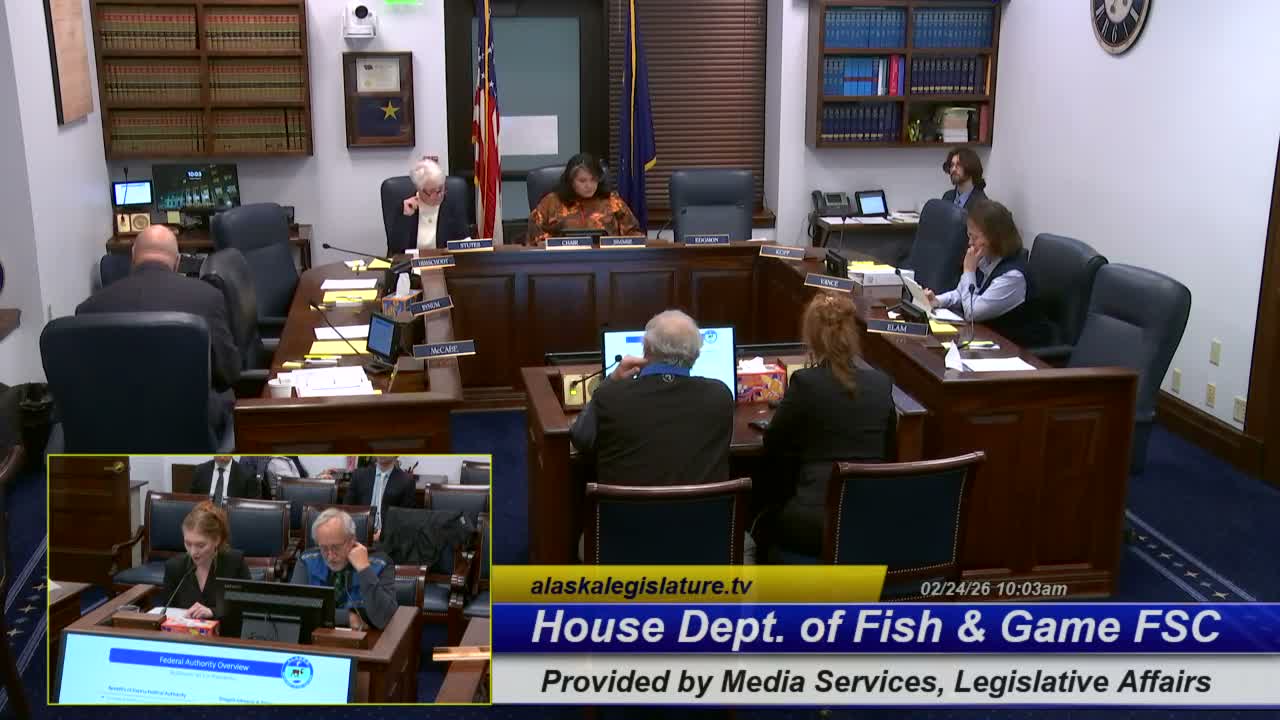
Summary
Department officials told the Fish and Game subcommittee that Dingell‑Johnson and Pittman‑Robertson funds are constrained by federal-purpose rules and a 15% boating‑access set‑aside; members pressed whether those funds can be used for invasive species management, hatchery maintenance, and infrastructure such as fish‑cleaning stations.
Juneau — Alaska Department of Fish and Game officials described to the House Finance Committee’s Fish and Game Subcommittee on Feb. 1 how Dingell‑Johnson (Sport Fish Restoration) and Pittman‑Robertson funds are apportioned and the limits on their use for hatcheries, invasive species control and boating‑access projects.
"These awards do not have a match requirement" and "access authority helps prevent any reversion of federal funds," Administrative Services Director Bonnie Jensen told the committee while describing the department's roughly 130 federal awards. Jensen said the Sport Fish Restoration (Dingell‑Johnson) apportionments have ranged between about $17 million and $23 million since FY2017 and that the department has used DJ authority to absorb salary increases and other operating needs.
Committee members pressed whether DJ or PR funds could be applied to invasive species such as green crab or pike. Commissioner Doug Vincent Lang said such funds can be used only where there is a clear benefit to sport fish or hunted species and that eligibility requires a nexus to sport-fishing or hunting purposes.
"We'd have to look at that project to make sure there's a nexus back into sport fish management," Lang said, describing the federal program constraints.
Members also asked about hatchery funding history. Jensen said that, beginning in FY23, the legislature separated Anchorage/Fairbanks and Southeast hatcheries into distinct results delivery units; that legislative change reduced the federal authority previously attached to hatcheries and the department instead used general funds and DJ authority where needed to pay maintenance and operations. She added that construction of hatcheries had been funded with bonds repaid by a fishing‑license surcharge that sunset after the bonds were paid, and that the remaining construction-match balance functions as nonfederal match on paper rather than cash the department can directly spend.
Lang and Jensen reminded the committee the federal Sport Fish Restoration law requires 15% of apportionments to be used for boating access projects, and that the department typically funds that match through the Fish and Game Fund and places multi-year boating access projects in the capital budget.
The subcommittee did not adopt any bill or motion during the hearing and asked department staff for additional breakdowns on how specific DJ and PR dollars are allocated across program categories.