Get Full Government Meeting Transcripts, Videos, & Alerts Forever!
Get email alerts on the Alcohol Local Option topic
No spam. Unsubscribe anytime.
Bill would let Alaska towns run municipal liquor stores without owning restaurant and bar licenses
Summary
HB155 would add a new local-option that allows a municipality to operate a municipal liquor (package) store while leaving restaurant and bar licenses in private hands; sponsor Rep. Foster's staff cited Kotzebue as an example where current law blocks a private restaurant because the city holds the package-store license.
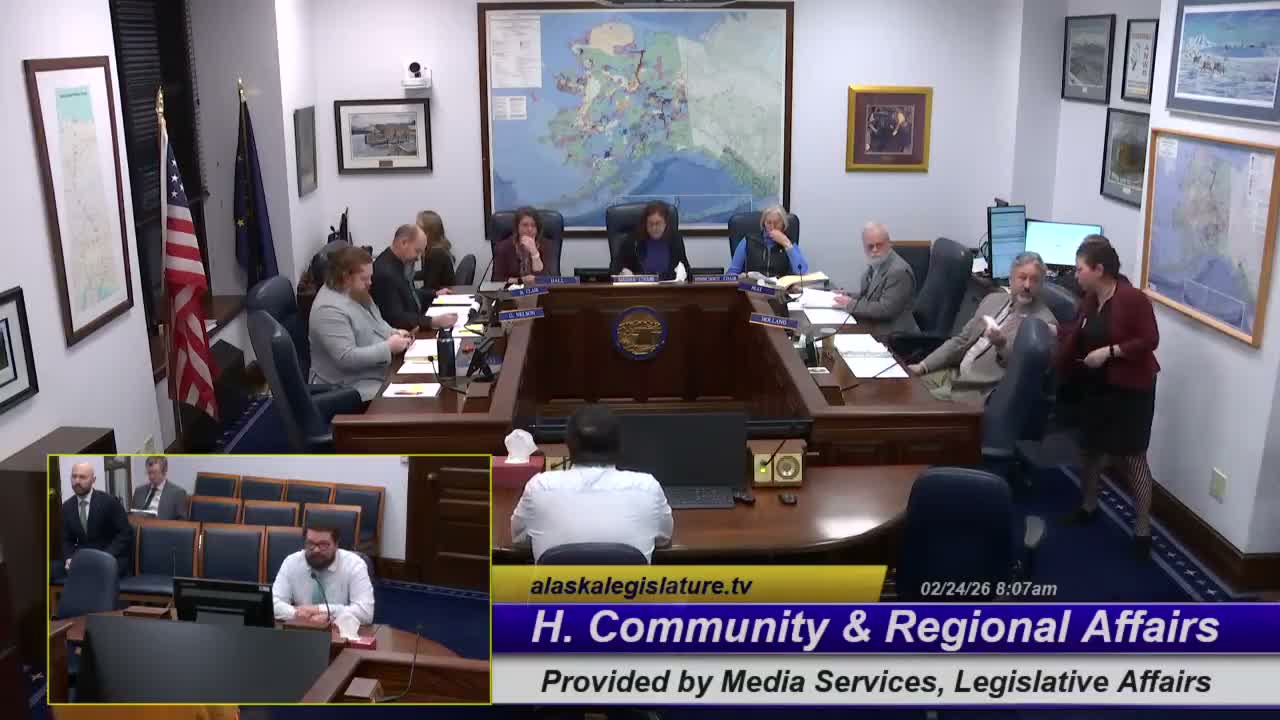
A bill introduced to the House Community and Regional Affairs Committee on Feb. 24 would give Alaska communities a new local option for alcohol licensing, allowing a municipality to operate a municipally run liquor store without being required to hold restaurant and bar licenses.
Paula Bole, chief of staff to Rep. Neal Foster (the bill sponsor), told the committee that "HB155 creates a new local option for alcohol." She explained that current Alaska law offers a range of community options — from dry to wet — and that one existing local option requires a municipality that runs a liquor license to hold all on-sale and off-sale licenses. "This creates a new local option where you can run the liquor store by the city while leaving the remaining restaurant and bar licenses to the private sector," Bole said.
Committee members asked for clarification about terminology and scope. Rep. Carolyn Hall asked whether the proposal effectively creates an "enhanced option in damp communities." Bole explained that, technically, "damp is where sales are not allowed, but importation is allowed," and that the new option does not yet have a commonly used nickname.
Bole cited Kotzebue as an example of why the change is being proposed: the city currently runs a municipally owned package store but was prevented, under the existing interpretation of law, from allowing a private operator to open a bar-and-grill because the municipality would have had to own the restaurant license as well.
Committee members asked how many communities the change might affect. Bole said she did not have an estimate and suggested the Alcohol and Marijuana Control Office could provide numbers; she also noted that any community could adopt the option by local election if the statute were changed.
Kevin Richard of the Alcohol and Marijuana Control Office told the committee he did not have the historical statutory rationale immediately available and offered to prepare a memo with background for the committee.
The committee did not take formal action on HB155 on Feb. 24 and set the bill aside for a later date to allow staff to gather technical information.
The committee's next procedural step will be a follow-up hearing after staff and the Alcohol and Marijuana Control Office provide background and community-impact information.