Get Full Government Meeting Transcripts, Videos, & Alerts Forever!
Get email alerts on the Transportation Contracting topic
No spam. Unsubscribe anytime.
Heated testimony as committee examines design-build-maintain bills; industry warns of higher costs and limited competition
Summary
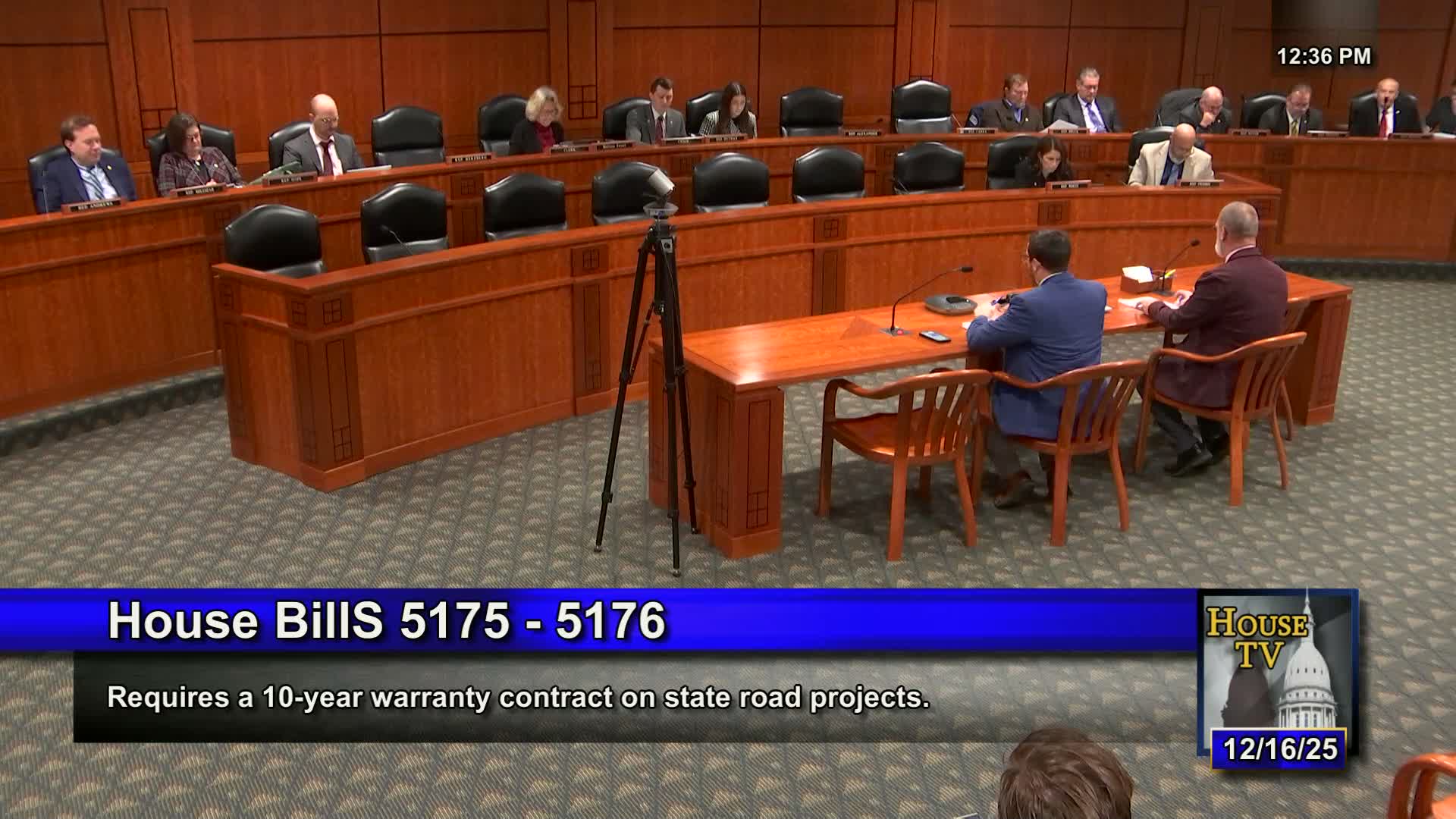
House Bills 5175 and 5176 would enable design-build-maintain contracting for road projects with negotiated long-term maintenance obligations. Sponsors argued the approach would improve longevity and accountability; industry groups and county road officials warned mandatory use could raise costs, limit competition, strain bonding capacity, and complicate maintenance duties. The committee paused votes to seek further input, including MDOT testimony.
Lawmakers and industry representatives spent the bulk of the hearing on House Bills 5175 and 5176, companion measures intended to allow — and in some versions encourage — longer-term 'design, build, maintain' contracts for road reconstruction projects.
Sponsor Representative Cara described the concept as a middle ground that preserves government oversight while assigning day-to-day accountability and longer-term durability to private contractors. "Design, build, maintain largely proposes... the private sector would have more responsibility... not just building the road, but how are we going to do it cost effectively for the longevity of the road," Cara said. Representative Alexander said the bills complement each other and aim to protect public investment by aligning incentives so contractors factor long-term performance into their bids.
Committee members pressed for specifics: whether the bills assume net cost savings or mainly improved accountability; which entities would hold bonds and how the bond process would be enforced; how 'out of control' events (weather, disasters, traffic-weight changes) would be defined and allocated in contracts; and whether small, local contractors would be crowded out by bonding and legal-compliance burdens. Sponsors said those details would be negotiated at the road-agency level and that 10 years was set as a minimum maintenance window that agencies could lengthen or shorten case-by-case.
Industry testimony was uniformly skeptical of making design-build-maintain mandatory. Lance Ben Onimi of the Michigan Infrastructure and Transportation Association said forcing this delivery method on all reconstruction would limit competition, increase costs, and could put smaller Michigan contractors at risk because of bonding and legal exposure. Steve Waukes of the Michigan Concrete Association said MDOT already uses warranties of two to five years across many products and that Michigan has a strong warranty program; he cautioned that warranty-driven projects often require financing partners because contractors cannot absorb long payment delays. Brett Stent of the Asphalt Pavement Association warned the model could increase administrative costs and noted the state's current specifications are already strict.
Ed Noyola of the County Road Association raised implementation concerns for local agencies: increased upfront engineering costs to evaluate 10-year warranties, the capital intensity of maintenance equipment (plow trucks), and how subcontracting maintenance responsibilities would work when 63 of 83 counties currently provide MDOT maintenance.
Given the complexity and outstanding questions, the committee did not vote on the bills and said it would invite MDOT and continue discussion. Several members urged refining definitions around bonding, force‑majeure, selection criteria, and how to protect small contractors.