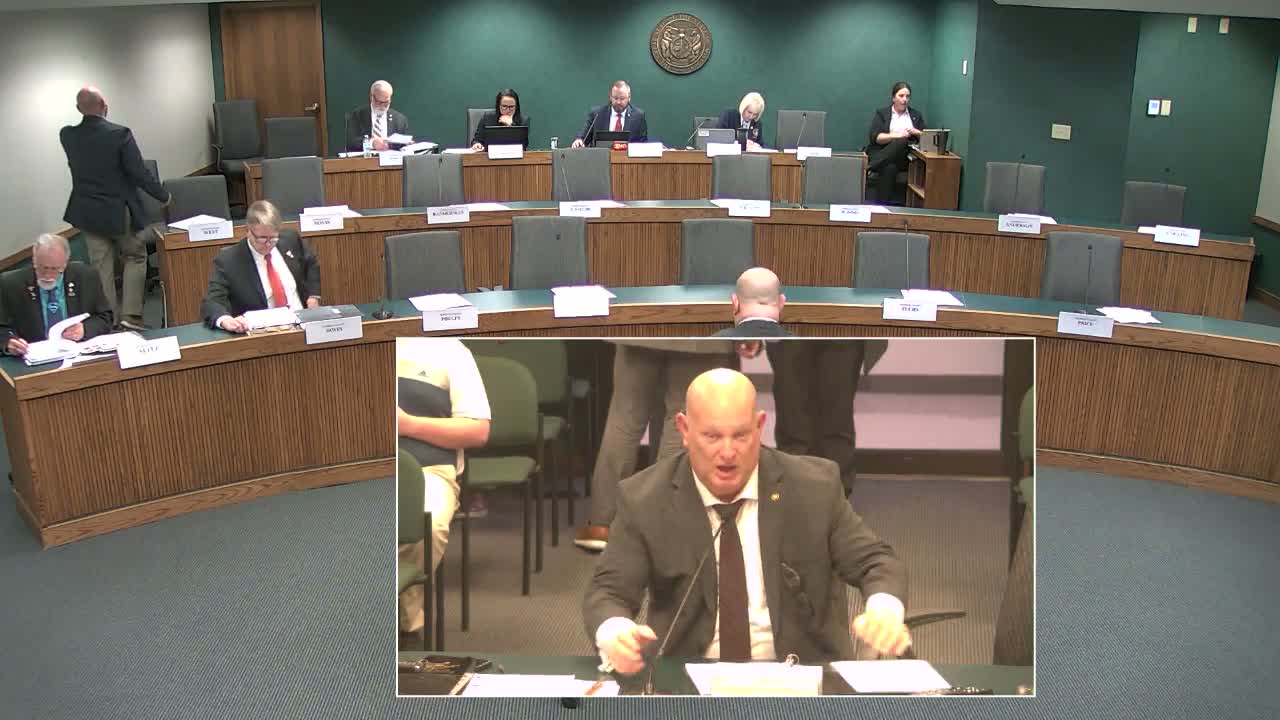
Missouri committee hears 'Mason's Law' to alert officers to drivers' communication disabilities
Loading...
Summary
A House committee heard testimony for House Bill 3175 — "Mason's Law" — which would let people register a physician‑verified communication or health condition with the Department of Revenue so MULES or license checks would notify officers during traffic stops; supporters said it could prevent dangerous misunderstandings, while questions focused on privacy and implementation.
Representative Chris Brown introduced House Bill 3175, which he called 'Mason's Law,' telling the House Committee on Crime and Public Safety it arose after a traffic stop in his district that nearly turned deadly. Brown said the bill would allow people to submit a physician‑signed form to the Department of Revenue when registering or renewing vehicle tags; DOR would then coordinate with the Missouri Uniform Law Enforcement System (MULES) so an officer who runs a license plate could see a note that a driver 'may have trouble communicating with law enforcement.'
The bill's namesake, Mason Ott, told the committee he froze during a sensory shutdown after a traffic stop and feared the officer perceived him as a threat. "I want to be able to drive to work and home without being afraid that a simple mistake or a slow reaction will cost me my life," Ott said. His mother, Megan Brown, recounted collapsing when she learned the officer drew his service weapon and urged lawmakers to adopt the measure so other families would not face the same risk.
Supporters included Lauren Ray, who said the measure would help drivers with autism and people with cochlear implants, and Brent Hemphill of the Missouri Speech Hearing and Language Association, who noted DOR had recently added a speech‑impairment marker. Major Josh Heiner of the Kansas City Police Department said officers now receive Crisis Intervention Team training and expressed support for tools that help de‑escalate encounters.
Committee members asked technical and privacy questions: whether the flag should appear physically on a license plate or on a driver's license, and how multiple plates or non‑vehicular encounters would be handled. Representative Chris Brown said he had discussed options with DOR, KCPD and Missouri Highway Patrol and was open to adjustments. The hearing closed with no committee vote recorded in this transcript.
Next steps: the committee concluded the public hearing and did not take a recorded vote on HB 3175 during this session.