
Committee holds hearing on bill to let counties prorate tax for totaled vehicles
Get AI-powered insights, summaries, and transcripts
Subscribe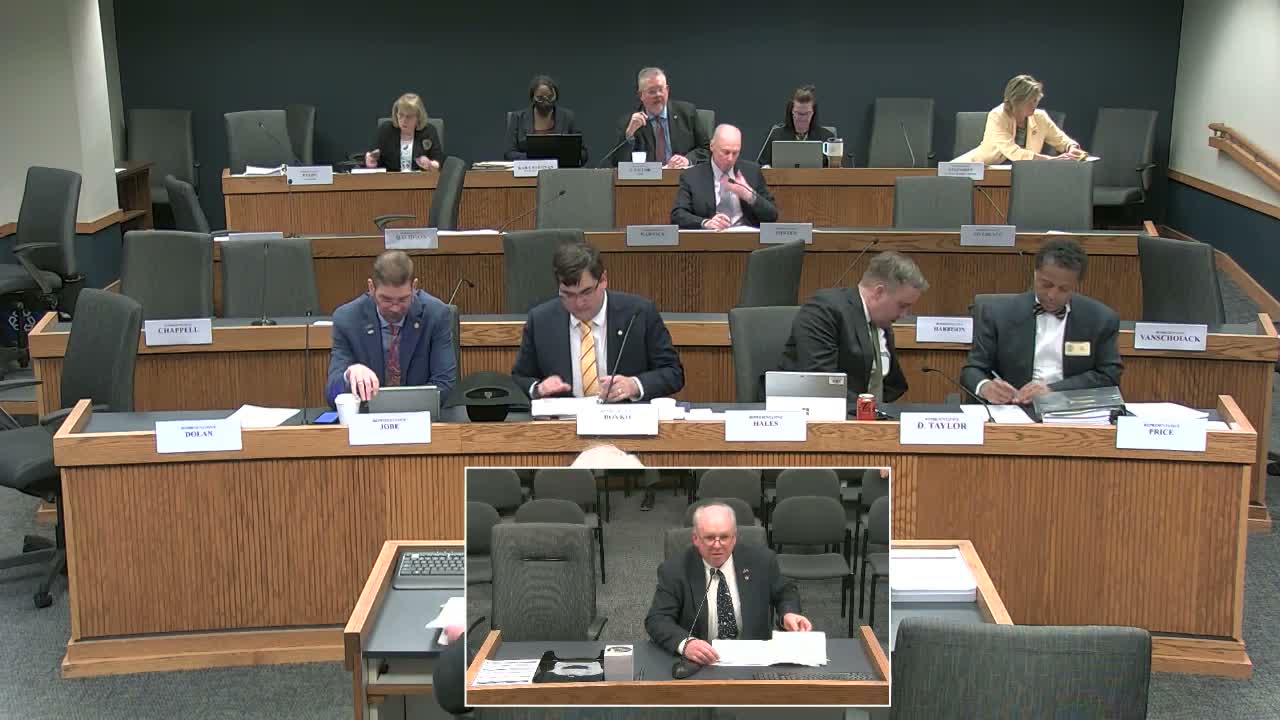
Summary
Representative Tim Taylor presented House Bill 2,627 to allow counties to adopt an optional prorated property-tax credit for motor vehicles totaled during the tax year; committee members raised concerns about scope, multi-county taxing districts and unintended effects on other categories of personal property.
The Special Committee on Property Tax Reform held a public hearing on House Bill 2,627, a bill that would permit counties to establish a program to prorate personal-property tax for motor vehicles that are totaled during the tax year.
Sponsor Representative Tim Taylor, who identified the bill as the "total motor vehicle property tax proration program," said the measure would allow taxing entities to create a prorated property-tax credit for a totaled vehicle and include a provision that, beginning Jan. 1, 2027, increases in aggregate personal-property valuation would not be counted as "new construction" for valuation purposes. Taylor used a personal example—his son's totaled 2013 Dodge Charger—to illustrate the problem the bill addresses and said the program would be optional for counties: "Any taxing entity that establishes a total motor vehicle personal property tax proration program under the provision of this section shall make information regarding such programs available to the taxpayers of the taxing entity."
Committee members questioned whether the bill's language—using the term "taxing entity"—could let individual taxing districts (ambulance, school, library) opt in independently of counties, and whether a county-level adoption could create inconsistencies for special districts that serve multiple counties. Representative Steinhoff asked whether the bill's exclusion of certain valuation increases from "new construction" risked sweeping in non-motor-vehicle categories, noting mobile homes and cell-phone towers are also classified as personal property in some cases.
Cole Areola Carr, managing director of the Missouri Special Districts Association, testified for informational purposes. He said the proration idea "makes some sense" but warned of unknown fiscal impacts for small special districts that depend primarily on property-tax revenue and urged consideration of inter-county consistency.
The hearing closed after testimony, with members flagging fiscal unknowns, the potential for uneven local adoption, and the need to define the bill’s scope precisely if enacted. No vote was taken at the hearing; the committee adjourned afterward.