Get Full Government Meeting Transcripts, Videos, & Alerts Forever!
Get email alerts on the Transportation Funding Registration Taxes topic
No spam. Unsubscribe anytime.
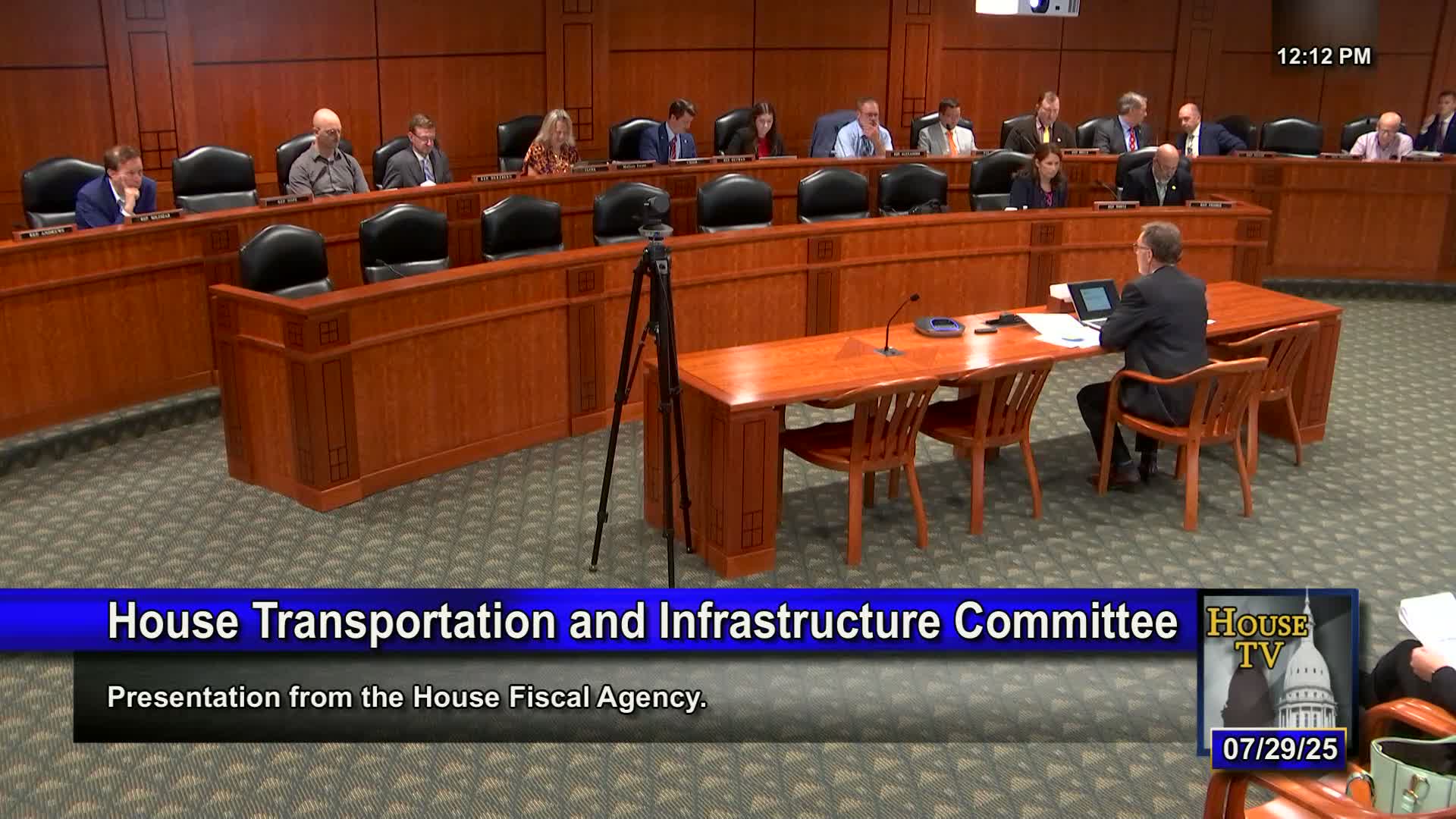
Officials brief committee on vehicle registration taxes, EV surcharges and MDOS operations
Summary
House Fiscal Agency and Michigan Department of State officials told the committee that vehicle registration taxes are a major source of transportation revenue (~$1.6B), explained EV/hybrid surcharges ($60 for hybrids; $160 for full EVs under 8,000 lbs) intended to offset lost fuel tax revenue, and reviewed MDOS operational changes, Real ID uptake and VIN decoding improvements.
House Fiscal Agency and Michigan Department of State officials gave a detailed briefing on how vehicle registration taxes and related fees support Michigan’s transportation budget, answered member questions on EV surcharges and VIN decoding, and described recent MDOS operational changes.
William Hamilton, senior fiscal analyst with the House Fiscal Agency, told the committee that state restricted revenue for transportation is about $4.2 billion in the current year and that vehicle registration taxes are the single largest component of that restricted revenue, estimated at about $1.6 billion for fiscal year 2025. He said that vehicle registration taxes have grown to roughly match combined motor fuel tax receipts and credited part of the change to the November 2015 road funding package, which took effect in 2017 and increased certain registration rates.
"The biggest component of this revenue pie is vehicle registration taxes," Hamilton said, and he described two primary registration categories: an ad valorem category (first‑time registration based on manufacturer’s list price) and a weight‑based category for large commercial trucks.
Hamilton explained the surcharge structure adopted in the 2015 funding package to adjust for reduced motor fuel tax revenue from nontraditional vehicles: a $60 surcharge for certain hybrids (under 8,000 pounds) and a $160 surcharge for full electric vehicles (under 8,000 pounds). He said those surcharges were intended to roughly equate to the motor fuel tax revenue those vehicles do not pay. Hamilton also described the 2004 change to permanent trailer plates, which produced a one‑time revenue spike followed by fewer future transactions because owners do not re‑register trailers annually.
Jackie Vinton, Chief Operating Officer, Michigan Department of State (MDOS), described operational changes that have increased online transactions and improved VIN decoding. She said MDOS collected about $3.5 billion in fiscal year 2024 (a 2.4% decrease from FY23, attributed in part to two‑year registrations) and that online and self‑service channels have grown since MDOS launched its CARS system in 2021.
"We collected $3,500,000,000 during fiscal year 24," Vinton said, and she reported MDOS’s ongoing work to decode VINs to determine fuel type and classify plug‑in hybrids and EVs more accurately with the help of a vendor.
Committee members raised technical and policy questions: whether the surcharges create parity with internal combustion vehicles (Hamilton said surcharges are "roughly equivalent" in the aggregate), how accurate mileage assumptions are when comparing lost fuel tax revenue (Hamilton cited FHWA average vehicle miles figures), whether MDOS can separate plug‑in hybrids from EVs at registration (Vinton said MDOS obtains fuel‑type info through VIN decoding and a vendor), and how Real ID compliance is progressing (Vinton said about 77% compliant). Members also asked for follow‑up on vendor names for VIN decoding, cost‑cutting measures in MDOS administration, and the department’s capacity to investigate dealer plate misuse and out‑of‑state registrations.
MDOS agreed to provide additional information to the committee on finance questions and vendor details. The committee closed the briefing with no formal action taken on registration policy or fee changes; follow‑up materials were requested by members.
The committee moved on to other business and adjourned.