Get Full Government Meeting Transcripts, Videos, & Alerts Forever!
Get email alerts on the Mdot Specifications And Procurement topic
No spam. Unsubscribe anytime.
MDOT tells committee how road specs, prequalification and truck‑weight rules shape projects
Summary
MDOT officials told the House Transportation Infrastructure Committee about Michigan's construction specifications, materials research, warranty practice and contractor prequalification; they said 256,000 lane miles exist statewide, the department uses mechanistic‑empirical pavement design, has roughly 600 prequalified contractors, and has issued about $2.8 billion of rebuilding Michigan bonds with $700 million authorization remaining.
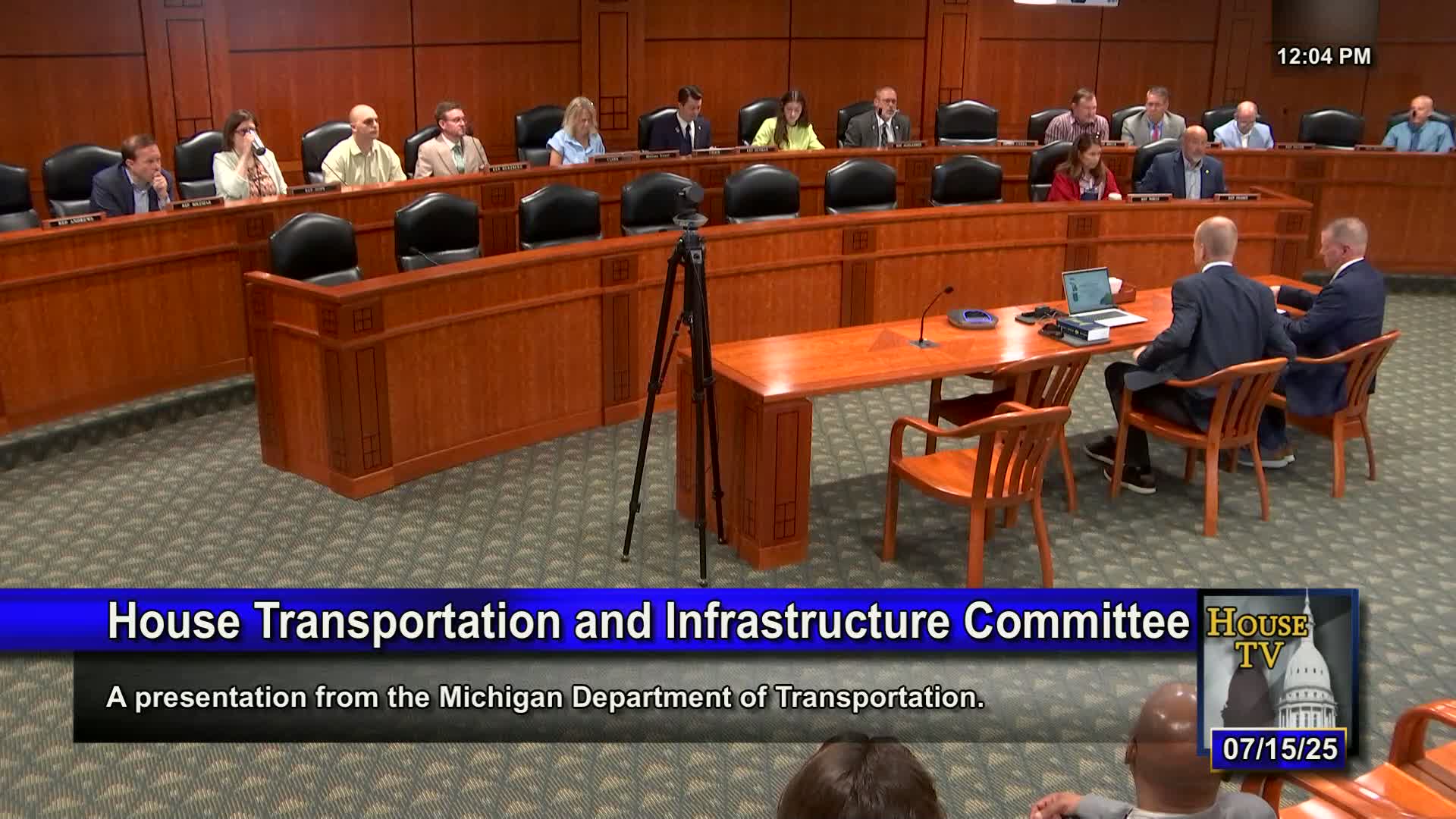
Greg Brenner, MDOT chief operations officer, and Patrick McCarthy, MDOT bureau director for finance and administration, gave a multi‑part briefing to the House Transportation Infrastructure Committee covering construction specifications, materials research, prequalification and truck‑weight policy.
Brenner said Michigan has about 256,000 lane miles and nearly 12,000 bridges. "We start looking at our road network as a whole," he said, and described how MDOT, counties and local jurisdictions share maintenance responsibility. He explained MDOT's standard specification book—updated with industry and local input every several years—aligns with federal requirements (23 CFR) and AASHTO guidance and is widely used by local agencies to keep construction practices consistent.
On materials and design, Brenner described MDOT's research program and adoption of mechanistic‑empirical (ME) pavement design to account for climate, soils, traffic loads and materials when selecting pavement thickness and subbase. He said state law requires a life‑cycle cost analysis for projects above a statutory threshold that compares asphalt and concrete; MDOT conducts alternate payment bidding when long‑term cost estimates are within 15%.
Brenner discussed quality assurance and warranties, noting two warranty types: performance warranties for smaller CPM (capital preventive maintenance) projects and materials & workmanship warranties for major work; the warranty framework dates to a 1997 law updated in 2015. He said MDOT's CPM program treated about 2,600 miles of road in 2024.
Patrick McCarthy outlined MDOT's contractor and consultant prequalification process (tied to 23 CFR compliance) and said MDOT has "a little over 600 prequalified contractors" and 133 prequalified consultants; MDOT awarded roughly $2.5 billion in construction contracts in 2022–23 and about $1.3 billion in the current fiscal year to date. On bonding, McCarthy said MDOT has issued about $2.8 billion of rebuilding Michigan bond authorization with roughly $700 million of issuance authority remaining.
On truck weights, Brenner described Michigan's approach of allowing higher gross vehicle weights by adding axles to reduce per‑axle loading and noted MDOT's concern about freeze‑thaw seasons and permit controls. Committee members asked about recycled inputs (tires, shingles, even ground wind‑turbine material), bridge bundling fiscal effects and how MDOT coordinates detours and enforcement with Michigan State Police and local governments; MDOT said pilots and STIC review govern adoption of new materials and that bundling has eased local administrative burden without clear evidence of systemic cost savings.
The briefing produced follow‑up requests for additional data (annual warranty reports and specific bridge/CPM performance metrics) and MDOT offered to supply more detailed analyses on bonding, contractor corrective actions and any pilot results for recycled inputs.
Next steps: MDOT will provide supplemental requested data and the department is expected to return for deeper discussion of truck weights and the bonding/issuance schedule.