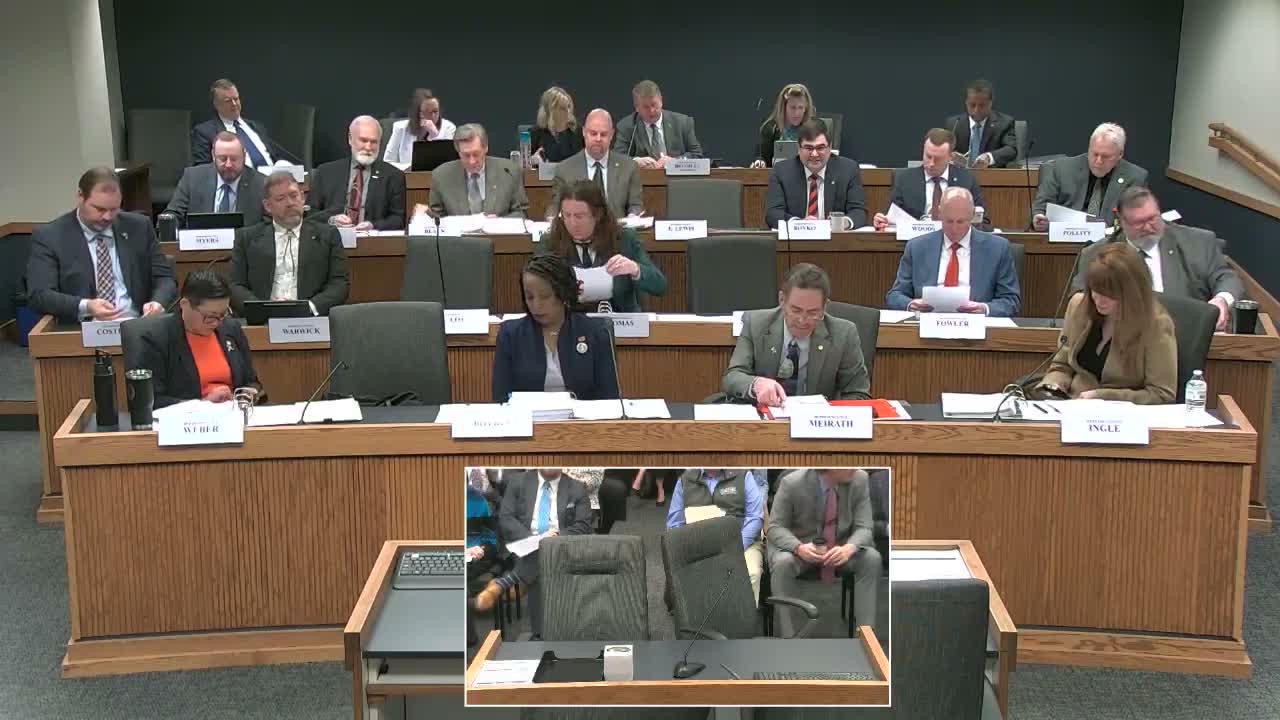
Utilities committee hears hours of testimony on broad solar, wind and water bill; taxation, setbacks and eminent domain draw sharp debate
Loading...
Summary
Representative Banderman presented House Bill 2,762, a multi-issue measure on commercial solar, wind and water. The committee heard proponents urging a $2,500-per-megawatt benchmark and grandfathering; landowners and local groups urged higher taxes, larger setbacks and stronger transparency and environmental protections.
JEFFERSON CITY — The Missouri House Committee on Utilities heard lengthy testimony and questions on House Bill 2,762, a multi-part bill addressing commercial solar production taxation and assessment, setback distances, grandfathering, wind lighting, public water district rules and eminent domain limits.
Sponsor Representative Banderman began the hearing by describing the bill as a "finished product" aiming to create uniformity in how large solar production facilities are taxed and assessed. The bill proposes taxing solar at $2,500 per megawatt of nameplate capacity, establishes assessment methodology for real and other property associated with projects, includes multiple grandfathering clauses for projects built before the change, sets a 200-foot minimum setback from an occupied dwelling, church or school, and contains a provision intended to prohibit use of eminent domain to acquire in-holding parcels after a project is developed.
Industry witnesses broadly supported the bill’s framework. David Bunge, president of Azimuth Renewables, told the committee he supports grandfathering, the $2,500-per-megawatt benchmark and assessing land under panels as commercial property, while urging guardrails on assessors to avoid extreme local valuations. Jeremy Lefebvre of the Clean Bridal Alliance (a trade association for large independent power producers) and Tyler Travers of Renew Missouri also urged the committee to adopt reasonable tax and setback standards so projects remain economically viable. John Dolan of MOCEA and a representative of Ameren Missouri provided informational testimony and offered reference materials the committee could use.
Opponents — largely landowners, county residents and landowner groups — urged higher taxation and larger setbacks. Susan Burns of the Missouri Landowners Alliance said the alliance supports a $6,000-per-megawatt approach and cited studies arguing small farms can lose substantial value when adjacent land is industrialized for solar. Several Callaway and Randolph County residents described homes surrounded by leased farmland with chain-link fences, cited glare, noise and safety concerns, and said the local real-estate market and small-town economies are being affected. John Burns asked the committee to "protect the people in your districts, not the businesses," and called a 200-foot setback "ridiculous." Laura Stinson, a realtor, said her family’s 16-acre property is already encircled by fences and that nearby houses are harder to sell.
Legal and procedural questions surfaced in informational testimony. Attorney Cody Holt explained that under current state law, utility-scale solar projects may be subject to Public Service Commission jurisdiction and that PSC authority can, in practice, preempt or override local planning and zoning when a project qualifies as an electric corporation or obtains a certificate of convenience and necessity. Holt said that dynamic can leave counties' planning and zoning input advisory rather than controlling for siting decisions.
Committee members pressed for accountability measures and clarity. Representative Simmons asked what success would look like after the bill’s proposed seven-year sunset and urged the sponsor to consider reporting or other accountability to confirm build-out of service in underserved areas. Representatives raised repeated concerns about transparency of lease negotiations (non-disclosure agreements), the effect on county economies and the need to define what land counts as "associated with production" for assessment purposes.
The committee received a mix of data and materials: MOCEA provided a multi-state tax chart and a primer on utility-scale solar terms; landowner groups offered studies and acreage counts (one witness cited 88,600 leased acres across 40 counties). The sponsor said he expects to assemble a House committee substitute combining elements from multiple bills and invited ongoing stakeholder input.
The hearing closed after extensive testimony and the chair reminded members they could submit written testimony through midnight.
What’s next: The sponsor said a House committee substitute is planned and that the committee will continue to refine the bill; no committee vote on HB 2,762 occurred during this hearing.
Key quotes: "This substitute combines House bills 21-22 and 16-26 and includes the clawback provision..." — Representative Black (on a different bill adopted earlier). "We support grandfathering and a reasonable $2,500-per-megawatt benchmark...but there needs to be guardrails on assessment values." — David Bunge, Azimuth Renewables. "The $2,500 in Representative Bannerman's bill does not have any accelerator. So it's going to depreciate over time and be worth less and less." — Susan Burns, Missouri Landowners Alliance (paraphrased from testimony).
No formal action was taken on HB 2,762 at this hearing; the committee closed the hearing and said a House committee substitute may follow.