Get Full Government Meeting Transcripts, Videos, & Alerts Forever!
Get email alerts on the Groundwater Governance topic
No spam. Unsubscribe anytime.
Regional study finds governance gaps and urges tribal‑first, data‑driven approaches to groundwater
Summary
A Freshwater-led, five‑year assessment of groundwater governance across EPA Region 5 found limited institutional frameworks, recommended tribal‑led engagement and more monitoring wells, and warned that funding and siloed planning hamper long‑term groundwater stewardship.
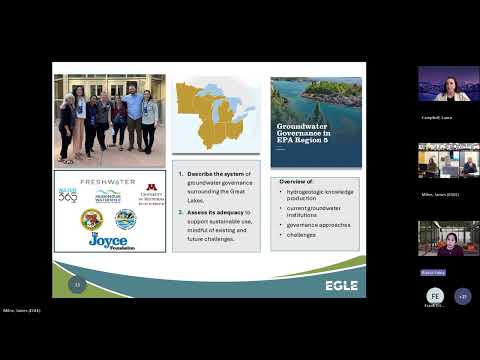
A five‑year, multi‑partner assessment of groundwater governance across the six‑state EPA Region 5 found “very, very little groundwater framework” at the local, state or federal level and urged governments to start with tribal partners and invest in monitoring and integrated planning.
Alyssa, an anthropologist with Freshwater who led the project’s outreach, told the Water Use Advisory Council on Dec. 3 that the team began with a tribal‑first approach, asking tribal natural resources departments where problems existed and designing workshops and hands‑on assessments around those invitations. “This entire project started with a tribal first focus,” she said. The work, Alyssa said, included interviews with 25 tribal partners and four multi‑state workshops to map governance responsibilities and gaps.
Why it matters: Groundwater supplies drinking water for many communities but is largely invisible and unevenly managed. Alyssa said gaps in mapped aquifers, limited monitoring and fragmented governance make it hard to know who relies on groundwater, who manages it or who should be at the table when decisions are made. “If we don’t know what’s available, how do you even start those conversations?” she asked.
The assessment documented practical barriers: thick glacial sediments that complicate mapping in parts of Michigan, limited state and local funding, shrinking federal pass‑through dollars and a shortage of trained staff. Alyssa relayed a geologist’s conclusion in blunt terms: “you need more monitoring wells,” and she recommended a combination of better data, transparent communication with communities and early, sustained tribal consultation to reduce the risk of litigation and build trust.
Council members pressed for examples and funding sources. Alyssa said the project was funded by the Joyce Foundation and described the Region 5 label as shorthand for the six‑state area studied; she said the team worked with Harvard, University of Minnesota, US Bureau of Indian Affairs, GLIFWC and multiple tribal nations. When asked whether any single state provided a reproducible model, she replied there was no one‑size‑fits‑all solution: “There is no best recommended option,” she said, because geology and state law vary.
Council members welcomed the tribal‑first method. Jim Mel, who attended a Southeast Michigan workshop, said he found the format valuable and heard perspectives from tribal representatives and private citizens who do not usually engage with the Council. Several members urged the Council to use the assessment to frame recommendations and to press for earlier budget timing so program funding can be considered within state budget cycles.
What’s next: Alyssa and Council members recommended tailored, place‑based frameworks—tools and model language that jurisdictions can adapt—combined with investments in monitoring, data sharing and outreach. The presentation highlighted opportunities to align research, local planning and tribal consultation to create defensible, transparent groundwater governance.