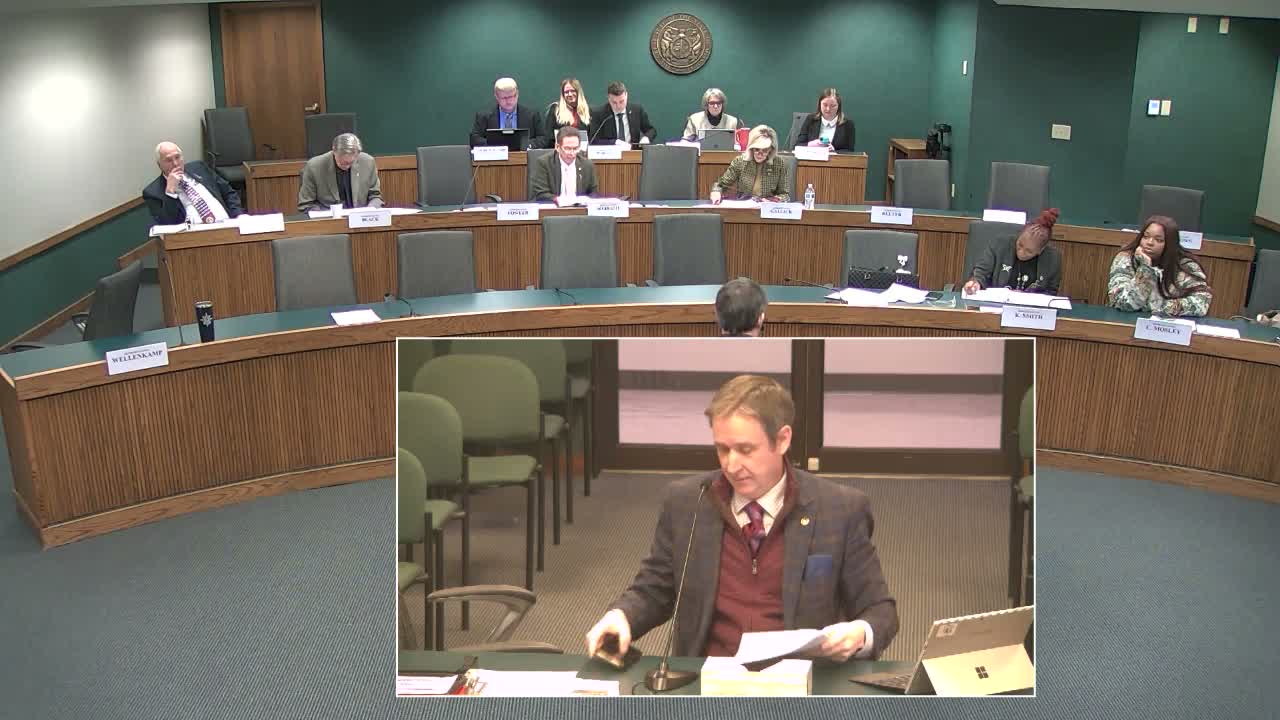
Lawmakers hear proposal for a Missouri sovereign wealth fund called the 'Show Me Prosperity Fund' (HJR 1189)
Loading...
Summary
Representative Colin Wellencamp presented House Joint Resolution 1189 to create a Missouri sovereign wealth fund that would be invested in private-market products until its earnings equalled state-imposed tax revenue; committee members asked about initial funding, investment restrictions, audit frequency and whether dividends to residents would be feasible.
Representative Colin Wellencamp introduced House Joint Resolution 1189, calling it an "innovative solution" to long-term fiscal pressures and infrastructure needs. He described the proposal as a sovereign wealth fund (the "Show Me Prosperity Fund") designed to grow via private-market investment until the fund's earnings could replace the state's tax revenues.
Wellencamp framed the fund as an endowment for fiscal sustainability and said other states and nations use similar vehicles. "Once the fund got to the point of actually replacing 100% of our budget, then and only then could we access it," he said, adding the measure would include constitutional protections to prevent premature withdrawals without further voter approval.
Members asked how the fund would be seeded and governed. Wellencamp said initial allocations would be a matter for the governor's budget and that the treasurer would oversee investments; he cited projections using initial investments in the $100 million range and conservative long-term growth rates in modeling. Committee members raised questions about which taxes would be considered "state-imposed taxes," whether the fund's total-return strategy would permit investments outside traditional government-obligation restrictions, and how the fund's earnings would be audited. Wellencamp said audits would be required every three years and that the language limits appropriations from the fund until net investment earnings equal tax receipts; after maturity, a capped spending rule would limit annual draws to a small percentage of the fund's average value.
Representatives also pressed governance and influence concerns, including whether private donations would create quid pro quo risks and what would prevent political actors from using the fund once it matured. Wellencamp said the proposed structure contains safeguards and that no one could "dip into the fund" until the maturity threshold is reached; he also said the proposal contemplates equal-distribution dividends to taxpayers if the fund produced excess returns.
No public witnesses testified for or against HJR 1189 during the hearing; the committee concluded the public portion with no formal action recorded.
Next steps: committee members requested clarification on funding sources, precise definitions of eligible investment returns and tax categories, and asked for fiscal modeling and legal language prior to further consideration.