Judiciary panel hears fiscal-note disputes on bill to raise age of consent to 18, holds bill for further review
Loading...
Summary
The committee discussed widely divergent fiscal notes for HB 101 (raising the age of consent to 18). Agencies offered differing estimates of staffing and costs; Department of Law and DPS said revisions reduced projected impact, while public defender and Office of Public Advocacy said additional resources will likely be needed. The committee set the bill aside for further review.
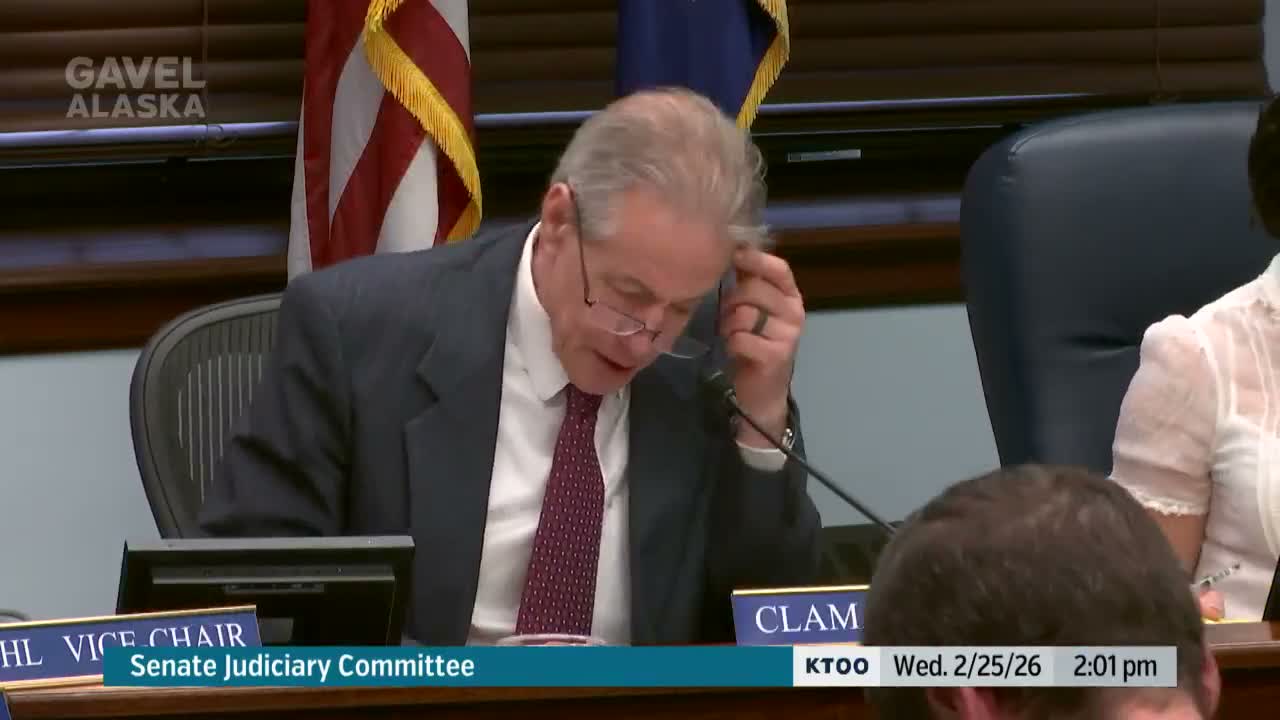
The Senate Judiciary Committee on Feb. 25 discussed fiscal notes for House Bill 101, which would raise the age of consent to 18. The committee heard witnesses from the Office of Public Advocacy, the Public Defender’s Office, the Department of Public Safety and the Department of Law about widely varying fiscal estimates and operational impacts.
James Stinson, director of the Office of Public Advocacy, said the office’s fiscal-note history included earlier indeterminate or zero entries and a later positive note of $291,700; he warned that the bill "casts a much wider net to capture that conduct" and said his Juneau office would struggle to absorb added criminal work without at least one additional attorney. Stinson said the change in covered conduct made a fiscal impact likely.
Terrence Haas of the Public Defender’s Office said initial zero fiscal notes were likely an error. He told the committee that raising the age of consent adds a block of cases that are among the most serious the public defender agency handles, that such cases require experienced lawyers and significant time, and that the agency estimated two flex attorney positions (Anchorage, Palmer) and a fiscal-note figure of roughly $536,000.
Representatives of the Department of Public Safety said they reassessed earlier estimates and now believe the revised bill would have a smaller, potentially absorbable impact. DPS witnesses referenced an Oklahoma change (to age 18 in 2025) that had a zero fiscal note and said they expect investigations to increase but not to the extent previously projected. DPS acknowledged it would need to develop a process to invoice property owners (questioning on SB 207 raised this administrative point) and offered to provide further finance information to the committee.
Angie Kemp, Deputy Attorney General in the Department of Law’s Criminal Division, said changes that preserve age gaps in some sections materially affected the department’s calculus. She cautioned that while she expects "we're gonna get more prosecutions as a result of this," the department must consider litigation load, lengthy trials, and the volume of digital evidence when projecting prosecutorial needs and costs.
Committee members expressed concern at the aggregate disparity between zero fiscal notes and multi-million-dollar estimates across various submissions; the chair said the committee must better understand the fiscal implications before advancing the bill. The committee set HB 101 aside for further review and adjourned. The next Judiciary Committee meeting was scheduled for March 2, 2026 at 1:30 p.m.